Examples of models: “Everybody does their best according to their abilities and perception of their environment”

[This post is part of a series on The Model -- my model for the human emotional system designed for use in leadership, self-awareness, and general purpose professional and personal development -- which I find the most effective and valuable foundation for understanding yourself and others and improving your life. If you don't see a Table of Contents to the left, click here to view the series, where you'll get more value than reading just this post.] I tend to believe that everybody does their best according to their abilities and perception of their environment. Sure, I know counterexamples, but in general I believe that at every moment, everyone observes their surroundings and, based on their perception and abilities (more precisely, their beliefs about their…
0 Comments

Examples of models: “beliefs and expectations filter your perception”

[This post is part of a series on The Model -- my model for the human emotional system designed for use in leadership, self-awareness, and general purpose professional and personal development -- which I find the most effective and valuable foundation for understanding yourself and others and improving your life. If you don't see a Table of Contents to the left, click here to view the series, where you'll get more value than reading just this post.] Let's look at another example of how we use models in more depth. As with yesterday, after treating the example I'll describe the lessons it teaches. Imagine you grew up with a pet pit bull. You might see it as an adorable pet. Someone else who never grew…

0 Comments

Examples of models: why he or she didn’t call

[This post is part of a series on The Model -- my model for the human emotional system designed for use in leadership, self-awareness, and general purpose professional and personal development -- which I find the most effective and valuable foundation for understanding yourself and others and improving your life. If you don't see a Table of Contents to the left, click here to view the series, where you'll get more value than reading just this post.] For the next three or four posts, let's look at examples of how we use models in more depth. After each example I'll describe the lessons it teaches. We'll start with an example we're all familiar with: someone told you they'd call Monday. By Friday, no call. It's…

0 Comments

Examples of models: how a slight change in your model can create big changes in behavior

[This post is part of a series on The Model -- my model for the human emotional system designed for use in leadership, self-awareness, and general purpose professional and personal development -- which I find the most effective and valuable foundation for understanding yourself and others and improving your life. If you don't see a Table of Contents to the left, click here to view the series, where you'll get more value than reading just this post.] A famous parable in business literature describes how two competing shoe companies considering expanding into a new market each sent a salesperson to research the market to figure out if they should enter it and how. The first, upon arriving, found that in this market, nobody wore shoes.…

0 Comments

Examples of models: beliefs and mental models

[This post is part of a series on The Model -- my model for the human emotional system designed for use in leadership, self-awareness, and general purpose professional and personal development -- which I find the most effective and valuable foundation for understanding yourself and others and improving your life. If you don't see a Table of Contents to the left, click here to view the series, where you'll get more value than reading just this post.] My past two posts on examples of models showed visual models -- maps and representations of the Earth. Such examples illustrate how models work because they are easy to see, but don't capture the subtlety of distinguishing models from what they represent. Mental models tend to be more…

0 Comments

Examples of models: the Earth from several perspectives

[This post is part of a series on The Model -- my model for the human emotional system designed for use in leadership, self-awareness, and general purpose professional and personal development -- which I find the most effective and valuable foundation for understanding yourself and others and improving your life. If you don't see a Table of Contents to the left, click here to view the series, where you'll get more value than reading just this post.] Yesterday I started with one of the simplest examples of models -- maps. Today we'll look at other models. The image below includes a model of the Earth. You might remember seeing models like this from school. It throws out a lot of information -- it's two-dimensional, showing…

0 Comments

Examples of models: maps

[This post is part of a series on The Model -- my model for the human emotional system designed for use in leadership, self-awareness, and general purpose professional and personal development -- which I find the most effective and valuable foundation for understanding yourself and others and improving your life. If you don't see a Table of Contents to the left, click here to view the series, where you'll get more value than reading just this post.] My series on the Model covered models in general but didn't give examples. My seminars cover examples, so the next few posts will cover some examples to illustrate some common models we all use. I have two goals: first to help expose how fundamental they are to our…

0 Comments

The heart of freedom, part 2

Yesterday I wrote about what I called the heart of freedom, stating that being able to choose your beliefs was more important than being able to change your environment. I quoted Viktor Frankl stating that being able to choose your beliefs was a freedom that could never be taken away. What does that freedom get you? "Just" feelings? Or does it get you more than that? He followed up yesterday's quote with When we are no longer able to change a situation — just think of an incurable disease such as inoperable cancer — we are challenged to change ourselves. By no means would I suggest his environment had anything desirable, but observe where this ability took him. In the midst of one of the…

0 Comments

The heart of freedom

Viktor Frankl, whom the Nazis captured and imprisoned as a slave laborer in concentration camps including Auschwitz and Dachau, perhaps best clarifies and shows that you can feel free independently of physical constraints and that feeling free gives you all the value of being free. We who lived in concentration camps can remember the men who walked through the huts comforting others, giving away their last piece of bread. They may have been few in number, but they offer sufficient proof that everything can be taken from a man but one thing: the last of the human freedoms—to choose one's attitude in any given set of circumstances, to choose one's own way. "Everything can be taken from a man but one thing: the last of…

0 Comments

There will never be a periodic table of emotions, part 2

Continuing yesterdays' post... In the examples above, the categorization schemes worked because they categorized something with an underlying structure -- the photon and its wavelength, the atom and its nucleus and electrons, natural selection and DNA, the (so far) fundamental particles and the laws governing their interactions. But not everything with patterns has an underlying structure. Let's look at anatomy, for example. As we'll see, it will reveal a lot about emotions and motivations. Notice that despite common characteristics across life, no one has created a periodic table of anatomy. Why not? Because anatomy has no underlying structure like those other categorization schemes. We know several unpredictable factors affect how a species' anatomy evolves -- for example, that species' current anatomy, its environment, and natural…

6 Comments

There will never be a periodic table of emotions, part 1

Discovering the periodic table of the elements told us wonders about chemistry and pointed the way toward understanding atoms. Figuring it out pointed the way toward tremendous understanding and improving our lives. We found similar structures that revealed underlying structure in the spectrum of light, life's family tree, the standard model of particle physics, and others. Wouldn't it be great to find such a structure for our emotions and motivations? Wouldn't we expect discovering such a structure reveal our emotional system and create tremendous progress in psychology, personal development, achievement, motivation, and well-being? Why can't we find such a structure? I think we never will. But that doesn't mean we won't make tremendous progress in those areas to improve our lives. Let's take a step…

0 Comments
The Method: summary of preparation (with diagram)
The Method Process, part 1

The Method: summary of preparation (with diagram)

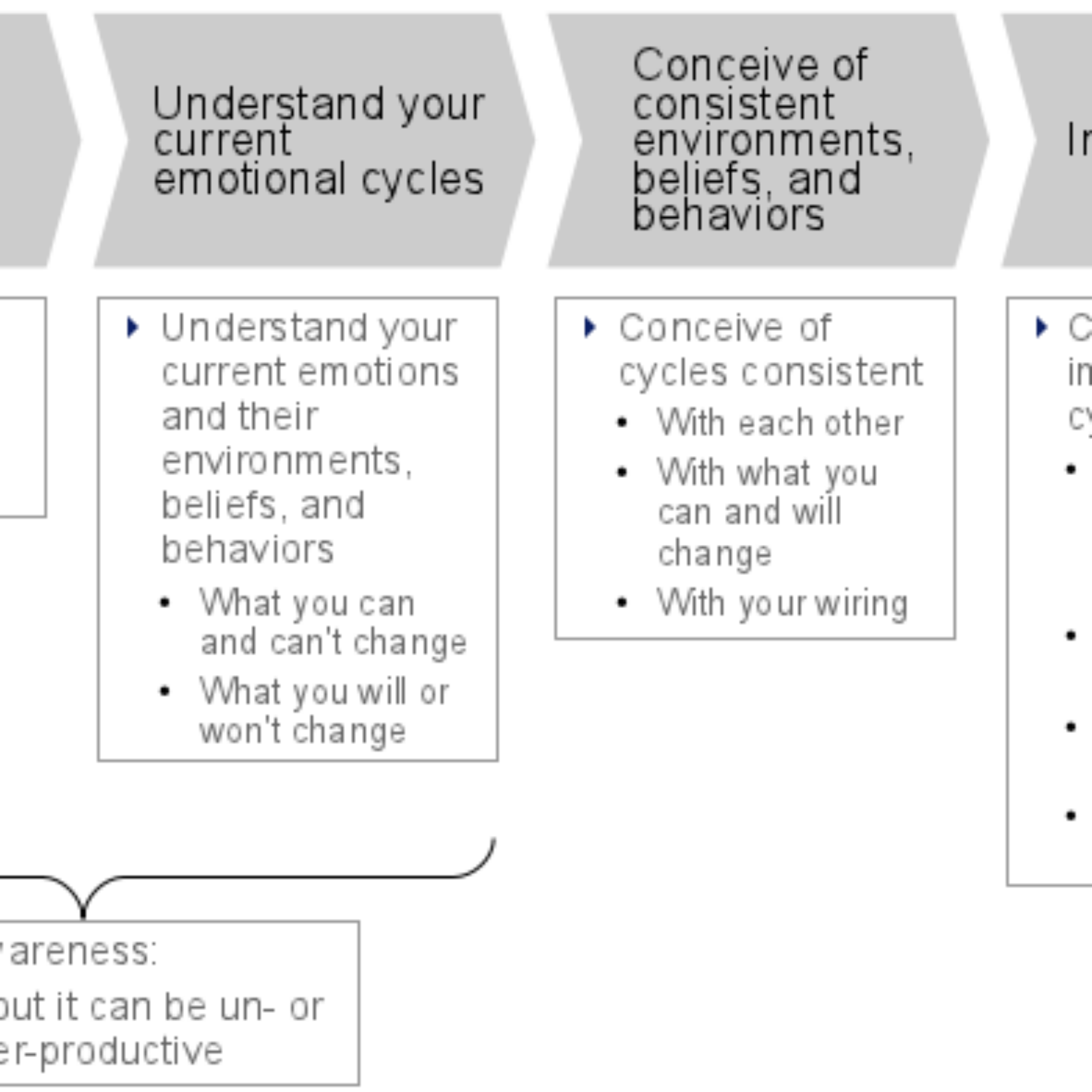
EDIT: I modified how I present the Method slightly. Please see the new version of this page and the updated series on implementing the Method. We've now covered the examples and preparation stages of how to implement the Method. Here is a diagram summarizing these steps (click it for full size) Preparation Know your emotional system Understand your current emotional cycles Awareness Conceive of consistent environments, beliefs, and behaviors Implement them Next: the stages of a transformation

0 Comments

Non-Method method 4: positive thinking

This post covers the fourth of several non-Method methods, generally expanding on non-Method method 3, "The Secret" or "Law of Attraction." People often, somewhere in the middle of presenting the Method for the first time, for example, ask if the Method is not just positive thinking. Likewise, I hear non-Americans say things like "What is it with you Americans and always wanting to feel happy all the time? Everything in life is not about happiness." I agree with the sentiment. I don't promote trying to feel happy all the time, "positive thinking," affirmations, or the like. They feel like putting lipstick on a pig. I promote you being you, being more aware of yourself and your emotions, and developing skills to act on that knowledge…

0 Comments

Non-Method method 3: “The Secret” or “Law of Attraction”

This post covers the third of several non-Method methods. People often try to improve their lives by changing only their beliefs. Typical examples of changing beliefs include believing money, friends, or health will come your way. Since the book and movie "The Secret" so popularly propagated this strategy a few years ago, I call this strategy "The Secret" or "Law of Attraction." Before delving into it, I'll point out that of all the non-Method methods I discuss, I believe changing your beliefs has the best chances of long-term success. Looking at the Model, changing your beliefs can influence how you perceive your environment, which can change your motivations, which can change your behavior, which can change your environment. Acting on no other place in the…

0 Comments

Non-Method method 1: “I need a new house/car/job/girlfriend/boyfriend/etc”

This post covers the first of several non-Method methods. People often try to improve their lives by changing or getting rid of something in their environment. By environment I don't mean trees and lakes and streams, but anything that affects your emotional system, as described in my posts on the environment as part of the Model. Typically that thing is their house, car, job, or significant other, but could be anything -- a new diet book, a new labor-saving device, a new degree, stopping seeing a friend, etc. This strategy comes from believing that something external is holding them back from a better life. Or at least that changing something external will improve it. I call the strategy "I need a new house/car/job/boyfriend/girlfriend/etc" Sometimes changing…

0 Comments

The Method: the foundation, part I

The Method is based on the Model. Keeping in mind that like any model, the Model simplifies what it represents for its purpose. The Model's purpose is to improve our lives by helping us understand our motivations, emotions, and emotional systems. As with any model, it can't be absolutely right or true. Neither can any alternative. I mention the above for context because the discussion on the Method will all adopt the perspective of the Model. Let's start our discussion on the Method with its foundations. Recall two points from our discussion on the Model. First, you can control some parts of your emotional system while others you can't. You can control you environment, beliefs, and behavior. You can't, except to a limited degree, control…

0 Comments

From the Model to the Method

I've written about the Model, my foundation for understanding value, meaning, purpose, importance, etc in life, based on understanding yourself, particularly your motivations, emotions, and emotional system. I'll now start on the Method, which covers how to implement the Model. I developed the Model on my own, without intending to create something meaningful or helpful, though I think I ended up doing so. The Method, however, came from applying the Model in life. If you learned the Model and implemented it in your life, I expect you'd come up with the Method too or something similar. By reading my Method you can save time and resources by avoiding my mistakes. I can't think of anything more valuable in life than to replace more of your…

0 Comments

The Model: summary

[I replaced this post with a series on The Model. Click here to view the series, where you'll get more value than reading just this post.] For the past six weeks I've posted on the Model, my model for human motivations and emotions. The Model forms the foundation of what I consider the best way to view and live life. For those who have been reading along, I recognize it may have been a bit dry or academic. I expect later posts will make life and living the lifestyle you want seem easy and obvious, but require referring back to the Model, in which case this summary will simplify learning it. Today's post summarizes all those posts, which will probably end up a chapter in…

2 Comments

The Model: what is freedom?

[This post is part of a series on The Model -- my model for the human emotional system designed for use in leadership, self-awareness, and general purpose professional and personal development -- which I find the most effective and valuable foundation for understanding yourself and others and improving your life. If you don't see a Table of Contents to the left, click here to view the series, where you'll get more value than reading just this post.] Ask people -- yourself! -- what they value and freedom will rank near the top. What do they mean by freedom? I bet you don't know and that this post will show you can have more. The better you know what freedom means, the more you can bring…

0 Comments

The Model: strategize, then enjoy

[This post is part of a series on The Model -- my model for the human emotional system designed for use in leadership, self-awareness, and general purpose professional and personal development -- which I find the most effective and valuable foundation for understanding yourself and others and improving your life. If you don't see a Table of Contents to the left, click here to view the series, where you'll get more value than reading just this post.] A quick followup to yesterday's post on first learning to manage your emotions, then enjoying the freedom mastery brings you. Here is some general advice for anything that requires planning. You probably already know it, but it bears repeating. First strategize, then act (and enjoy). In other words,…

0 Comments

The Model: bring about emotions you want and enjoy them, don’t dwell on them

[This post is part of a series on The Model -- my model for the human emotional system designed for use in leadership, self-awareness, and general purpose professional and personal development -- which I find the most effective and valuable foundation for understanding yourself and others and improving your life. If you don't see a Table of Contents to the left, click here to view the series, where you'll get more value than reading just this post.] Creating a lifestyle you want by bringing about the emotions you want is an art. I've written a lot about the craft -- the functional view of emotions, which is useful for bringing about emotions you want. Let's talk about the art today. The functional view may sound…

0 Comments

The Model: “What is the meaning of life” is a needlessly and counterproductively complicated question

[This post is part of a series on The Model -- my model for the human emotional system designed for use in leadership, self-awareness, and general purpose professional and personal development -- which I find the most effective and valuable foundation for understanding yourself and others and improving your life. If you don't see a Table of Contents to the left, click here to view the series, where you'll get more value than reading just this post.] The past two day's posts on meaning and complexity in emotions helps us understand the age-old, often asked but never answered question, "What is the meaning of life?". More importantly, it helps us make sense of a question that doesn't make much sense. Unfortunately, the question's complexity makes…

2 Comments

The Model: the source of all meaning, value, purpose, and importance

[This post is part of a series on The Model -- my model for the human emotional system designed for use in leadership, self-awareness, and general purpose professional and personal development -- which I find the most effective and valuable foundation for understanding yourself and others and improving your life. If you don't see a Table of Contents to the left, click here to view the series, where you'll get more value than reading just this post.] Most of our greatest life questions and quests involve meaning and values. What things are meaningful and why? What are our values? What is important and why? Looking up words like meaning, values, and importance in the dictionary or Wikipedia doesn't help. At least one dictionary online gave…

0 Comments
The Model: a single cycle is simple. Many cycles get complex.
Three interacting thoughts

The Model: a single cycle is simple. Many cycles get complex.

[This post is part of a series on The Model -- my model for the human emotional system designed for use in leadership, self-awareness, and general purpose professional and personal development -- which I find the most effective and valuable foundation for understanding yourself and others and improving your life. If you don't see a Table of Contents to the left, click here to view the series, where you'll get more value than reading just this post.] Do you consider emotions complex and bewildering? I wouldn't surprise me if you did. Many people present them that way, what I call romanticizing them. Making them seem complex and bewildering sells movie tickets, magazines, and books, unfortunately at the cost of making people misunderstand themselves. I hope…

0 Comments

End of content

No more pages to load