More inspiration from Martin Luther King, especially if you haven’t achieved much yet

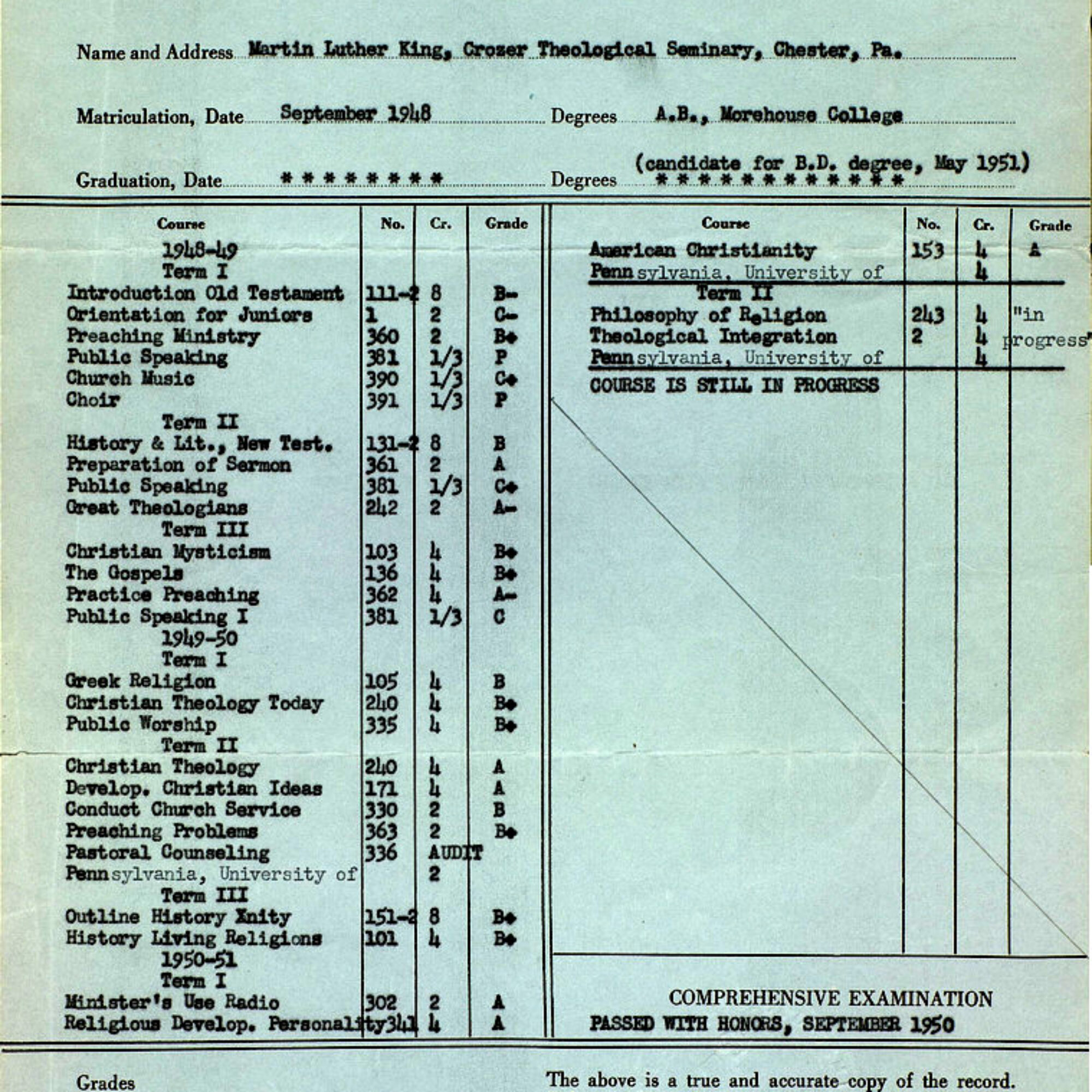
Perhaps the best honor one person can give another is to understand them and continue their legacy. I'm writing today's post to suggest you can do that with Martin Luther King more than you think. Many people believe Einstein got bad grades, but I understand he didn't. Martin Luther King, Jr got bad grades. He started graduate school at a school near Philadelphia called Crozer. Note among his grades -- the grades of one of the premier public speakers I've heard of -- he got a C in Public Speaking one term and a C+ in another term. He also got a C+ in Church Music and a C- in another class. Now look at his college grades. They are hard to read, but you'll…

0 Comments

The shells we put around ourselves

As children we start defenseless. I don't mean physically, though we start physically defenseless too. I mean kids don't protect themselves from being emotionally hurt or having their identities challenged. Kids say things we adults recognize we would catch in mental filters before speaking. What mental filters? Everybody knows what I mean. As we get older we learn to protect our vulnerabilities. We learn protocol and manners. We learn how to behave in certain situations to meet social expectations. Doing so rewards us with getting the results we wanted. With a cost, though. Some examples: When we meet a girl or guy we like we play it cool and don't let on. We don't tell a friend about a shortcoming. We don't tell anyone we…

1 Comment

Integrity in successful leaders: Gandhi cleaned toilets

This post is about integrity and sticking with your values. A few years ago I visited my father in Ahmedabad, India, the country he has studied his professional life. We visited Gandhi's ashram, a community where people who wanted to learn about and support him went. It still exists, though mainly as a static, historical site. It's a humble place on the banks of a river, humbler than you'd expect one of the great historical world leaders to live.  A sign there (sorry no picture) stated clearly that part of everyone's duties was cleaning the toilets, meaning scrubbing the buckets since I don't think they had plumbing. As I understand, Gandhi's environment in India included a very stratified caste system he opposed. He felt no…

0 Comments

Goenka and 10-day meditation retreats

Two days ago a guy named Satya Narayan Goenka died. Who was Goenka and why should I care? First, I'll mention how I found out about him. I had no experience with meditation when a longtime friend I hadn't seen in a while suggested I try it. The idea made no sense to me because meditation made no sense to me. I didn't know or care about it to that point in my life -- somewhere around 2006. But my friend knew me a long time and I valued her perspective. I decided to try a ten-day meditation retreat, I guess like jumping in the deep end -- these retreats allow no talking, reading, writing, etc for the first nine days. You can leave if…

0 Comments

An essay on money, part 2

Today being Labor Day makes it an interesting day to think about money. I've noticed my post "An essay on money" gets almost the most number of hits of all my posts so I re-read it periodically. (Speaking of money, today is the also the last day to get the early discount on my awesome seminar on September 21 and 22 -- "Leadership Through Self-Awareness and Emotional Intelligence" so sign up now and save money!) My mom pointed out we never went on welfare when she read that essay, just that they gave the food out on our block without checking because the neighborhood was so poor. We loved the food I now wouldn't touch because the bread was so sweet and white and the…

0 Comments

You call exercise torture? I call it glory.

[This post is part of a series on my daily exercise and starting and keeping challenging habits. If you don't see a Table of Contents to the left, click here to view the series, where you'll get more value than reading just this post.] Emotionally, I don't want to do burpees nearly every single time I do them. As you probably know, I do twenty twice-daily. Starting is never easy. Never. If you think you have a harder time starting to exercise than others, I think you're wrong. I don't think anybody has it easy. Just some people developed skills to overcome the emotional challenges we all feel. Rationally, I want to do them, but my emotions oppose my rational thoughts. I use willpower to…

2 Comments

Who is today’s King George III? Who are today’s patriots?

No two people are the same, especially centuries apart. Still, I can't help but think about the leader of a great empire, occupying foreign lands, facing bankruptcy from an expensive victory in a war that galvanized many nations against it , taxing without representation, changing laws arbitrarily, putting his troops in people's homes, with a legislative body insensitive to its citizens' concerns, ... I could go on, and ask "Who resembles this person most today?" I can't help concluding the United States government resembles less its founders than the imperial government they rebelled against. Thinking about Edward Snowden, Chelsea (born Bradley) Manning, and Daniel Ellsberg got me thinking about my country's founders and revolutionary figures. I couldn't help but read about Samuel Adams, Crispus Attucks,…

0 Comments

A counterproductive pattern of success

Is everyone familiar with this pattern? It doesn't always happen, but a lot. If you want to make money, it helps to interact with other people who make money and join their community. But then when you end up making money, you have to keep interacting with them, maintaining your role in the community, which forces you to spend money. The cost of living that lifestyle eerily takes about as much material and emotional resources from your life as living your old one. As with any community, if you don't maintain your role in it, you lose your place in it. While in that community, you get more expensive stuff and status, but you have to maintain them. Instead of driving a used car you…

0 Comments

Today’s Harvard student versus 176 years ago

Let's look at two former Harvard students from now and nearly two centuries ago. 176 years ago Henry Thoreau finished Harvard in 1837, one of its best-known students of his age. Let's look at him before looking at this generation's most prominent Harvard student. Thoreau wrote Walden, his treatise on living simply, escaping petty human affairs and gossip, appreciating nature, self-reliance, and such. He lived for two years mostly on his own, growing his food, building his shelter, figuring out how to spend his time, and so on. The book opens When I wrote the following pages, or rather the bulk of them, I lived alone, in the woods, a mile from any neighbor, in a house which I had built myself, on the shore…

2 Comments

What kind of leadership is this: Obama fighting for less accountability and more centralized power

Leadership and politics overlap. I generally try not to take political positions on this blog to make it accessible to more people, but the push to increase surveillance and erode protections like habeas corpus seem enough like ineffective leadership that I feel compelled to cover them. In response to this article stating that Congress granted the president the authority to arrest and hold individuals accused of terrorism without due process under the NDAA [National Defense Authorization Act of 2012], but Mr. Obama said in an accompanying signing statement that he will not abuse these privileges to keep American citizens imprisoned indefinitely Note it says merely "accused." Note it also says "indefinitely." I wrote the following on Hacker News (an entrepreneurial / geeky community site), which…

0 Comments

Restore the Fourth

Independence Day is one of the holidays I like to take time to think about its meaning. Today I'm thinking about the U.S. Bill of Rights, as timely today as ever. Why are they as important today as ever? They limit the power of government. It seems unchecked governments tend to try to seize more power. That doesn't mean they're bad or the people in them are bad. Just that people in positions of power feel motivations to increase that power, often for what many people would consider noble reasons. If you've read my posts lately you've read how I consider the NSA's spying a major step toward unaccountable centralized power (which I think the writers of the Constitution would have called tyranny) and an…

0 Comments

Morality and the development of language

I write a lot here about how counterproductive judging others or imposing your values on them is for leadership or influencing them. (Here are five posts on it, for example: Instead of calling something right, wrong, good, or bad, consider the consequences of your actions, What is morality?, On the counterproductivity of motivating people with guilt and blame — aka moralizing, Talking about “truth” or “reality” always confuses things, How willing are you not to judge?) Thinking about the development of language gave me a new perspective that, I think, helps undermine people's attachment to calling things right, wrong, good, bad, or evil. This post may sound philosophical or esoteric, but I didn't write it that way. My goal, as with the posts I linked…

0 Comments

Leadership and United States’ spying

I'd like to look at some headlines from a leadership perspective. I don't intend for today's post to be political. Governments have needed secrecy and spying since before Sun Tzu's The Art of War over two thousand years ago. People will also oppose governments that overreach their influence into their lives. Different people oppose different levels of intrusion so that the more a government intrudes the more people will oppose the government. One of the main roles of a government's highest leaders is to balance the government's secrecy and spying with its citizens' private interests. Government officials and decision-makers have conflicting interests because their jobs get easier with more of the former and harder with more of the latter. If a leader doesn't take responsibility…

0 Comments

Google, strategy, and what your strategy says about you

I've read a few articles recently how people are using search engines that track you less than Google in light of the spying. I've been using DuckDuckGo for a while since I find Google so spooky. Nobody is challenging in Google's dominance, but competition is increasing. Its search results aren't as good as Google's, but I prefer it, as I'll explain. Nearly every successful company has a strategy or it will lose focus and fail. Same with people, for that matter. Whatever a company or person says, if you know their strategy you can predict their behavior. Usually if you know their behavior you can figure out their strategy. In the case of Google and your privacy, I believe their strategy says a lot about…

2 Comments

A model for one of the most valuable skills related to beliefs

[This post is part of a series on “Mental models and beliefs: an exercise to identify yours.” If you don’t see a Table of Contents to the left, click here to view the series, where you’ll get more value than reading just this post.] This series covered a lot about flexibility with your beliefs -- the ability to try out believing something new and letting the new belief crowd out the old one. Doing so is hard because believing means believing something is right. If you don't get it, changing beliefs is hard because you'll think it means believing what you thought was wrong is right and vice versa. I made a point of undermining beliefs being absolutely right or wrong -- it's impossible for…

0 Comments

More thoughts on centralized power without accountability

Comparisons to Nazis and Hitler happen all the time, usually backfiring on the people making the comparison. Since almost no one has tried to take over the world or kill everyone they could based on religion, whomever you're comparing looks better. This comparison makes things so black-and-white you lose the ability to learn from the past. Today we know how Nazism ended, but while it developed and grew, nobody knew. When most people talk about the topic, they talk about after their power passed a point of no return. The problem with looking only there is that there was little anyone could do then to change anything. I write this blog about what you can do. I want to share things we can act on.…

0 Comments

My main problem with centralized power without accountability

I once read that in the build-up to WWII, people in America were concerned that democracy would hold them back in a conflict with the nations creating strong centralized authorities. They speculated that in a war, while they deliberated, nations with centralized power would win for not having to take time making decisions. Apparently they were right, but only at the beginning. When the strong central leaders made effective decisions, their nations won. Things changed when the strong central leaders started making bad decisions when things got out of their depth. The powerful leaders continued making decisions and nobody could stop them until their nations were ruined. I don't know how accurately I remember what I read or how accurately what I read portrayed what…

0 Comments

Ad hominem attacks are easy but counterproductive and best ignored

I'm following the story of the government spying more closely than most issues and writing about it here because I see it as a failure of leadership in many ways, most importantly that the system seems to be out of control with the person in charge -- the President of the United States -- exercising little accountability if not outright lying. Yesterday an opinion piece in the New York Times ignored the issues and attacked the character of the whistle-blower, using malevolent tones to insinuate problems. Today the New Yorker challenged that piece, still respecting the Times writer, as if the piece deserved respect. I don't think the piece deserved respect of serious consideration. Instead of addressing it point by point, as the New Yorker…

0 Comments

Edward Snowden — Whistleblower

[My previous post is my second-to-the-last on my series on daily and weekly beliefs that improve my life and may improve yours, in no particular order. See the introduction to the series and the value of flexibility in beliefs for background. The last one will be an introduction to the whole series, to come soon.] I haven't written about freedom and the Freedombox project in a while. If you've followed the leak about the information about how much the U.S. Government is spying on seemingly everyone it can, you can imagine I feel strongly about it. Readers here know the value I hold for accountability in leadership. Secrecy seems antithetical to accountability so the news seems to reveal something counter to what I consider effective…

4 Comments

A model that all models are flawed but inevitable

[This post is part of a series on “Mental models and beliefs: an exercise to identify yours.” If you don’t see a Table of Contents to the left, click here to view the series, where you’ll get more value than reading just this post.] Though this series covers models and their importance, one of their most important properties is that they inherently have flaws and inconsistencies. Flawed as they are, we can't avoid using models -- we can't avoid believing things beyond what our experience allows. The universe is larger and more complex than we can observe or comprehend so we have to make do with flawed and inconsistent simplifications. You might say you can never be completely right about anything -- not you nor…

0 Comments

A model to think deeper

[This post is part of a series on “Mental models and beliefs: an exercise to identify yours.” If you don’t see a Table of Contents to the left, click here to view the series, where you’ll get more value than reading just this post.] Have you gotten to consider and tackle the important things in your life? Do some important issues still elude you? Do you still spend time in the unimportant parts of life? Or even when on the important parts, do the urgent fires take more of your time than you want? Urgency Importance Important, not urgent Important, urgent Unimportant, not urgent Unimportant, urgent Today's belief helps you get to those topics. A model to think more deeply: You think on the time…

0 Comments

A model to help you get more out of traveling and to save money traveling at the same time

[This post is part of a series on “Mental models and beliefs: an exercise to identify yours.” If you don’t see a Table of Contents to the left, click here to view the series, where you’ll get more value than reading just this post.] Most people I share today's belief with seem surprised or even shocked when I express it. Probably because the way I say it -- that I don't like traveling -- seems contrary to something nearly everyone values. Also, I travel a lot and talk about how much I get out of it. If I have to travel, I'll find ways to make it amazing, but if I don't travel I can make staying home just as amazing. The best way I…

0 Comments

A model to help accept things without judgment or feeling sorry for yourself

[This post is part of a series on “Mental models and beliefs: an exercise to identify yours.” If you don’t see a Table of Contents to the left, click here to view the series, where you’ll get more value than reading just this post.] Do you find yourself feeling sorry for yourself and not like feeling that way? Do you get depressed or feel helpless when things don't go your way? Do you wish you could take things in stride better so you could move on from or solve problems and get on to better times? A model to help accept things without judgment or feeling sorry for yourself: "Good thing bad thing, who knows?" Here’s an old story that comes in many versions (here…

0 Comments

A belief to help you let go when you want to

[This post is part of a series on “Mental models and beliefs: an exercise to identify yours.” If you don’t see a Table of Contents to the left, click here to view the series, where you’ll get more value than reading just this post.] People say "You should just let it go" all the time. Are you able just to let go of important things? Personally, I never could. I don't think many people can. Yet I've been able to achieve the same effect. Today's model covers how I've achieved it for myself, at least. I don't claim to have made up this model -- only that it works. A model to help you let go: I can't let ideas go, but I can crowd…

0 Comments

A model to make you more intelligent and free

[This post is part of a series on “Mental models and beliefs: an exercise to identify yours.” If you don’t see a Table of Contents to the left, click here to view the series, where you’ll get more value than reading just this post.] I once spoke with a psychologist who specialized in intelligence. She told me that flexibility in how one sees the world is a major part of intelligence. At first I didn't see the connection, but then it made sense. The more ways you can look at a problem, the more ways you can try to solve it. By contrast, if you limit the number of ways you see something, you limit the number of ways you can solve it. Most people…

0 Comments

End of content

No more pages to load