This week I finished:
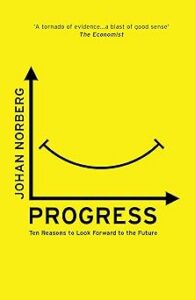 Progress : Ten Reasons to Look Forward to the Future, by Johan Norberg: I met Johan at a Cato event in midtown last month. I’d watched videos of his before. He spoke last month about his latest book, Peak Human, which I expect to read, but started with this book.
I thought it would read like Steven Pinker’s books Enlightenment Now and Better Angels of Our Nature. I didn’t expect as much Julian Simon, but Norberg recalled all of them.
As with Pinker’s books, I was pleasantly surprised myself to find many of his points compelling. Despite how much inequality, poverty, injustice, and war exists, much of it is less than before and decreasing and, while there are innumerable factors, some reasons are understandable and predictable. I found the book compelling.
That said, I found many quotes that seemed worth considering to include in my upcoming book since they supported ending pollution and depletion, not that I want to end them specifically, but that as far as I can tell, only by ending them can we restore or create liberty, freedom, equality, democracy, and national security.
Here are a bunch of such quotes followed by some thoughts I might incorporate with them. My thoughts are just notes—sorry not yet edited or fully considered.
“The wealthier the country, the more it had done to clean up the environment and to make it safe for humanity. Countries such as Australia, Germany, Sweden and Britain come out on top, whereas we find countries such as Haiti, Sudan, Liberia, and Somalia at the bottom”
Clean in one place doesn’t mean people there lowered their pollution or depletion. Many goods now come from places that pollute and deplete because they are at the bottoms of dominance hierarchies and can’t resist.
In 1806, President Jefferson called for the criminalization of the international slave trade, and the next year Congress voted to make American participation in it a felony. Later the same month, Britain abolished slave trading in the British Empire. How far the climate of ideas had turned against slavery could be seen at the Congress of Vienna in 1815. The victorious powers in the Napoleonic Wars, who were all fairly conservative and fiercely opposed to republicanism and revolution, declared that the slave trade was considered ‘by just and enlightened men of all ages, as repugnant to the principles of humanity and universal morality. Over the next decades almost every European country began to abolish slavery, as did their former colonies in Latin America.
Compare with a Coolidge/Arnn quote I also expect to put in my book. Dr. Larry Arnn, president of the conservative Hillsdale College and board member of the conservative Heritage Foundation, speaking of the conservative US President Calvin Coolidge said:
We live, he says, in an age of science and of abounding accumulation of material things. These did not create our Declaration. Our Declaration created them. The things of the Spirit come first. Unless we cling to that, all our material prosperity, overwhelming though it may appear, will turn to a barren scepter in our grasp.
To clarify, Arnn and Coolidge say that wealth results from freedom. Norberg implies wealth is cause:
One classic study found that ‘the level of economic development, as measured by per capita income, is by far the best predictor of political regimes.’ The most important factor is not that economic development directly results in democratization, but that when a regime changes for whatever reason—it can be the death of the dictator, popular protests or anything else–democracy is fare more likely to survive in a fairly wealthy country. At a GDP per capita below $1,500 annually, there is a much greater risk that a new democracy will founder. But as incomes rise, the chance that a democracy will survive grows dramatically.
I say both result from one cause.
“Peaceful mass movements against dictatorships stand a better chance at successful democratic change than violent revolutions, like those we saw during the Arab Spring. If the change has support of insiders, who have the trust of the establishment and the military, as in Spain in 1975 and South Africa in 1988, it makes for a smoother transition. But even though it doesn’t help to destroy all institutions and purge every supporter of the old regime, the old guard has to be rooted out. The problem in countries like Russia, Egypt and Thailand is that the old regime stayed in power in a sort of ‘deep state,’ and was always ready to sweep back to power when they felt that the changes were threatening their core interests.”
Likewise the US Reconstruction.
“Women’s rights: For most of recorded history, women were more or less the property of their fathers, until they married and became the property of their husbands, as symbolized in the wedding ceremony where the father delivers the bride into the hands of the groom. Women did not have the right to vote, own property, control their own bodies, get an education or work outside the home. They could even be bought and sold, like chattel. This is the other side of our hostility to outsiders: man’s ancient attempt to control what he considers his. In almost all societies men have attempted to control the sexuality of women of reproductive age with veiling, chaperoning, purdah, foot binding and imprisonment.”
Note: recorded history, not human existence. The genus Homo goes back 250,000 years. In all that time before about 12,000 years ago, our ancestors lived more egalitarian.
“We know more than ever, we are more literate than ever, and we can find almost anything we are interested in, in just a few seconds. Soon every person in almost every country will have a smartphone or a computer with a connection to almost anyone else on the planet. Considering what humanity has been able to accomplish when only a fraction of us had access to a fraction of that knowledge, and could collaborate with only the people we met and knew of, it is easy to predict that a world without such limitations will unleash incredible creativity.”
Technology augments values of culture. Phones can be used to atrophy minds too. Our culture rewards addiction more than thoughtful reflection or benign innovation.
“The only way we can get close to a world where we explore all the possibilities and us all available knowledge — to invent, to create, to solve environmental problems — is to allow everyone to participate. The living standards we have attained have meant that, as a species, we have a bigger pool of energy and intelligence than ever, which will be used to make our lives even better. In physics, escape velocity is the speed an object needs to break free from the gravitational pull of a body. Mankind is now breaking free fro the natural and self-imposed limitations that have always held us down. Humanity has reached escape velocity”
Or: not self-imposed. Imposed by those with rank (believing to help). Briefly conditions of abundance allowed what he calls progress, but conditional on enforcing democratic hierarchy.
“Progress is not automatic. All the progress that has been recorded in this book is the result of hard-working people, scientists, innovators and entrepreneurs with strange, new ideas, and brave individuals who fought for their freedom to do new things in new ways. If progress is to continue, you and I will have to carry the torch.”
Yes: freedom precedes everything else he listed, which requires enforcing three requirements for liberty, freedom, equality, democracy, and national security that the US doesn’t enforce:
- The consent of the governed
- No person shall be deprived of life, liberty, or property without due process of law
- Property rights as understood by the framers, ratifiers, and public.
I hope my notes of responses weren’t too cryptic.
 History of the World, a course by Richard Bulliet: My dad got his undergraduate degree at Columbia, where Bulliet taught a course in world history. My dad also wrote a textbook on world history, so I was curious how much my dad’s work overlapped with Bulliet’s.
I don’t remember how I found it, but Bulliet’s lectures were recorded and posted. I finished watching the first semester this week and started watching the second. I’m not also reading the textbook Belliet cowrote, just watching the lectures.
I lot of what he lectures about is what I might call meta-history. He talks about how we know things, what factors influenced other factors, how we know these things, and how we might look at things differently. I found it more about the craft of history more than specific history.
Two annoyances I had to keep working to get over: 1) They recorded only one ear so one headphone was quiet and 2) his umms and ahhs followed be exhalation. I’d recommend someone at Columbia splitting out the audio, copying it to both stereo channels, and removing his umms and ahhs.
For reference, here’s the cover of my dad’s book. I’ve read a lot of it, but not cover to cover.