
This week I finished:
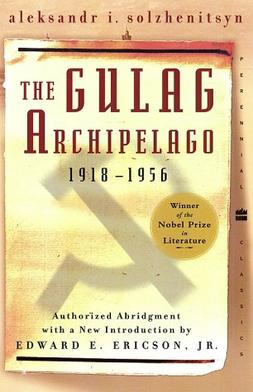
The Gulag Archipelago, volume 2, by Aleksander Solzhenitsyn: I think this book has changed my view of the world as much as it will, then it changes me more. The end of this volume becomes more reflective and introspective. It describes how it changes and corrupts society outside the archipelago.
As horrific as the archipelago is on the inside, and how far beyond what I would have imagined, the changes to all of society, even those not in the gulag surprised me more. Everyone lies, which is just the start.
I keep seeing more why people call this book essential and how it motivates people to protect freedom. I had plenty reason before, but far more now.
A big part of my approach is to understand dominance hierarchy beyond the main political examples I know: tyranny, totalitarianism, and slavery. Gulags and the USSR under Lenin and Stalin in general share systemic properties with them, but beyond.

The Battle Over Citizen Kane, written and produced by Thomas Lennon, Richard Ben Cramer, and Michael Epstein with American Experience: I like American Experience shows on topics I like. This one was interesting. I’m also posting it to represent the many videos and print reviews and analyses I’ve been devouring on the movie and Orson Welles. Another is the Cine-Files podcast, which did four episodes on it.
When I started watching the movie for the first time in ten or more years, I thought it lacked the subtlety of the great movies that prompted me to watch it, so I thought I wouldn’t like it as much. I wondered if people liked it partly for historical reasons, like starting things that became standard.
It did start many things that became standard, but they didn’t lose anything. Many parts were brash instead of subtle, but no less expressive or evocative. I already wrote last week how much I loved Citizen Kane, but I can’t help repeating it since criticisms and reflections have added to it.
Totalitarian Novels, led by Larry Arnn: This class covered George Orwell’s 1984, Aldous Huxley’s Brave New World, Arthur Koestler’s Darkness at Noon, and C.S. Lewis’s That Hideous Strength. I had already read the first two. The third I haven’t, but it overlapped with The Gulag Archipelago. I’ll try to read it after I finish. I didn’t know of That Hideous Strength, but Lewis himself described it as a novel version of Abolition of Man, which I just read.
I think people attribute tyranny to people’s intent. I find it results from conditions, in particular those that create dominance hierarchy: necessary resources that can be controlled with no alternative. When those conditions become extreme enough, dominance happens. Over time, it develops as much as the resource will allow.
The state arose to maintain and extend dominance hierarchy through codifying relationships, such as through laws and cultural beliefs, and through technology, which extends the domain of domination. Thus, it’s obvious to me that legislation and innovation within a culture of dominance hierarchy tend to grow and accelerate it, not change it.
Democratic hierarchy can counter dominance hierarchy, but it doesn’t happen through legislation and technology. It happens through change at the level of a national constitution. Even if you succeed at creating a democratic hierarchy through a constitution, it’s unstable. You have to work at it—everyone in the society must, or nearly so. The government must enforce the constitution, which I mention because our government is not enforcing the fifth amendment, which pollution and depletion violate.
These books illustrate the predictable results of the US continuing not to enforce our Constitution and motivate me to keep doing what I’m doing: to lead the US to enforce the fifth amendment.
