
This week I finished:
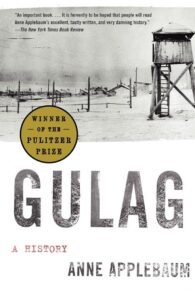
Gulag: A History, by Anne Applebaum: I read, listened, and watched a lot on the gulag system while reading Solzhenitsyn’s Gulag Archipelago. This book came up a lot, after all it won a Pulitzer.
Compared to Solzhenitsyn, it’s more scholarly and researched, less personal and biting. I think only survivors could include humor like his. Applebaum said she was prompted to write this book in part based on seeing USSR memorabilia sold to tourists in Eastern Europe, noting that no one would consider buying and wearing Nazi memorabilia.
She commented what many have and what these works have led me to conclude: Americans don’t know or understand enough about what happened in the USSR. Many people consider The Gulag Archipelago essential reading. I now agree, at least starting the first volume or an abridged version, or something like this book.
While Solzhenitsyn covered many stories of many people, Applebaum benefited from many released documents and the ability to research more openly. Despite my calling it scholarly, the writing was accessible. Despite recounting horrors, I didn’t want to put it down. On the contrary, some parts toward the end caused me to tear up.
I recommend this book.
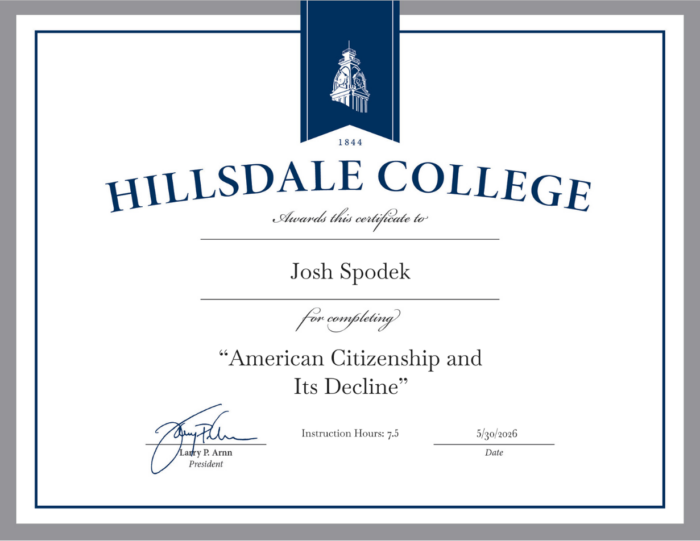
American Citizenship and Its Decline, an online course from Hillsdale College by Victor David Hanson: Hillsdale College touts itself as teaching how to think, not what to think. I’ve only recently come across Victor David Hanson, but I’d listened to many hours of his podcast before this course and found him and his reputation to be scholarly and knowledgeable.
This course undermined my opinion of Hillsdale and Hanson. It lowered my respect for both. Obviously, having spent the time to take seven courses before this one, I value something of Hillsdale’s online courses. Less so now.
Hanson promoted his political view in the guise of teaching students. More grievous, he consistently confused correlation with causation. He described historical events and trends and implied that they caused outcomes or patterns without considering alternatives or if the implications made sense.
A performance of modern classical music at Music at the Anthology (MATA): My friend who invited me, who also plays and reviews this type of music, told me a major figure from whom it derives is Morton Feldman, whose name I didn’t know. She sent me a link to the 2006 New Yorker piece below, which led me to the other pieces as well as some recordings of his music.
Regular readers know that I value experiencing and learning new cultures and that I find more opportunity for not flying, which in the past may have facilitated cultural exchange, but has homogenized culture globally to where most destinations end up mere facades for most people just going through the motions. Taking classes at colleges whose politics you disagree with, as above, or volunteering as an auxiliary police officer for people who never wore a uniform before give greater experiences.
It’s tempting to say that living in Manhattan enables me to access more cultural offerings, but everyone has access to people with wildly divergent views. We treat relatives at holiday dinners with differing views as people to avoid meaningful conversation with, but they reveal that we actually have to work to avoid encountering people with divergent views.
Anyway, I never heard of Feldman, nor had I listened to nearly any modern classical music since a required music appreciation class in college. I don’t even know if “modern classical” is the term to use. Thus, learning more about Feldman and listening to his music fit the bill. Plus I’d asked myself what to pursue since finishing listening to Led Zeppelin’s catalog. A live performance with someone knowledgeable to start me off worked.
I read American Sublime: Morton Feldman’s mysterious musical landscapes (2006) and Morton Feldman’s Music of Stillness (2026), by Alex Ross in the New Yorker and Morton Feldman’s Music: A Singular Expression of Wonder and Memory by Jeffrey Brown in the New York Times.
The Times piece contained a few short recordings of performances of his music so I listened to them, plus I watched the videos below. Before the videos is a description of the event I attended. As it happens, it was in the room that my friend who met Einstein performed his piano recital a few months ago. The room is small enough and my friend’s reporting status got us seats in the front, close enough to touch the musicians.
I won’t lie: I don’t get this music, or at least I haven’t so far. I guess I’m glad to have learned what people have been doing for about a century. I think they trace their lineage to classical music. I understand that they are expanding the definition of music beyond just tonal, atonal, or playing instruments as they were designed. I kept thinking that the music won’t stand the test of time, but I’m the ignorant one.
Now that I’ve been exposed to it in person, I expect I’ll be more open to experiencing more of it.
Music at the Anthology (MATA)is an incubator for adventurous emerging artists experimenting with composition, multi-media, collaborative performance art, and every imaginable sound in between. We present, support, and commission the music of early-career composers, regardless of their stylistic views or aesthetic inclinations. Founded by Philip Glass, Eleonor Sandresky, and Lisa Bielawa in 1996 as a way to address the lack of presentation opportunities for unaffiliated composers, MATA has since developed into the world’s most sought-after performance opportunity for young and emerging composers.
MATA presents an internationally-recognized festival each spring in New York City of new music by early-career composers selected from a free global call for submissions; MATA Presents, commissioned projects presented at venues and non-conventional spaces throughout New York; and MATA Jr., an evening of music by pre-college composers, mentored by emerging composers, and performed by top performers in new music.
MATA’s festivals and events are critically acclaimed and broadly respected: The New Yorker has hailed MATA as “the most exciting showcase for outstanding young composers from around the world.” The New York Times has called it “nondogmatic, even antidogmatic;” The Wall Street Journal said that it “tells us a lot about how composers are thinking now.” Composers that have been presented by MATA early in their careers include future Rome, Alpert, Takemitsu, Siemens, and Pulitzer Prize-winners, Guggenheim Fellows, and MacArthur “Geniuses.” In 2010 MATA was awarded ASCAP’s prestigious Aaron Copland award in recognition of its work.
I only listened to a few minutes of the hour-plus from this video, not just from the start, but jumping around
Likewise, only a few minutes of this video: