
This week I finished:
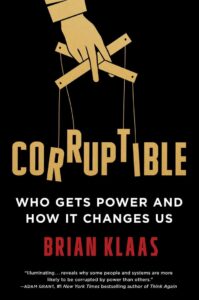 Corruptible: Who Gets Power and How It Changes Us, by Brian Klaas: This book asked the big questions about corruption: Does power corrupt, does power attract corrupt people, do corrupt people seek power, nature versus nurture, and so on. It treated power, status, and hierarchy.
My upcoming book treats the process of culture inducing people to violate their values, which I call corruption, so I was drawn to this book. I forget where I heard of it.
It presents lots of research on people’s behavior related to corruption. It wasn’t boring, but I found it academic, lacking hands-on practical experience. Most of all, it didn’t break down what power, status, and hierarchy meant. I kept translating those terms in my head into access and control over necessary resources.
The book mostly looked at people with authority and leaders. It described people and policies as good or bad. When it described people seeking power or status, it implied they wanted to be able to dominate others. But if you understand power and status as access to resources, you could alternatively see someone seeking power as seeking access to resources for themselves and their community. In that light, they might not seem bad. It focused a lot on psychopathy, narcissism, and other traits that might correlate with someone wanting power, meaning the ability to coerce.
It never treated corruption of everyday people. What about everyone polluting and depleting, knowing that they are hurting people, violating consent? What about culture becoming corrupt? I consider these issues relevant to our time, in which nearly everyone has been corrupted to polluting and depleting.
The book was interesting but I don’t think reached its potential. Still, it presented plenty of research relevant to my work. I may quote it in my book.
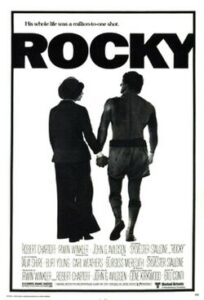 Rocky, written by and starring Sylvester Stallone: I grew up in Philadelphia in the 1970s. Rocky was huge. I was probably prompted to watch it again after reading about Springsteen and visits to Philadelphia.
Also, I’ve long seen my burpees as implementing something of the Rocky character. He’s the underdog without resources. The other guy in each movie has more money, trainers, etc, except when Rocky becomes soft, then has to return to his roots. As I described in my posts Rocky 1 and exercising solo versus at a luxury gym and What I love about expensive gyms:
I love walking past Equinox gyms, or any other luxury gym. Or any gym for that matter, though especially the expensive ones. New Yorkers commonly pay $300 to $400 per month for Equinox memberships.
Why do I love walking past them? Because almost guaranteed, someone will be walking in or out who is less fit yet spends more per month than I spent in probably the last decade on fitness. and I know that I got my full workout in less time than they took commuting or possibly even just changing clothes.
I like the movie. it reminds me of home, my childhood, and the parts of my life where I’ve strived. It’s inspirational, though as a work of art, in my recent passion for movies, I didn’t find it measured up to Yi Yi and movies since, despite having won best picture.
On the value of boxing, or at least competitive sports, to life, I happened to reread some of Nelson Mandela’s autobiography Long Walk to Freedom and stumbled on a passage on his boxing, to which he attributes some of his success and the development of his character. I grew up not valuing athleticism and competition that much. I learned to contrast it with intelligence, a terrible mistake that cost me years when I could have learned intellectual skills from physical training and competition. Darn.
Anyway, here’s Nelson. You can learn from every page of his book. Much of it relates to his time and place and may not be relevant to your life, but I believe this part can connect to anyone if they want it to.
I soon became involved in mediating a bitter political dispute right in Johannesburg. It pitted two sides against each other, both of which were seeking my support. Each side within this particular organization had legitimate grievances and each side was implacably opposed to the other. The altercation threatened to descend into an acrimonious civil war, and I did my best to prevent a rupture. I am speaking, of course, of the struggle at the boxing and weight lifting club at the Donaldson Orlando Community Center where I trained almost every evening.
I had joined the club in 1950, and on almost every free night I worked out at the Community Center. For the previous few years I had taken my son, Thembi, with me, and by 1956, when he was ten years old, he was a keen if spindly paperweight boxer. The club was managed by Johannes (Skipper Adonis) Molotsi, and its membership consisted of both professional and amateur boxers, as well as a variety of dedicated weight lifters. Our star boxer, Jerry (Uyinja) Moloi, later became the Transvaal lightweight champion and number one contender for the national title.
The gym was poorly equipped. We could not afford a ring and trained on a cement floor, which was particularly dangerous when a boxer was knocked down. We boasted a single punching bag and a few pairs of boxing gloves. We had no medicine or speed balls, no proper boxing trunks or shoes, and no mouth guards. Almost no one owned head guards. Despite the lack of equipment, the gym produced such champions as Eric (Black Material) Ntsele, bantamweight champion of South Africa, and Freddie (Tomahawk) Ngidi, the Transvaal flyweight champion, who spent his days working for me as an assistant at Mandela and Tambo. Altogether, we had perhaps twenty or thirty members.
Although I had boxed a bit at Fort Hare, it was not until I had lived in Johannesburg that I took up the sport in earnest. I was never an outstanding boxer. I was in the heavyweight division, and I had neither enough power to compensate for my lack of speed nor enough speed to make up for my lack of power. I did not enjoy the violence of boxing so much as the science of it. I was intrigued by how one moved one’s body to protect oneself, how one used a strategy both to attack and retreat, how one paced oneself over a match. Boxing is egalitarian. In the ring, rank, age, color, and wealth are irrelevant. When you are circling your opponent, probing his strengths and weaknesses, you are not thinking about his color or social status. I never did any real fighting after I entered politics. My main interest was in training; I found the rigorous exercise to be an excellent outlet for tension and stress. After a strenuous workout, I felt both mentally and physically lighter. It was a way of losing myself in something that was not the struggle. After an evening’s workout I would wake up the next morning feeling strong and refreshed, ready to take up the fight again.