
I’m learning more about dominance hierarchy and how conditions led people to form them. The term is a general term for many types of political structures that rely on coercion to impose the choices of some people, or one person, on others.
To clarify, since I used the term “political,” by politics I refer to decision making in groups: whose choices the group includes, how the group decides, how the group enforces these decisions. Leveling mechanisms maintain common access to resources. I’ll write about them in another post.
Coercion is possible when one group or person can control resources others depend on with no alternative. Those resources can be tangible, like food, tools, machines, or water, or intangible, like education, safety through police protection, justice, or technology. If I am stronger than you or have weapons, the resource may be your safety.
Examples of dominance hierarchies include monarchy, oligarchy, authoritarianism, fascism, despotism, chiefdom, aristocracy, and effectively all hereditary rule.
 Hierarchy in general is an abstraction, including dominance hierarchy. The concept refers to tangible things in people’s lives and social interactions.
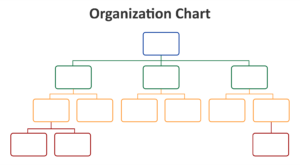
We can view dominance hierarchy as a distribution-of-resource hierarchy. That is, diagrams of their structures, like organization charts, are like flow diagrams, illustrating the flow of the resources the on the control of which the domination is based.
 Understanding and compassion
Looking at dominance hierarchy in the abstract blinds us to how life looks to someone inside them. People inside them don’t think, “I’m in a dominance hierarchy. I am seeking to seize this position in rank.” They think about their lives, which depend on a resource that others control.
What do you do and think when someone controls your access to a resource you depend on? If you need food, don’t have any, and someone else does, do you think, “I’d like to rise in a dominance hierarchy or seize power over others to control them?” Probably you think something like, “How can I get some food?” and “How can I make sure I can reliably get food in the future?” and “How can I keep them from holding food back from me?”. Probably you do things to gain access to food and ensure you don’t lose it.
That is, people seeking authority are people seeking reliable access to resources. People seeking to dominate are seeking to maintain access to resources. Security.
It’s tempting when we see someone appear to try to raise their position in a dominance hierarchy to say they want power and control. If they hurt others in the process, we may say they don’t care about others or are psychopathic, narcissistic, Machiavellian, or the like, but this view projects our impression onto their motivation. When you seek reliable access to resources, are you “trying to raise your status in a dominance hierarchy or seeking to dominate others”? No, you’re trying to eat, feed your kids, keep safe, get an education, and so on. So are they?
People seeking freedom from domination are trying to avoid being deprived of resources.
People often describe assertive behavior or disposition as a way people gain power. Being assertive only leads to domination if used to access and control resources. Someone who wants to dominate when there are no resources to control won’t get far.
The growth of the state is the development of resources that can be controlled and mechanisms to control them. These developed resources include safety (police), justice, education, finance, and institutes of culture like in arts and music.
But what about Hitler or the politicians on the other side today who we see as becoming fascist? Okay, I’ll grant that people exhibit a range of properties like psychopathy, Machiavellian-ness, and so on, but 1) they remain a small fraction of the population, too small to account for all leaders, 2) they don’t account for people who rise to the top but aren’t psychopaths, like George Washington, Abraham Lincoln, Gandhi, Mandela, King, and countless others, and 3) they were just as large a fraction of the population before agriculture for the 300,000 years humans lived without dominance hierarchy.
Even if corporations are psychopathic and many people are, the overwhelming fraction of people in dominance hierarchy are statistically normal on those traits—that is, like you and me. That is, why should we see them any different? They’re trying to get access to resources and keep it. If their group is a nation, that nation is running out of a resource, and another nation controls that resource, they may feel they have to fight a war with that other nation.
What about patriarchy?
Here are definitions I found for patriarchy:
- A social system in which the father is the head of the family.
- A family, community, or society based on this system or governed by men.
- Dominance of a society by men, or the values that uphold such dominance.
Since men are generally stronger than women, it’s tempting to say that men dominate women by controlling access to their safety. That situation often happens, but one person dominating another isn’t the same as a group’s political structure.
A situation where even all the people at the top of a dominance hierarchy are men isn’t the same as “dominance of a society by men” or a system “governed by men,” at least not if it means that the people with status act to get and control resources because of their being men or to advantage others for their being men.
The overwhelming majority of men in systems called patriarchy have low status, often the lowest. They are often the first to die.
I’m not saying that dominance hierarchies with men at the top aren’t a problem, just that identifying their being male misses the cause of their being there. Do you know of societies called patriarchal in which the men at the top don’t distribute resources to some women and children ahead of most men?
In societies with more equality, but they have social norms that man approach and women can choose, men who appear to be seeking authority are seeking resources that women require too, without which he might not mate if other males acquire more resources. This last point is complicated enough that I’ll have to take it up in another post.