
Geoffrey West
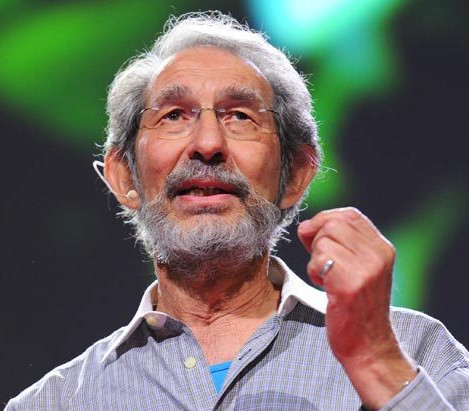
Trained as a theoretical physicist, Geoffrey West has turned his analytical mind toward the inner workings of more concrete things, like . . . animals. In a paper for Science in 1997, he and his team uncovered what he sees as a surprisingly universal law of biology—how heart rate, size and energy consumption are related, consistently, across most living animals.
Time magazine listed him in its list of “100 Most Influential People in the World”.
Harvard Business Review named his work on cities and companies was selected as a breakthrough idea of 2007.
West searches for “simplicity underlying complexity” and the unifying principles that can lead to a quantitative, predictive, integrated framework for understanding complex adaptive systems ranging from cells and ecosystems to cities, social networks and the challenges of sustainability.
His primary interests include fundamental questions in physics and biology, ranging from the elementary particles (quarks, gluons, strings, etc) and cosmology to universal scaling laws and quantifying diverse questions in biology. His biology research included metabolic rate, growth, aging & mortality, sleep, cancer, and ecosystem structure and dynamics.
He speaks worldwide, including at TED. Among recent awards are the Mercer Prize from the Ecological Society of America, the Weldon Prize for Mathematical Biology, the Glenn Award for Aging research and the Leo Szilard Award from the American Physical Society.
He wrote several books, including the #1 bestselling Scale: The Universal Laws of Life, Growth, and Death in Organisms, Cities, and Companies and a Fellow of the American Physical Society. He has been featured in The New York Times, Nature, Science, The Financial Times, Wired and Scientific American, as well as Nova, the National Geographic and the BBC.
Geoffrey West received his BA from Cambridge University in 1961 and his PhD in physics from Stanford University in 1966. After spells at Cornell and Harvard Universities, he returned to Stanford in 1970 to join the faculty. Prior to joining the Santa Fe Institute (SFI) in 2003, he was the founding leader of the high energy physics group at Los Alamos National Laboratory, where he remains a Senior Fellow. He was President of SFI from 2005-09.
110: Geoffrey West, part 3: Using science to create a vision for the future
My third conversation with Geoff covers using his research to figure out what to do.
I start with a few questions on how to create a vision for the future based on his research. Can we change our growth trajectory, currently leading to ever-accelerating growth, without sacrificing the superlinear growth that makes cities and presumably culture stable? Recall that sublinear growth leads to companies’ and animals’ limited lifetimes.
Without leadership, it seems inevitable to me that we’ll reach collapse. Leadership—changing cultural beliefs—seems our best hope. Creating new technology keeps us on the same track. We’d have to work hard to stay off the track we’re on.
He talks about how futurists from generations ago predicted technology would free up so much time we wouldn’t know what to do with ourselves. History shows we found the opposite. The research I’ve seen on technology creating efficiency has led to more pollution, not less.
Listen to the conversation to see what we can do.
Read the transcript.
103: Geoffrey West, part 2: theoretical physics and the environment
In our second conversation, Geoffrey and I continue to pursue his unique approach to viewing the environment. I find it fascinating because he approaches the environment from a different direction, but he arrives to the same conclusion—the need for leadership to change cultural norms.
Talking here gave him the chance to explore ideas he raised in his book but didn’t pursue. He wanted to do so, as I understand him. His book went in that direction, but he kept conservative.
We also considered the role of a scientist in our world’s situation, then spoke about science, culture, the environment, and the role of scientists. It seems to me that we have to change the goals of our system, which doesn’t mean stopping capitalism.
On the contrary, rules like bankruptcy and antitrust legislation fix inherent problems in capitalism of monopoly and debt turning into slavery. Markets also overproduce. We’ve accepted laws fixing such problems. Why not things like pollution taxes and externality taxes?
We also regulate accounting. We don’t allow companies to lie about their finances. What’s wrong with accurate accounting, not allowing companies to unload their costs on me?
Geoffrey was light on specifics on what to do. Leadership isn’t just about a vision but how to implement—not just we should do X, but how to motivate people to do it. I’m a fan of basic research, science, and education, but I think we know enough. We aren’t acting.
084: Geoffrey West, part 1: Simplicity beneath it all
Geoffrey West’s work beautifully and elegantly ties biology to how we interact with our environment. Amazingly, his unique views lead to the same conclusions as mine, though coming from totally unrelated directions.
You’ve never seen work like his.
If you love nature and science, you’ll love Geoffrey’s approach. You’ll see life and death in new ways.
I hope you’ll also catch my enthusiasm for his view and a chemistry in our conversation, which I see stemming from the passion and view of the world physicists have that drew me to the field and that tell us new, important things.
I kept the conversation mostly intact since if you like nature, you’ll appreciate his views. If so, I urge you to stick through to the end, where his views converge with mine.