Education


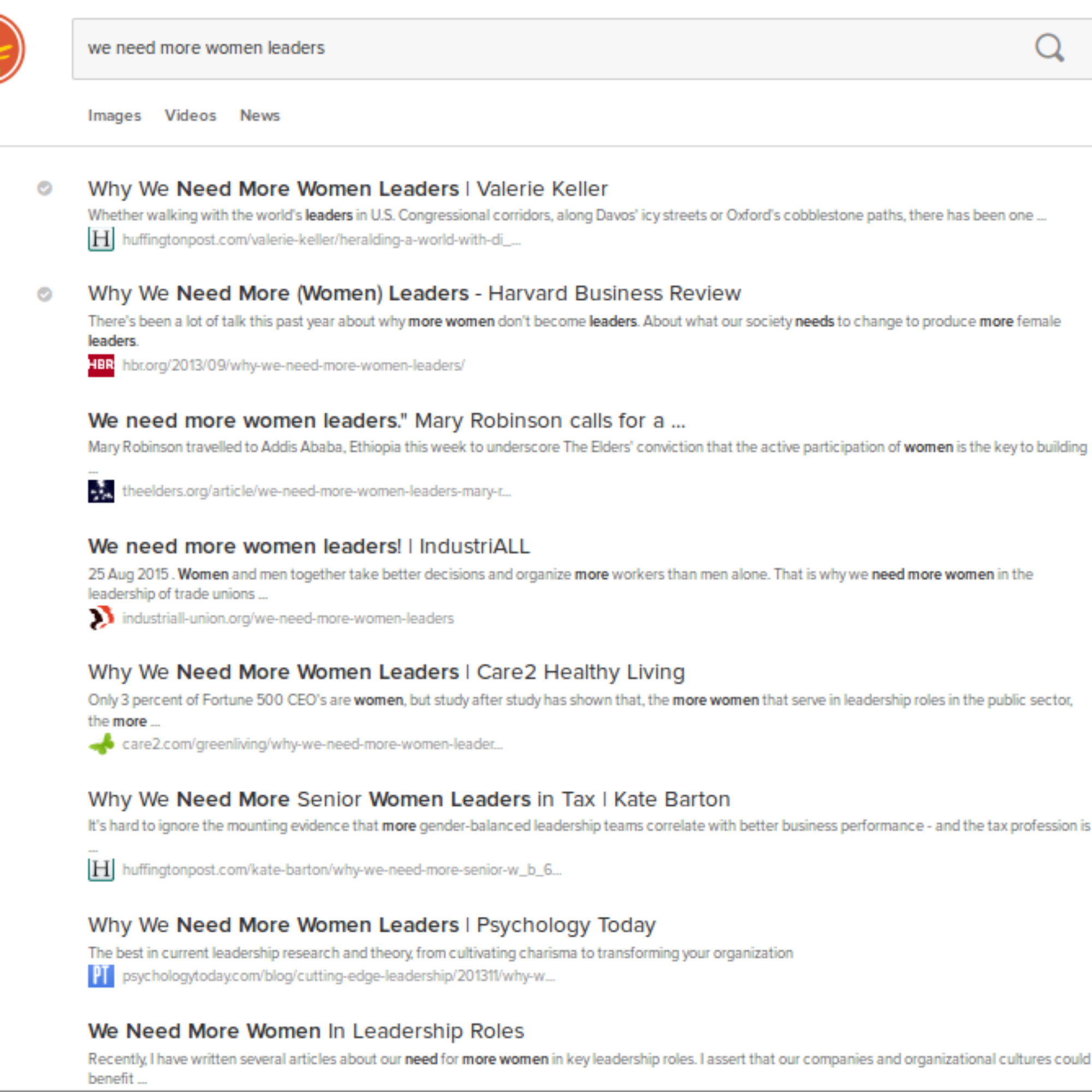
The problem with “We need more women leaders / in tech / in STEM fields / etc”

Teams with members with diverse experience and skills outperform teams without diversity, as I understand research shows. My experience is consistent with that view. I am a huge fan of diversity, and, for that matter, equality. Many people promote having more women in areas where there are fewer---in leadership, in science, technology, engineering, and math (STEM), in college, and so on. Searching on the topic on the web shows plenty of results. The internet's preference for promoting women in leadership becomes more stark when you search on needing more men leaders, where the top seven links promote women, not men, nor diversity. The same happens for women in STEM. Searching on women gives plenty of results promoting women in STEM. Searching for men shows the…

0 Comments

Cockroaches and equality

A couple weeks ago I was in NYU's "eLab," a space that promotes entrepreneurship. Besides a few administrators who work there, it's mostly students there, mainly connected with tech startups. That morning there weren't many people there. I sat on a couch near the entrance and the staircase downstairs. Twenty or thirty feet away, across the open meeting area to my left, a few students worked on their laptops in the booths. The place was pretty quiet. Morning light poured in the big windows. Out of the corner of my eye I saw movement on the floor. A large cockroach creeped slowly across the meeting area---large like a few inches long, between the size of a thumb and the size of a palm. I don't…

1 Comment

Read about my entrepreneurship course at the Princeton Tech Meetup

"If lean startup methodology doesn't work for you, then maybe you're a candidate for the alternative method of company creation espoused by Joshua Spodek, entrepreneur, professor and coach at Columbia and NYU. Spodek explained his process to an enthusiastic and receptive audience at the Princeton Tech Meetup at the Princeton Public Library on July 16, in a talk titled "8 Steps from No Idea to Funding."" So begins an article, "Professor/Entrepreneur Talks about New Method of Company Creation at Princeton Tech Meetup," in the New Jersey Tech Weekly that summarizes my July talk in Princeton. It covers my process at a high level, which will be in the course I'll soon release here that differs from the popular Lean Startup methodology the article mentioned. I…

0 Comments

Leaders and tools

A friend wanted to develop expertise in a field by getting more degrees in school. As I wrote in "Programmers work with computers and leaders work with people," people with functional skills can solve problems in that functional area: carpenters can solve problems with wood, plumbers can solve problems with pipes, and so on. Leaders can solve problems with people. Expertise is nice, but if you have leadership skills, you can hire experts in fields you need problems solved in. If you don't have leadership skills, you may end up the tool of someone who does, helping them achieve their goal. Do you want to be someone else's tool?

1 Comment

Learn and practice one of the most effective leadership techniques in person — September 30 in Manhattan

Want to learn and practice one of the most effective leadership techniques? Then join me for a workshop, Wednesday, September 30th at 6:30pm in midtown, and get a copy of the #1 bestselling leadership book included! From the announcement from the Columbia Business School Alumni Club (everyone is welcome): The Workshop Committee of the Columbia Business School Alumni Club invites you to a workshop on Marshall Goldsmith's FEEDFORWARD hosted by Joshua Spodek, PhD MBA '06 including a copy of his #1 New York Times and Wall Street Journal bestseller TRIGGERS with admission Click here to purchase tickets. The Economist named Marshall "World's #1 Leadership Speaker" and Harvard Business Review named him "World's #1 Leadership Thinker," among many other accolades. Feedforward is a major reason. It…

0 Comments

More education doesn’t make you less capable, but universities make you think so

Academia has some serious problems. I give a lot of talks to graduate students on what they can do after graduate school, though the following applies to undergraduates too. Many of them are worried about finding jobs. I grab their attention every time with this question: When I was getting my PhD in physics, I thought the only fields I could go into were academia to become a professor, industry to work probably on something military-industrial, or wall street. I didn't want to do any of those. I felt trapped. You've all heard about people who drop out of school, maybe to start a company, and succeed? With more education, shouldn't you be better prepared than they are? So why do you feel worse prepared…

2 Comments

Op/ed Fridays: Academics studying leadership versus leadership

A reader sent me an article in the New York Times called "Rethinking Work." It began, "HOW satisfied are we with our jobs?" and continued about polls about job satisfaction and various people's views on work, implying we should think about work differently---we like work less for money and more for intrinsic reward. The author is a psychology professor. Articles like this come out all the time. I'm glad academics think about these points, but he doesn't suggest anything to do. He just writes. I suppose the writing isn't boring, but what's the point of suggesting things could be better without at least trying to act? I used to hold academics in high regard, I guess because in my field of physics, academics did most…

0 Comments

Leadership lessons from Frances Hesselbein, part 3

Over lunch Frances described to me her background. I had wondered how she got started, why when the CEO of Ford, Alan Mulaly, gave her a car, she picked it up near Pittsburgh. She told me about growing up near there and going to the University of Pittsburgh. If I remember right, she didn't finish. It struck me because she is yet another prominent leader who didn't graduate college. She's surrounded by the best and brightest---leading them, responding to their requests for advice---and didn't get there through traditional education. One of my main inspirations for teaching and coaching leadership end entrepreneurship experientially and actively was seeing the high emotional awareness and skills of the guests on the TV show Inside the Actors Studio, then hearing…

0 Comments

Lessons in leadership from Frances Hesselbein, part 1

"To serve is to live." Frances Hesselbein had the fastest, clearest, most direct, and most meaningful answer of anyone I remember asking her passion. Five minutes into our pre-lunch conversation and she went right to the point. Experience and, I believe, only experience enables people to encapsulate great meaning in a minimum of words. I was immediately struck by the power and meaning in these few short words: "to serve is to live." If you read her writings, you see these five words a lot, but they carry more meaning when she says them directly after you ask her passion. Most of the next couple hours' conversation was reviewing and approaching the words from different perspectives. I knew many people call her the best leader…

0 Comments

Where do you see yourself in five years?

The college course catalog fascinated me---hundreds of courses in dozens of subjects from amazing teachers. I wanted to take them all! Choosing four or five course from them was wonderful torture. Choosing which to take wasn't nearly as hard as choosing which not to. I used to think, "I'll take these two courses ... which will set me up for this major ... which will set me up for this job ... which will set me up for this career ..." and in a few hours I'd plan out my life's next few decades. The next semester I'd find other courses and plan a new and different several decades. By graduate school I learned to plan only a couple years ahead. Who knew what experiment…

0 Comments

Learning to communicate beyond words and talking

I once read that the difference between activities that cool kids do and uncool kids do is that uncool kids' activities tend to be based in rules and cool kids' less so. I don't know how you'd verify the idea, but I found exploring it told me about myself. Uncool kids play chess, which has clear rules. You can count the possible states. Cool kids play football. Football has rules, but loosely describing the boundaries, not the state of play. Football players shine when the strategy falls apart and they have to improvise. Uncool kids dance partner dances with structured rules. Cool kids dance more free style and make things up as they go. A lot of structured partner dances probably emerged from cool kids'…

0 Comments

The hardest problems I’ve solved

How did it begin? After the first two years of classes in graduate school I had to take Qualifying Exams to continue to research. Columbia's Qualifying Exams are three days of about six hours a day. You get eight problems and have to solve six of your choice. They can cover any physics subject covered in classes to that point. If you remember high school or college physics being difficult, graduate problems are harder. Since they can ask questions on any subject you can't focus on one area. You have to study everything. What was the process? First you read all the questions. Some you can see how to solve right away. Some you can't understand the question. I solved the ones I knew I…

1 Comment

Summer Teaching Institute Reflections, day 5

I've written about inquiry-driven project-based learning and learning leadership and entrepreneurship. It's a style of teaching that's one of the main foundations of how I teach and coach leadership. It's different than lecturing. Here's why I avoid lecturing when I lead and teach. This week I'm attending Science Leadership Academy's intensive Summer Teaching Institute. Science Leadership Academy is a school founded on inquiry-driven project-based learning, so it's one of the best places to learn it. To help reflect and share what I learn, I'm posting daily notes here. Day 5 Presentation Revise vision statement Today we presented our unit plans. Everyone had fifteen minutes to present what they created over the past few days, though we've all taught our courses before. Everyone started with a…

0 Comments

Summer Teaching Institute Reflections, day 4

I've written about inquiry-driven project-based learning and learning leadership and entrepreneurship. It's a style of teaching that's one of the main foundations of how I teach and coach leadership. It's different than lecturing. Here's why I avoid lecturing when I lead and teach. This week I'm attending Science Leadership Academy's intensive Summer Teaching Institute. Science Leadership Academy is a school founded on inquiry-driven project-based learning, so it's one of the best places to learn it. To help reflect and share what I learn, I'm posting daily notes here. Day 4 Agenda Exercise: Make passive course exercises they gave us (like "have the students do a lab") active by having everyone suggest an idea (like "have the students describe the effect of the discovery on science…

0 Comments

Summer Teaching Institute Reflections, day 3

Day 3 Today's agenda: Nature versus nurture interactive exercise Unit flow Solo work on unit plan Talk about rubrics Described deliverables: Friday we'll present our unit plans to the group. Tomorrow we'll do some exercises but mostly work on the unit plans More solo work on unit plan Unit flow Do they know what's coming next? If not, maybe you lead them through steps with exercises, materials, data, etc. If so, are they figuring out what to do? You plan stages. Students need a rationale to do it, why should they care? Can work backward from what you want them to learn and create exercises or other way around Useful to break big projects into many checkpoints. How will they get feedback before they submit?…

0 Comments

Summer Teaching Institute Reflections, day 2

I've written about inquiry-driven project-based learning and learning leadership and entrepreneurship. It's a style of teaching that's one of the main foundations of how I teach and coach leadership. It's different than lecturing. Here's why I avoid lecturing when I lead and teach. This week I'm attending Science Leadership Academy's intensive Summer Teaching Institute. Science Leadership Academy is a school founded on inquiry-driven project-based learning, so it's one of the best places to learn it. To help reflect and share what I learn, I'm posting daily notes here. Day 2 Today's first set of exercises seemed to revolve around expression, language, power, and self-awareness. Again we approached them From different perspectives: written, videos from student projects, group discussion, personal reflection Using different media Solo and…

0 Comments

Summer Institute Reflections

I've written about inquiry-driven project-based learning and learning leadership and entrepreneurship. It's a style of teaching that's one of the main foundations of how I teach and coach leadership. It's different than lecturing. Here's why I avoid lecturing when I lead and teach. This week I'm attending Science Leadership Academy's intensive Summer Teaching Institute. Science Leadership Academy is a school founded on inquiry-driven project-based learning, so it's one of the best places to learn it. To help reflect and share what I learn, I'm posting daily notes here. Day 1 We practiced parts of two projects: a "court case" about factory conditions (part of a unit on the industrial revolution and its results today) and creating a child's toy based on neuroscience. The two teachers…

0 Comments

Aristotle, then and now

Aristotle was assigned reading in college. I read him like everyone did, to understand his concepts enough to write about them in essays and on tests. Also to talk about him at cocktail parties to look cultured. His writing stayed academic to me---that is, abstract and historical, not connected to my life. I knew his concepts were important because everyone recognized his name. Learning about emotional awareness and skills led me to learn more about how people looked at them before, which led me back to Aristotle. Rereading him when my life drove my interest showed me that school killed my interest in him. Now I see him as a person like anyone, figuring out how to make himself happy, how to figure out how…

0 Comments

Op-Ed Friday: Men and learning leadership

At a meeting to promote the teaching of leadership a couple months ago, I saw several proposals to support women pursuing leadership but none for men. I sensed that others there felt that since men held nearly all corporate and government positions of authority that men had greater access to positions of leadership. I didn't feel comfortable bringing it up, but I found a few perspectives missing. Advantages existing for men to attain leadership positions doesn't make the average man happier or make his life easier. Most men have no access the corporate or political power of any sort. Actually, men having advantages unrelated to leadership would suggest men would learn less how to lead, since they'd need less skill. We as a nation, society,…

0 Comments

Why leadership and entrepreneurship exercises work

It sucks when you're playing a team sport and you get shut down trying to cut to get open, the other team scores on you, you throw into an interception or some mistake like that. Few of us enjoy admitting to faults, so we often make excuses that the problem was with your team mates, the sun, the equipment, or something out of your control. When you run drills or exercises in practice, it's another story. Effective ones are designed to focus on particular skills. A cutting drill, for example, focuses on cutting. You might have to run the same cut many times in a row against different team mates but everything else is the same. If you don't get open, you can't blame anyone…

0 Comments

See me speak on entrepreneurship: Princeton, July 16

Join me at Princeton's tech meetup, July 16, 6:45pm! The title of my talk is "8 Steps from No Idea to Funding." I hope to see you there. From the announcement: Topic: 8 Steps from No Idea to Funding Speaker: Joshua Spodek 6:45 - Arrival - Snacks, Pizza and Networking. 7:15 - Introduction / Announcements by the organizers. 7:20 - 7:30 Apply for Startup Demo / Pitches (ONE MINUTE each) 7:30 - 8 Steps from No Idea to Funding -  Joshua Spodek 8:30 - Open-mic to quickly promote your business or broadcast a need that someone in the group might be able to fill. 8:45 - Wrap-Up, discussion of Meetup, feedback and opportunities for improvement or future topics. 8:55 - End of formal part of meeting. 9:00 - Exit…

0 Comments

This is not leadership. It makes people think it is and that’s part of why we have poor leaders, part 2

Once in high school some of the popular kids picked on me. It humiliated me. That evening I talked to a friend on the phone who told me that many people in the school felt for me and looked down on them. On the phone, I felt I had their support and started developing an idea: I would confront the kids who picked on me in a public venue, like the cafeteria, where the mass of other students would see me taking charge. They would rally behind me and we would rise victorious somehow, winning the confrontation. I didn't know how and even now I have trouble thinking what I could do, but I knew it would be dramatic and everybody would love it. Looking…

0 Comments

Learn inquiry-driven project-based learning from experienced experts this July!

If you've talked to me about teaching in the past year, you know how much the students at Science Leadership Academy have inspired me to teach in the style of that school---that is, what they call inquiry-driven project-based learning. The first student I interacted with when she showed me around the school showed as much leadership skills as many people with MBAs I've met. I've participated and led talks at the school's EduCon annual January conferences. This summer, the week of July 20th, I'm attending their one-week Summer Teaching Institute in Philadelphia. If you're teach or lead, I predict this event will help you. It's mostly geared toward teaching K-12 teachers, but I'm going as a university professor because I've learned so much from that…

0 Comments

“You’re too f-ing cheap to by my book?!”

My professor cursed: "You're too fucking cheap to buy my book?!" This was an Ivy League business school. I was stunned. Class just ended and I was asking him a question, as students do. Other students probably heard as they packed their bags and left the room. He had assigned his own book for the class. A couple weeks before, the bookstore clerk told me the book would come out soon in paperback and that I could save money if I waited. The cursing came in response to my telling him this, and that I was using the library copy in the meantime. I don't remember how I reacted in the moment. I know I felt shocked, which soon turned to offense and outrage. I…

0 Comments

Student feedback on my leadership class

I asked the students from my leadership class for undergraduates at NYU last semester for the three top things they learned, the three things they valued most, and the three things they'd improve. The responses were all anonymous. I collected the information to know what to keep and what to improve for next year. Some parts might not make sense if you weren't in the class, but I thought I'd share them to show the results of how I teach leadership. I'd love to read your impressions. Not all the students responded. Each set of three responses is from a different student. Learned I learned that people aren't necessarily born leaders, that leadership (more importantly, good leadership) can be learned, practiced, and mastered. I learned…

0 Comments

End of content

No more pages to load