
I heard about a case where so-called indigenous people in Vancouver were restored land by the government that they had been kicked off of. As a sovereign nation, they didn’t have to follow Canadian law. I heard that they decided to build giant skyscrapers, which prompted people who supported rights of so-called indigenous people to complain that they didn’t do what they expected indigenous people to do.
I found some coverage. It revealed deep misunderstandings of what indigenous means, as well as what the relevant issues are.
For background, I’ll start with an NPR Planet Money piece, The skyscrapers that NIMBYs and zoning couldn’t stop. It treats the issue as zoning. The piece states that “The development, Sen̓áḵw, is a reserve that belongs to the Squamish Nation (Skwxwú7mesh Úxwumixw), whose members have lived in North America since long before the arrival of Europeans.” I quote the piece more below, plus you can read and listen to it.
Living in North America before Europeans doesn’t mean that they are indigenous to that land. I’m not a historian or anthropologist, so maybe I didn’t know where to look, but my admittedly amateur web search implied that nobody knows if the Squamish are indigenous. They only know they were there when, in the words of one of the Squamish, “the white people came.” People lived on that land for maybe 10,000 years. The villages there seem to date 4,000 years, leaving up to 6,000 years unaccounted for, and the people in those villages may have been displaced many times in those 4,000 years.
If at any point in those 10,000 years any group coerced anyone off, then those living there when “the white people came” weren’t indigenous. They may be descended from people who did what “the white people” did to them. Plenty of North American societies before Columbus kicked plenty of others off their land. It’s possible that no societies in place when “the white people came” were indigenous.
I’m not saying anyone or any society is good, bad, right, or wrong, just that the measure of indigeneity is misused and misunderstood.
It’s hard to trace land ownership among cultures that keep paper records. What evidence does anyone have that the people who lived there when “the white people came” descended directly from the first people who settled there? If it exists, I’m happy to learn I suspected wrong. Otherwise, are we rewarding people who did to others what happened to them?
Now they’re building giant buildings and the NPR piece suggests that zoning restrictions are the main point. Any time someone says “housing crisis” many people’s brains seem to shut down critical thought beyond, “build more” whether left, right, or center. Say the word “indigenous” and the brains of people left of center seem to shut down beyond reflexively thinking “we must honor them,” even when they have no idea of the people living there are indigenous.
Here are the buildings with one of the people featured in the piece in front.
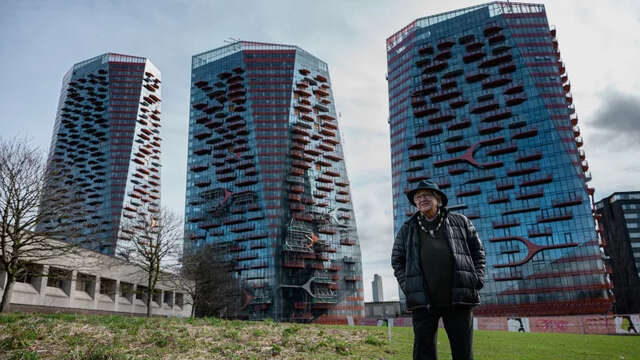
Some people were indigenous there, but not likely those there when Europeans arrived. People use the word indigenous to mean “living there when Europeans arrived,” but that’s not indigenous. Indigenous means “there first.” Again, it could be that every group called indigenous today descended from some invaders who did to people before what Europeans did to them.
Meanwhile, at one time people living in Europe were once indigenous. They were displaced, assimilated, and destroyed by waves of imperialism coming from Rome, Greece, and so on ultimately back to the first dominance hierarchies and imperialists of Mesopotamia and Egypt, which are in Asia and Africa, not Europe.
The point isn’t where they were from or their skin color, which wasn’t white, but their ways of living, which was to invade, expand, and not steward.
I suggest that the issue is behavior, not skin color or if someone was there before someone else if neither was first (or invited by the first). People get that if a group is indigenous but practices live human sacrifice or infanticide, we don’t just say, “Okay, that’s how they do things.” Nor if a group is indigenous but displaces others from their land. If people hurt others without consent, international law can have some say.
Unless the people there when “the white people came” descended directly from the very first people who arrived there, or I suppose if later groups were invited there and immigrated without coercion, then the Squamish are doing to people affected by their actions what was done to them. Building skyscrapers pollutes and depletes, affecting people far from the buildings.
In other words, they are imperializing. They have become part of the culture they and others accuse of harming them. And that culture is based on imperialism emerging not from people acting because of their skin colors but because of their control over necessary resources that be controlled with no alternative. They’re continuing and accelerating the problems, including racism.
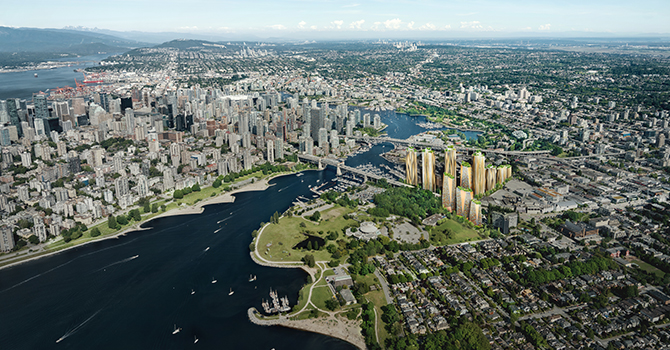
Here is a rendering of the new buildings. It doesn’t show the impact on those affected by the pollution and depletion.
The NPR podcast
Here is the podcast:
Here are some excerpts:
ALEX MAYYASI: This is Gilbert Jacob. Everyone calls him Chief Gibby. He used to be one of the leaders of the Squamish Nation, a nation of around 5,000 Indigenous people living in the Pacific Northwest. We met him in this charming little neighborhood full of single-family homes. There was a big open park nearby.
GUO: Now, the land that we were standing on used to be a Squamish village. It was called Senakw. Chief Gibby’s ancestors once lived here back in the 1800s.
JACOB: This was one of the most bountiful areas in all of the coast. We had elk. We had moose. You know, we had killer whales. We had seals, sea lions. You know, we had– catch lots of different fish out here, you know?
GUO: And then what happened?
JACOB: Then the white people came.
No distinction between “white people.” Should we just say all Native Americans are one group with no distinctions? How handy, then they would all be indigenous. They used to call them “red.” Do we want to go back to that view, because that’s how this guy is stereotyping one group of people.
A former city counselor told a reporter that there was a, quote, “big gap” between these big concrete high rises and, quote, “an Indigenous way of building.”
III: A lot of people look at us as, you know, we’re an Indigenous developer, so they’re expecting longhouses. And they’re expecting– You know what I mean?– like, things like we used to live in. No, like, we’re gonna– we’re creating something new, right?
GUO: Jacob says these critiques were kind of offensive.
III: I mean, it’s frustrating. I know what it is, and I call it out what it is. It’s– you know, there’s levels– just levels of racism.
The so-called indigenous guy is clarifying that even if they were indigenous, being indigenous doesn’t imply anything about their behavior. Their culture has become assimilated into the dominance hierarchy and imperialism that I contend is the root problem.
As just one measure of the impact of construction on people and the environment, according to the UN:
The building and construction industry is a big emitter of planet-warming greenhouse gases
The sector accounts for 32 per cent of global energy consumption and 34 per cent of carbon dioxide emissions, finds the Global Status Report. That is more than transport and agriculture.
and this peer-reviewed piece says that the “Carbon footprint of the construction sector is projected to double by 2050 globally.”
Since there are under 4,000 Squamish people, according to Wikipedia at least, and construction pollutes and depletes so much, it may be that the Squamish pollute and deplete per capita more than any other nation. I haven’t seen any quantification of their impact, so I can’t say, but they’re hardly benign. I hope someone can show me I’m wrong.
The piece’s closing reveals how much the Squamish have assimilated into global dominance hierarchy and imperialism, though it refers to an earlier part of the piece that clarifies how the buildings will provide not stewardship but money for seven generations:
JACOB: We’re back. [LAUGHS] We’re back. We’re just placing our– our footprint back on our land again, you know? And to me, that’s important.
MAYYASI: These towers, they are a case study in what’s possible, how big you can build and how quickly, if you don’t have to follow the regular rules. And look, the Squamish are very clear about their main goal for this project. Their goal is to make money, to provide for the next seven generations.
Maybe I misunderstand the seven generations principle, but I understood it as stewarding the relevant nature for seven generations, not bank accounts.
Another piece
There are lots of pieces, but from The Squamish Nation’s Impossibly Simple Solution to Vancouver’s Housing Crisis “50 percent of the workers are Indigenous, with 15 percent Squamish representation, according to 2024 data.”