
Leadership lessons from 360-degree feedback charts

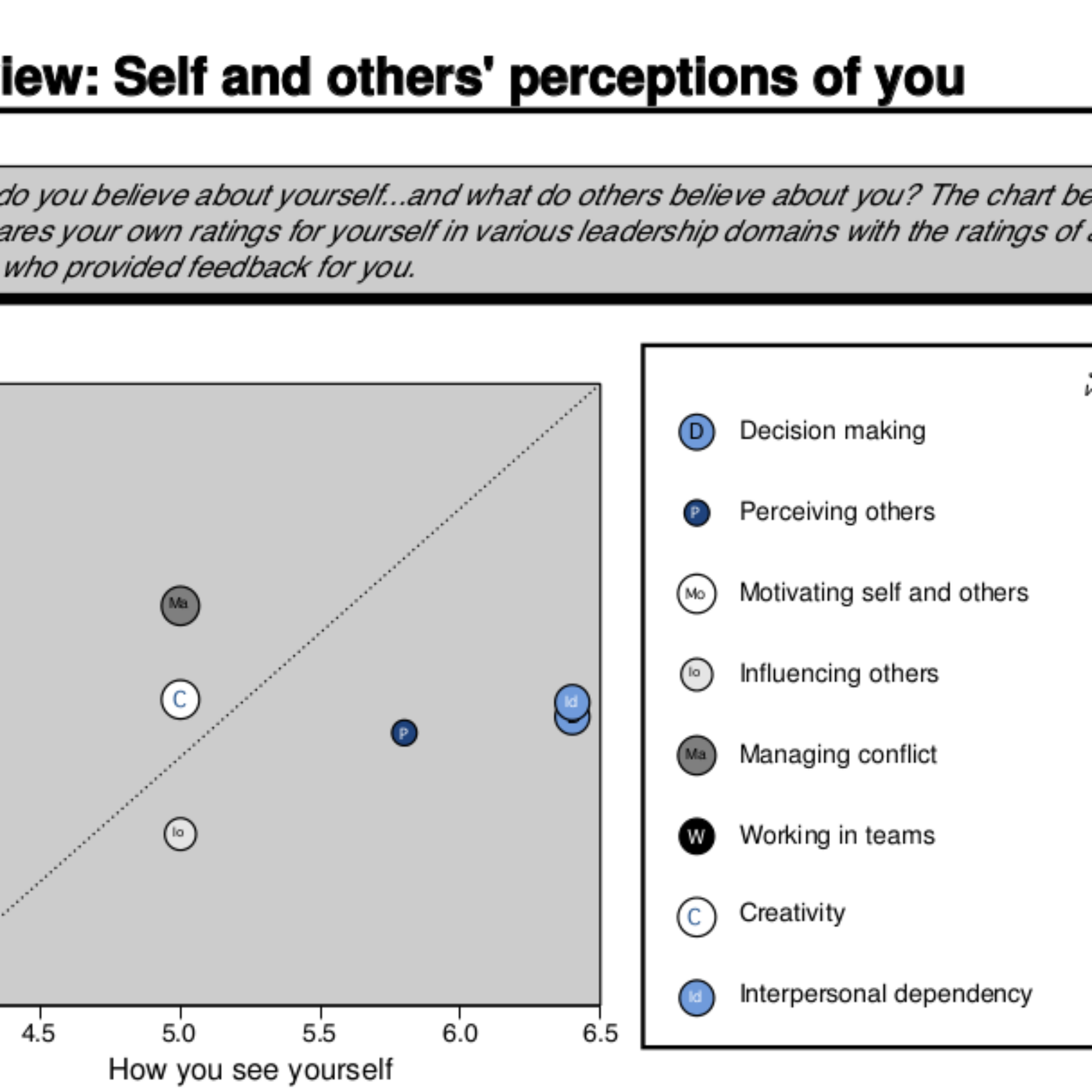
[This post is part of a series on Coaching Highlights from coaching Columbia Business School students. If you don't see a Table of Contents to the left, click here to view the series, where you'll get more value than reading just this post.] Just the structure of yesterday's charts teaches a lot about leadership. They emerged as main tools for communicating leadership ability and guiding improvement so even if you're never the subject of one, you can still benefit from knowing about them. Let's see a few reasons why. Let's look at one again. The chart breaks leadership into sub-skills My Core Leadership class at Columbia began with asking the professor asking us to define leadership. It's notoriously difficult to define. So instead of trying…

0 Comments

A sample 360-degree feedback: Overview charts

[This post is part of a series on Coaching Highlights from coaching Columbia Business School students. If you don't see a Table of Contents to the left, click here to view the series, where you'll get more value than reading just this post.] Let's look at part of a sample 360-degree feedback report. Today I'll show the highlights -- the summary of all the questions. Even if you've never had a 360-feedback for yourself, just knowing how they work can help you. Understanding their structure alone can help you figure out how to improve your leadership skills. First I'll explain what you're about to see. Each person responding to the survey about the person receiving the feedback gets asked to rate the person in several…

0 Comments

Coaching highlights from coaching Columbia Business School students: 360-degree feedbacks

[This post is part of a series on Coaching Highlights from coaching Columbia Business School students. If you don't see a Table of Contents to the left, click here to view the series, where you'll get more value than reading just this post.] Before going into the details of looking at a 360-degree feedback report, I want to talk about the structure of the 360-degree feedback process and what it tells you about leadership. What is a 360-degree feedback? 360-degree feedbacks are usually done in corporate and bureaucratic environments as review processes, both to help evaluate performance and to help people improve their performance. The process is that you or someone (typically in the Human Resources department) gets feedback from all sides -- people above,…

0 Comments

Coaching highlights from coaching Columbia Business School students

[This post is part of a series on Coaching Highlights from coaching Columbia Business School students. If you don't see a Table of Contents to the left, click here to view the series, where you'll get more value than reading just this post.] I've been posting a lot on personal development, so I'm going to focus on specific leadership and leadership development issues for several posts. I've had the privilege and responsibility of coaching leadership to many Columbia Business School students, both in the regular and Executive MBA programs. For the next several posts I'll cover a few of my observations in coaching leadership in that environment -- usually tips on improving business leadership, but also leadership, leadership development, and personal development in general. The…

0 Comments

A fundamental contradiction for many women in dating

I'll tell you a fundamental contradiction in nearly all women seeking men. Though glaringly obvious, most women (and men) I mention it to have never noticed it before. Point 1: Women don't want to be evaluated only on appearance I don't think I've ever met a woman who wants to be evaluated only on her appearance. Every one I've talked to wants people to know her personality, history, dreams, etc. Point 2: Women don't like men approaching many women I haven't met many women who support men approaching and flirting with lots of women. They tend to presume guys who do are looking for superficial relationships. Contradiction: How does a man learn about a woman besides her looks without talking to her? You can fantasize…

3 Comments

Would you eat the cherry tomato?

Here is a deep question about values, spontaneity, risk, adventure, the best things in life, and your appetite for them. The context It begins with my mom's garden years ago when she lived in Nebraska. Now I'm not that big on tomatoes, like some people are, and less so then than now. But when I tasted the cherry tomatoes from that garden they tasted like sunshine. I couldn't believe how much flavor they had -- sweet, tangy, juicy... everything you could hope for in a piece of fruit. And with all the vines there, you could pop cherry tomatoes in your mouth all day. There were more on the vie and overnight yet more would appear. Plus she had  -- I should mention it was…

5 Comments

You don’t have to accept anyone else’s hierarchy of taste

I posted on another board in a discussion on taste Is classical music better than punk? Museum art better than street art? Haute cuisine better than burritos? Is the op-ed page better than stand-up comedy? Is classical philosophy better than folk wisdom? My life improved when I learned I didn't have to accept anyone else's hierarchy of taste. Most people may consider one better than another, but I've learned to see them as meeting the values of a community better, not being absolutely better. Classical music meets the values of some communities better than punk. But punk meets other communities' values better than classical. I prefer evaluating things by the values of the communities that practice it. Then I appreciate more things and judge less.…

0 Comments

Spending less improves your life

Preface: I started writing this blog about how cutting personal costs (of any resource, including time, money, energy, attention, etc) improves your personal life. Rereading it I realized it overlapped so much with what leaders can do in business, I'll tag it leadership too. Translating the post into business-speak I'll leave as an exercise to the reader. You can probably do it on the fly. People who know me in person know I work very little at a job -- like a day a week, sometimes more in crunch times, which happen once a year or so. When they hear I work so little, they first ask, usually indirectly, where I make enough money to live on. I view going this direction first as a…

2 Comments

“Extremes” usually aren’t

I've written before on the persuasive but specious rhetorical trick that goes something like John is very conservative about these things. Mary is very liberal. Me, I'm practical and... Do you sense that you're probably going to agree with what the speaker next says? Extremists like John and Mary are difficult to deal with. People reject extreme views out of hand. You don't want to be like that, do you? Being practical makes more sense, doesn't it? The speciousness is subtle. I'll point the flaw out in a second. When you get it, you realize what the other person is doing and how to protect yourself from their influence when you don't want it. You'll start to see people doing it all the time. The…

0 Comments

Not envying others, without complacency

Do you ever wish you made more money or had more power, fame, free time, or something else others have and you don't? Maybe you look at Brad Pitt or Oprah Winfrey and think, I wish I had what they do. Then you get stuck realizing you don't and feeling sorry. I've found the problem isn't their having something and you not having it. The problem is you wishing you had it and not realizing their situation fully. More precisely: your thoughts are making you feel bad, not the external world. Getting tangled in thoughts of comparing yourself to them by standards that don't work for you bring you down. What to do instead? Here's a thought process I found myself in yesterday that I…

0 Comments

What is progress?

Almost daily I face what I see as the key misunderstanding between how to lead your life to everything you want from it and how to follow what society tells you to. If you're lucky the latter will bring you what you want. You're guaranteed to produce for others, but you may never create what you want for yourself. By contrast, the former -- leading your life based on your values, meaning, and purpose, which are based on your emotional reactions (what motivates you, how you motivate others, etc) -- will always lead to a rewarding life, always great by your standards, no matter how things turn out. People call growth progress and by growth they mean the material outputs of society, which may be…

0 Comments

Difficult life decision? Here’s how to look at it.

Life is full of difficult decisions. People struggle over them, sometimes for years, even people living great lives. You probably have one or two or more. I've had my share. A couple questions people asked me recently got me to figure it out. If your questions are reasonably similar, read on. Typical life questions "Which job should I take?" "Should we become boyfriend and girlfriend?" A couple friends asked me these questions lately. You probably have similar questions. "What major should I pick," "should I get a new apartment," "what should I do for vacation," and so on. The questions affect many parts of your life for a long time, but they don't have clear answers. You've probably succeeded at enough things at life that…

0 Comments

A leader and physicist’s view on morality, ethics, and judgment

Wrapping up my series on the counterproductivity of leading with morality, ethics, and judgment, I'll present a model based I got from Einstein. Without all the emotion judgment can grip you with, you can understand the physics model easily. Then you can apply it to the emotional situation. Then I bet you'll improve your life. Before Einstein: the problem of the aether Before Einstein, people created a concept called the aether. They saw light traveling through a vacuum and figured something must be there, so they created a concept. For years they looked for properties of it. No one succeeded. You might remember the Michelson-Morley experiment from high school physics that famously couldn't detect the aether. That was a problem. People were looking for something…

0 Comments

How do you lead when you can’t stand working with someone?

Yesterday I wrote on how to lead people (yourself or others) you disagree with without judging them. I skipped cases where you felt you could not work with the person under any circumstances. Let's look at such cases today. I'm going to treat these cases strategically. Most cases will be unique at the tactical level so you'll have to figure out how to apply the strategy. If you can't work with someone, YOU have a problem First things first. No matter how bad you think they are, no matter how much evidence you have pointing out their faults and shortcomings, no matter how many other people agree the other person has problems, you have a problem too. I'm not saying they don't have problems too.…

0 Comments

Deciding right and wrong for others and causing them guilt and blame doesn’t help anyone

Prelude: this is about leadership (of others and yourself) Yesterday I outlined an essay on the counterproductivity of deciding right and wrong for people who disagree with you. Today I'm fleshing out the essay. The point of this blog is to help people lead -- to influence others, to work with them in teams, to negotiate with them, and so on -- even when you disagree. So I'll leave deciding right and wrong for others, figuring that, since some issues haven't been resolved for thousands of years, you might not resolve them before you have to deliver on your project (or while you improve your life if we're talking about leading yourself). Successful leaders ship while attract people to work with them. Today's post covers…

0 Comments

On the counterproductivity of motivating people with guilt and blame — aka moralizing

I liked Michael Pollan's Omnivore's Dilemma, which people have suggested I read for years. I like his perspective on food and "food." I don't intend for the following to detract from his overall message, but his chapter 17, "The Ethics of Eating Animals," makes a great example for leadership. Leadership means motivating others, which means changing their emotions. Few of us like when others motivate us with guilt or blame, so I find using leading through those emotions counterproductive. Claiming to appeal to absolute measures of right, wrong, good, bad, or evil tend to polarize. Motivating through guilt or blame with appeal to absolutes has a name: moralizing. Morality, ethics, meddling, being holier-than-thou, self-righteousness, and so on work to some degree, but risking alienating, polarizing,…

0 Comments

I don’t like to travel

I don't like to travel. I didn't say I don't get value from traveling. I didn't say you shouldn't like traveling. I didn't say I don't travel. In fact, I travel a lot. I've visited 21 countries last I checked, a high number for Americans, I think. I rode a bike with a friend 1,500 miles from Philadelphia to Bar Harbor, Maine and back the summer between high school and college at sixteen years old. In conversation, I find people hold travel as almost a universal virtue. I get a lot out of traveling, but I don't see it that way. Maybe it's because I love living in New York so much, but I think anyone can love where they live just as much, or…

0 Comments

Creating miracles

I just finished an exercise on "How to Create Miracles in Your Life." I wrote up the following. It's out of context so it may not make sense to everyone, but you may get the gist of it. I found it important. I had my biggest problems with this exercise last time. In the end I figured out the exercise with my interpretation. At first my biggest problem was with the term miracle, which to me inextricably implied supernatural. I haven't found the supernatural helpful. More recently I realized a conflict with "Good thing bad thing." Nothing inherently wrong with conflict, but if the train coming just in time was so miraculous, did that imply something un-miraculous about the train not coming on time? If…

0 Comments

One way to accept without judging

Here's an old story that comes in many versions (here are seven), but I learned from Srikumar Rao's book Are You Ready to Succeed (text from this blog). An old man lived in a valley with his son, a handsome and dutiful youth. They lived a peaceful life despite a lack of material possessions. They were very happy. So much so, that neighbors began to get envious. One day, the old man used all his savings to buy a young wild stallion. It was a beautiful horse that he planned to use for breeding. The very same day he bought it, the horse jumped the fence and ran off. The neighbors came over to sympathize. “How terrible!” they said. “Good thing? Bad thing? Who knows?”…

0 Comments

Psychologists on self-awareness

This quote on self-awareness, from the book Willpower, describes some psychologists' perspectives on self-awareness. I like its perspective. It asks how self-awareness could have evolved and notes the importance of the behavior the mental ability motivates By the way, I recommend the book for its content and engaging writing style, although I prefer the advice and perspective in my willpower series. Read both. (Edit: and my Empathy Gap series. Read all three.) In the 1970s, social psychologists studying subjects in self-conscious situations began to understand why self-awareness developed in humans... When people were placed in front of a mirror, or told that their actions were being filmed, they consistently changed their behavior. These self-conscious people worked harder at laboratory tasks. They gave more valid answers…

0 Comments

How to respond to insults

Nobody likes being insulted. We often feel compelled to respond in kind, all too often exacerbating problems. I haven't found advice to have a thick skin or not to let it affect you helpful, especially when angry or feeling attacked. It feels like letting the other person win. Understanding the situation from a different perspective makes responding easier. The main principle: When people insult, they say more about themselves than the person they insult. To clarify, everybody has values and standards. When they evaluate others they come up with their judgments. Insults express how their perception of someone measures up to their standards. In other words, when someone insults someone, they are telling you about their standards. Often they say nothing about the other person.…

0 Comments

The Method: exercise to transform yourself

This exercise transforms your life. It has you do the first three steps of the Method, prepares you for the fourth, and sets up accountability with others for step 4. Accountability is how things get done, so it can help a lot. I do this exercise halfway through my seminar. People get deeply into it, even after sitting in a room for five or six hours. When we review the exercise people sometimes tell me it gave them their first experience ever sharing some problems, then finding themselves surprised to find simple solutions to them. Requirements (or good-to-haves) You can do the exercise alone, but I prefer to group people into three to five. Everyone should know the Model and the Method. Preferably you've prepared…

0 Comments

The Method: exercise in new beliefs

The Method's steps 2 and 3 have you conceive of new emotions, environments, beliefs, and behaviors for emotional cycles you want to change. The challenge How do you pick the new beliefs to crowd out the old ones? Choosing the opposite to existing beliefs rarely helps. You end up debating yourself in your head. Discussion I find complements to beliefs crowd out existing ones more effectively. For example, I found an effective alternative to rising anger is not to try to be calm, but to be curious about the situation causing the anger. The curiosity crowds out the anger and I get calm anyway. I've found effective complements to many emotions, though curiosity works well for many situations for me. When I feel frustrated, impatient,…

0 Comments

The Method: exercise in knowing yourself

Many people feel they can't change themselves or that doing so is fake. Here is a quick exercise to show you how easily you can change yourself because you do it already. Step 1 First answer the question "Who are you?" by describing yourself with three or four adjectives. I know you're just reading a web page, but if you have pen and paper or can open a window on your computer to write in, write a few adjectives that describe you before going to the next step. No one will hold you to them, so you don't have to pick the best ones. Just a few. Step 2 Now imagine yourself in a job interview and answer the same question. Write a few adjectives…

0 Comments

The Method: long term

If you lined up all the cycles in your life by the amount of reward they brought you, you might represent them like this. The low bar on the left might represent something you can never get right -- like feeling helpless about your weight if you're overweight or about a big debt you have to repay. The high bar on the right might represent the joy you feel for your favorite hobby or spending time with your best friend. I'm only casually representing things. I don't know how objectively you can measure the amount of reward, but in general we know some parts of our lives bring us great joy, others misery, and others in between. I think the graph above illustrates that. According…

0 Comments

End of content

No more pages to load