Why I don’t eat meat: non-issue5: feeling closer to nature

Following up my series on liberating ourselves from moralists, meddlers, and others who want to impose their subjective values on us in the name of objective truth in the realm of food, let’s continue with feeling closer to nature, the next on my list of a few days ago. I can keep this post as brief as yesterday. Both meat eaters and non-meat eaters claim their eating habits bring them closer to nature. Hunters claim hunting feels primal and puts them in tune with nature and the animals they hunt. Fishers claim similar feelings. Likewise, people who don't eat meat claim avoiding meat makes them feel bonded with all of nature and to feel more compassion for living creatures. If you've read my series on…

1 Comment

Why I don’t eat meat: non-issue4: animal cruelty

Following up my series on liberating ourselves from moralists, meddlers, and others who want to impose their subjective values on us in the name of objective truth in the realm of food, let’s continue with animal cruelty, the next on my list of a few days ago. I'll keep this brief. Once an animal is born, it has to die. Killing it for meat doesn't mean it feels more pain. In fact, killing it intentionally can create the opportunity for it to feel less pain than it would have felt if it died not by human hands. If not for humans, some predator or parasite would likely kill it, and likely more painfully. I don't eat meat, but I don't accept that a human killing…

0 Comments

Why I don’t eat meat: non-issue3: animal rights

Following up my series on liberating ourselves from moralists, meddlers, and others who want to impose their subjective values on us in the name of objective truth in the realm of food, let’s continue with animal rights, the next on my list of a few days ago. I confess I don't know much about animal rights, so I won't say much today. I distinguish between reasons not to eat meat based in animal rights from reasons based in animal cruelty. The former seems to propose a set of rules for people to follow. The latter seems based on an individual's personal feelings. As I understand animal rights, people don't suggest giving animals legal rights, like to sue or vote. I understand the concept of animals…

0 Comments

Why I don’t eat meat: non-issue2: environment

Following up my series on liberating ourselves from moralists, meddlers, and others who want to impose their subjective values on us in the name of objective truth in the realm of food, let’s continue with environmental reasons since I listed it next on my list a few days ago. People who don't eat meat often point out that eating meat pollutes the environment significantly more than not eating meat. As far as I know the data overwhelmingly supports this conclusion. I've heard people who eat meat argue that eating meat pollutes less, but I've never heard one of their arguments hold water in the least. They generally forget or neglect something obvious like that animals eat food too. I'm open to hearing something I missed,…

0 Comments

Why I don’t eat meat: non-issue1: health

Following up yesterday's post on liberating ourselves from moralists, meddlers, and others who want to impose their subjective values on us in the name of objective truth, let's start with health since I listed it as the first non-issue two days ago. First, nobody chooses what they eat solely for health, so claiming to eat meat or not as a wholesale policy based on health is a red herring. Next, let's look at what I claim is a typical example of someone claiming health as a foundation for eating meat or not. This example goes one way, but it ones in the other direction go the same. In graduate school I knew a guy who claimed eating meat was necessary for life. We had a…

0 Comments

Why I don’t eat meat: non-issues

People spout tremendous nonsense on why people should or shouldn't eat meat. My next several posts will point out flaws in their reasoning. I think in the echo chambers of their minds, people come to believe their reasons for eating or not eating meat are grounded in absolute truth. Or they only talk with people who agree with them, while arguing positionally with people who don't, a recipe for confirming and firming one's beliefs more firmly, no matter how wrong they are. I speak, of course, from now-humble experience, having spewed nonsense myself, trying to convince others of the unhealthiness of eating meat. No more. I don't claim to know what's right, but I can tell you some things that are wrong. My goal is…

0 Comments

Why I don’t eat meat, part 2

Yesterday I mentioned I didn't eat meat for two categories of reasons: taste and intellectual reasons. Today I’ll cover my intellectual reasons. Intellectual You know what? None. Now that I think of it, no intellectual reasons motivate my eating habits. Everything I think of that seems not based in taste, when I peel away at it, turns out based in taste. I expect your reasons ultimately are based in taste too. You can tell your reasons aren't objective because other people disagree with you. I mean, maybe you're right and they're wrong, but they say the same about you, so I'll stick with my conclusion. See my next few posts on non-issues to see why I don't find your reason objectively true. Non-issues Here are…

0 Comments

Why I don’t eat meat, part 1

Why I don't eat meat differs from why I stopped eating meat, though the reasons overlap in matters of taste. As I mentioned, I lived over half my life since I stopped eating meat and, as you might expect, my reasons changed. The main reasons for the changes were realizing that I found no objective reason for eating meat or not. I've looked and they all turn out subjective. People have suggested lots of reasons for eating meat or not and none of them have been objective either. All reasons boil down to matters of taste and belief. If people disagree on their reasons, the reasons probably aren't based in objective truth. People claim their reasons are objective, but I don't find someone saying they…

0 Comments

Why I stopped eating meat, part 3

Three days ago I mentioned I stopped eating meat for two categories of reasons: taste and intellectual reasons. Two days ago I covered taste. Today, intellectual reasons. First I'll mention that none of the following reasons motivate me anymore. Though I once did, I no longer find them compelling. I find their counter-arguments equally valid, or just as well, I find them equally invalid. I find talking about these reasons tends to promote arguments. As part of this series on food I'll write why I find the arguments uncompelling reasons not to eat meat (though I do find them compelling reasons to avoid factory-farmed and some other kinds of meat). From 1989 and until the past few years, my motivations for not eating meat included…

0 Comments

McLibel

By the way, having mentioned McLibel and the difference between "food" and food and between "meat" and meat, and as long as I'm on the topic of reasonable talk about eating, I can't help mention more about the case. Quoting from a web page devoted to the case, The McLibel Trial is the infamous British court case between McDonald's and a former postman & a gardener from London (Helen Steel and Dave Morris). It ran for two and a half years and became the longest ever English trial. The defendants were denied legal aid and their right to a jury, so the whole trial was heard by a single Judge, Mr Justice Bell. He delivered his verdictin June 1997. The verdict was devastating for McDonald's.…

0 Comments

Why I stopped eating meat, part 2

Yesterday I mentioned I stopped eating meat for two categories of reasons: taste and intellectual reasons. Today I'll cover taste. By taste I mean not just flavor, but what one likes or not, as in musical taste. I never liked eating meat. At least I don't remember liking it, but it was a long time ago. I remember disliking eating meat. My mom would say "It's all meat!" about the fat around a steak that, no matter how much you chew, doesn't break down in your mouth. So I had to chew that stuff while it made me gag. I think my siblings all remember the phrase. So if I ever liked steak I didn't like it after that. The tendons on a drumstick eventually…

1 Comment

Why I stopped eating meat, part 1

People often ask me why I stopped eating meat. I wrote a few days ago about how often people ask in order to argue and how I find the question boring after having been asked roughly daily or so for decades. Still, I've learned to appreciate and even celebrate things I can't change so it doesn't get me down. I used to argue with people about food too so I empathize with them, though I learned to stop arguing, so I feel justified in expecting more of them. Anyway, before writing why I stopped eating meat, I'll point out most of my reasons for not eating meat now, which I'll write about later, are different than my reasons for stopping eating meat in 1989. I've…

2 Comments

More reasonable talk on eating, part 3

Yesterday covered more the physical side of the change in the trucker's life with food. Today let's look more at the emotional side. The movie showed that, however ingrained the punishment of "food" and its related confusion-based helplessness, just a few days of new experience can overcome it. The trucker's physical health didn't change overnight, but his emotional health did. And a major point of this blog is the fundamental importance of emotions in changing your life. Once he found that food -- something so simple as food -- could create power (ability to influence his life), joy, reward, and so on, he found he could create something to live for, which I believe was a better life for himself, spending time with his family…

0 Comments

More reasonable talk on eating, part 2

Yesterday I wrote about healthy food, unhealthy "food," and how we've created industries that confuse the two, leading to people eating things they don't like and avoiding things they do. The day before I wrote about the movie Fat, Sick, and Nearly Dead (view for free here, view trailers here). Since food can be such a rewarding part of life when you find ways to actively enjoy it, many books, movies, restaurants, and so on inspire people by removing the deception and confusion "food" vendors create to sell their products. Once you realize how much joy and reward food can create, you love it. Many have inspired me. A character in Fat, Sick, and Nearly Dead inspired me most recently. The movie's main thread is…

0 Comments

More reasonable talk on eating

I alluded to a point yesterday that people don't eat what they want and eat what they don't want. They diet, avoid things for reasons other people give them, eat unhealthy foods, and so on. Is this mind-blowing or what? How can someone eat things they don't like and avoid things they do? Food is as basic as things get. What better feelings does life offer than for eating food we like? Could you imagine our ancestors evolving liking eating anything but healthy food? Or disliking eating anything but harmful things? Wanting to eat healthy food and avoid unhealthy alternatives must be fundamental to our wiring. The opposite -- eating unhealthy stuff and not getting healthy food -- must confuse our systems. Answering these questions…

0 Comments

Some reasonable talk on eating

A movie I saw recently called Fat, Sick, and Nearly Dead (view for free here, view trailers here) struck a chord and got me thinking more about food recently, and buying and eating more fresh, organic fruits and vegetables than ever. So I'll post a few posts on food and diet. The last time I intentionally ate meat was the spring of 1989. Occasionally someone brings me a turkey burger when I order a veggie burger and I accidentally eat some or a bug flies down my throat when I'm running, but I don't count things that happen without intent. People who eat meat can get weird about people not eating meat sometimes. I'm sure from their perspective they seem normal and people who don't…

1 Comment

The heart of freedom, part 2

Yesterday I wrote about what I called the heart of freedom, stating that being able to choose your beliefs was more important than being able to change your environment. I quoted Viktor Frankl stating that being able to choose your beliefs was a freedom that could never be taken away. What does that freedom get you? "Just" feelings? Or does it get you more than that? He followed up yesterday's quote with When we are no longer able to change a situation – just think of an incurable disease such as inoperable cancer – we are challenged to change ourselves. By no means would I suggest his environment had anything desirable, but observe where this ability took him. In the midst of one of the…

0 Comments

The heart of freedom

Viktor Frankl, whom the Nazis captured and imprisoned as a slave laborer in concentration camps including Auschwitz and Dachau, perhaps best clarifies and shows that you can feel free independently of physical constraints and that feeling free gives you all the value of being free. We who lived in concentration camps can remember the men who walked through the huts comforting others, giving away their last piece of bread. They may have been few in number, but they offer sufficient proof that everything can be taken from a man but one thing: the last of the human freedoms—to choose one's attitude in any given set of circumstances, to choose one's own way. “Everything can be taken from a man but one thing: the last of…

0 Comments

There will never be a periodic table of emotions, part 2

Continuing yesterdays' post... In the examples above, the categorization schemes worked because they categorized something with an underlying structure -- the photon and its wavelength, the atom and its nucleus and electrons, natural selection and DNA, the (so far) fundamental particles and the laws governing their interactions. But not everything with patterns has an underlying structure. Let's look at anatomy, for example. As we'll see, it will reveal a lot about emotions and motivations. Notice that despite common characteristics across life, no one has created a periodic table of anatomy. Why not? Because anatomy has no underlying structure like those other categorization schemes. We know several unpredictable factors affect how a species' anatomy evolves -- for example, that species' current anatomy, its environment, and natural…

6 Comments

There will never be a periodic table of emotions, part 1

Discovering the periodic table of the elements told us wonders about chemistry and pointed the way toward understanding atoms. Figuring it out pointed the way toward tremendous understanding and improving our lives. We found similar structures that revealed underlying structure in the spectrum of light, life's family tree, the standard model of particle physics, and others. Wouldn't it be great to find such a structure for our emotions and motivations? Wouldn't we expect discovering such a structure reveal our emotional system and create tremendous progress in psychology, personal development, achievement, motivation, and well-being? Why can't we find such a structure? I think we never will. But that doesn't mean we won't make tremendous progress in those areas to improve our lives. Let's take a step…

0 Comments

Central Park: Sunday’s stunning explosion of autumn colors

A friend asked what site to see in New York City if she could only see one. Without hesitation I said Central Park. Thinking about it later, I thought if an alien asked what site to see on Earth if he, she, or it could only see one. I might still say Central Park. I've seen beautiful days, but none more so than Sunday, when Central Park exploded with autumn colors. Unfortunately I had only my crappy cell phone camera, but I like the pictures anyway. A nice bookend to when the explosion of spring in the park across the street from me prompted me to post pictures of it. Here's a tree quote, not that relevant to Central Park, but useful in life anyway.…

0 Comments

Amartya Sen and North Korea

A friend and reader, es, commented Your posts about North Korea remind me of some parts from Amartya Sen’s "Identity and Violence” and “the Idea of Justice”. Over-generalization, exclusion, multiple identities, basic norms existing in each society and universal norms that should transcend them. Narrow views on North Korea can be attributed to people only focusing on one aspect of North Koreans’ identities through the lens of basic norms in the first world. There may not be norms based on social contracts in North Korea but that does not necessarily deprive them of their other identities and humanity. People tend to blur this line, though. I haven't read those books of Sen, but I appreciate the ideas of his I've come across. To have one's…

1 Comment
The Method: summary of preparation (with diagram)
The Method Process, part 1

The Method: summary of preparation (with diagram)

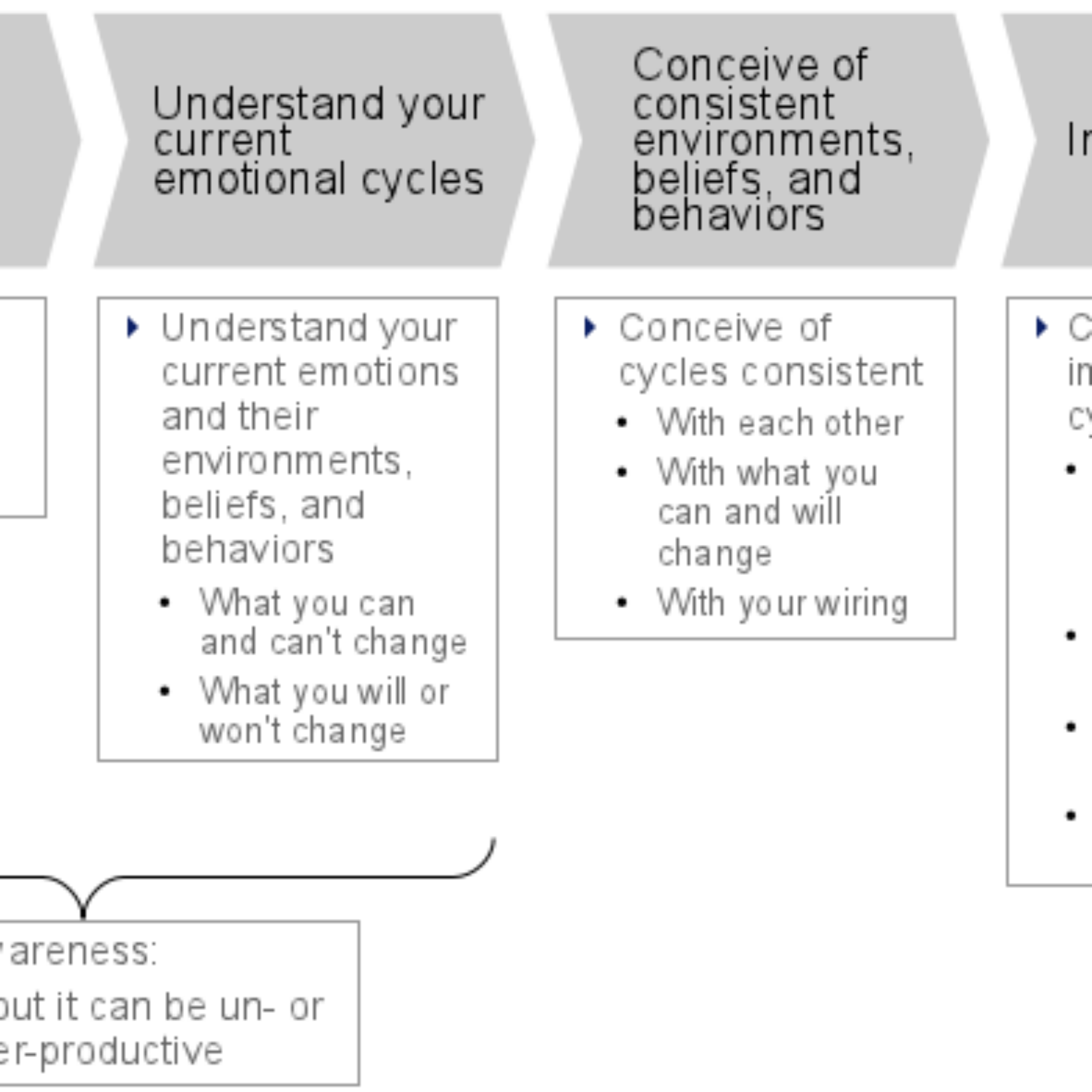
EDIT: I modified how I present the Method slightly. Please see the new version of this page and the updated series on implementing the Method. We've now covered the examples and preparation stages of how to implement the Method. Here is a diagram summarizing these steps (click it for full size) Preparation Know your emotional system Understand your current emotional cycles Awareness Conceive of consistent environments, beliefs, and behaviors Implement them Next: the stages of a transformation

0 Comments

Non-Method method 4: positive thinking

This post covers the fourth of several non-Method methods, generally expanding on non-Method method 3, "The Secret" or "Law of Attraction." People often, somewhere in the middle of presenting the Method for the first time, for example, ask if the Method is not just positive thinking. Likewise, I hear non-Americans say things like "What is it with you Americans and always wanting to feel happy all the time? Everything in life is not about happiness." I agree with the sentiment. I don't promote trying to feel happy all the time, "positive thinking," affirmations, or the like. They feel like putting lipstick on a pig. I promote you being you, being more aware of yourself and your emotions, and developing skills to act on that knowledge…

0 Comments

Non-Method method 3: “The Secret” or “Law of Attraction”

This post covers the third of several non-Method methods. People often try to improve their lives by changing only their beliefs. Typical examples of changing beliefs include believing money, friends, or health will come your way. Since the book and movie "The Secret" so popularly propagated this strategy a few years ago, I call this strategy "The Secret" or "Law of Attraction." Before delving into it, I'll point out that of all the non-Method methods I discuss, I believe changing your beliefs has the best chances of long-term success. Looking at the Model, changing your beliefs can influence how you perceive your environment, which can change your motivations, which can change your behavior, which can change your environment. Acting on no other place in the…

0 Comments

End of content

No more pages to load