Solving Problems I: The Dandelion Versus The Burning Building

Many people have a counterproductive yet common model for solving their problems. If you use it, you're holding yourself back from a better life. There's an alternative, however, which I'll write about below too. The Dandelion Model I call it the "dandelion model" because it's based on the idea that to get rid of a dandelion, you have to get to its roots. If you don't, it will grow back. The dandelion model says that to handle a problem in your life, you have to understand the root of the problem. If you don't, even if you think you've solved it, it will return and you'll have to deal with it all over again. A consequence of the model is that you should understand a…

0 Comments

More belief-changing exercises

Continuing the theme on flexibility in your beliefs giving you freedom, contributing to your intelligence, and attracting people, I'll continue about ways to increase that flexibility. Yesterday covered using a prevalent ad campaign to help develop non-judgmental acceptance of other people's beliefs and changing your own. By the way, by accepting other people's beliefs, I don't mean necessarily agreeing with them, just accepting that they have them and understanding them. The day before used changing your physical perspective to change your mental perspective. Today I'll give a couple cases where you routinely change your beliefs 180 degrees in a matter of seconds. The more you recognize you already change your beliefs to such a wide degree without thinking about it consciously, the more you'll be…

0 Comments

The CEO carries the least

Important people do things differently than unimportant people -- that is, behavior correlates with importance. If you want people to consider you more important -- to trust and defer to you -- you should pick up on how behavior correlates with importance. And with unimportance if you want to avoid being lumped in with unimportant people. The more important you are, the less you carry. The following corporate examples are simplified to communicate easily, but see how they resonate with your experience. An engineer who is easily replaced often carries tons of stuff -- a big bag, sometimes so full he or she rolls it on wheels, pockets full, multiple cell phones sticking of the belt, etc. Everything is functional. A manager may have a…

0 Comments

Leadership and personal development and school

In my seminar yesterday I mentioned "plays well with others" may be one of the most valuable skills in adulthood for team-based activities. Yet we treat it as a joke for children, or at best a euphemism implying the student in question doesn't do well academically. Have you ever learned something amazing while developing yourself as a leader or person and wondered why leadership and personal development isn't taught in school? School taught me valuable things like math, science, history, and so on. It vaguely addressed things like physical fitness. What didn't school teach? When I lead seminars on self-awareness, emotional intelligence, personal development, leadership development, and such, we cover things like how to motivate yourself and others, how to raise awareness of your emotions…

0 Comments

Best solo workout I know

I've been loving the rowing machine I bought last fall, but I've been waiting to use it six months before posting about it to make sure its value endured a reasonable time. I'm going to write about my experience with it, but if anyone has other experiences, please let me know because I'm still new to it and would love to learn more. This is the one I bought (used, half price, on Craig's List). I normally don't endorse workouts or machines -- I've never bought one before -- but I am happy with this thing and the workout it gives. If your gym has one and you don't use it, give it a shot. Even if you do something else to keep in shape,…

0 Comments
Observations on Flow, part II: two improvements
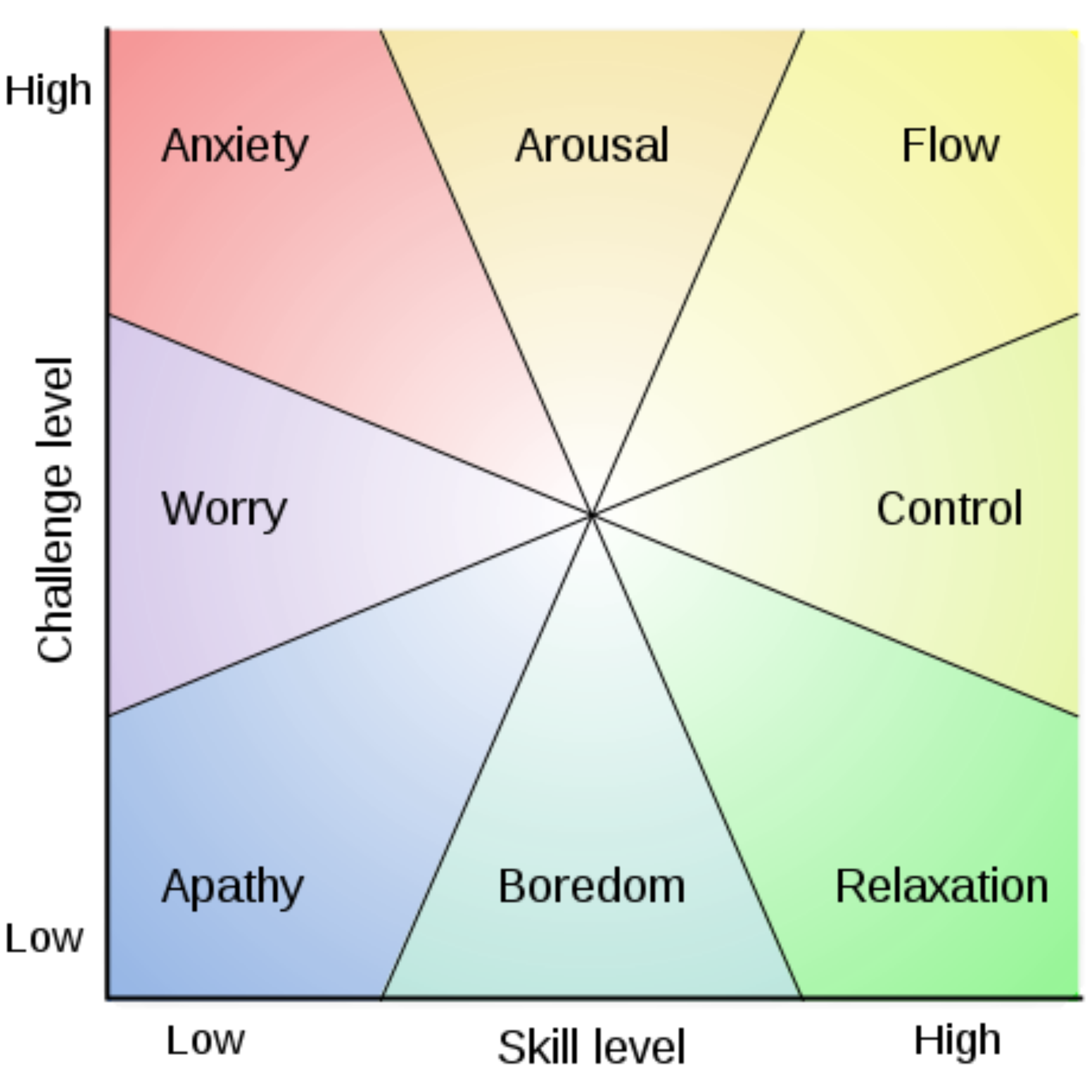
Emotional state resulting from level of challenge and skill

Observations on Flow, part II: two improvements

Following yesterday's primer on flow, here are two simple ideas to bring more flow. If you've read only Mihaly Csikszentmihalyi's book, they may be new. The Wikipedia page on flow but not Csikszentmihalyi's book covers the first. The second is new, as far as I know, though small. Recall the ten conditions of the flow state (from Wikipedia, citing Csikszentmihalyi articles): Clear goals (expectations and rules are discernible and goals are attainable and align appropriately with one's skill set and abilities). Moreover, the challenge level and skill level should both be high. Concentrating, a high degree of concentration on a limited field of attention (a person engaged in the activity will have the opportunity to focus and to delve deeply into it). A loss of…

0 Comments

Observations on Flow, part I

Do you remember the last time you felt like this musician? You are in an ecstatic state to such a point that you feel as if you almost don't exist. I have experienced this time and again. My hand seems devoid of myself, and I have nothing to do with what is happening. I just sit there watching it in a state of awe and wonderment. And [the music] just flows out of itself. We all know the feeling. We love it. It's one of the great states of being. It comes through many ways -- sports, hobbies, work, conversation, etc. A psychologist, Mihaly Csikszentmihalyi, studied that state and called it flow, now established as a something to be studied and understood. I figure most…

0 Comments

If you love it, do it even if you aren’t good at it

"I love to do X, but I'm not good at it" or "I think I'd love X, but I can't do it." Such common excuses not to do something. People just stop thinking or motivating themselves after saying that. Result? Even as they watch others have the times of their lives, they don't sing, they don't go to the gym, they don't dance, they don't get on stage, they don't ask for the promotion, they don't ask out the girl or the guy, they don't rock climb, ... They deprive themselves of things they would love. I can't think of anything you'd want to do less than avoid something you love. If you have a reason that makes sense -- like you're allergic to some…

0 Comments

Vipassana Meditation

A reader emailed me about mindfulness and self-awareness. I mentioned to him a meditation retreat I did a few years ago and found an old post I wrote about the experience, answering another reader's questions about the course. I did a ten day Vipassana course a few years ago. What it's about: It teaches you a meditation technique and gives you the time and space to practice it. It's based on buddhist beliefs. We meditated for 8-10 hours per day for ten days. That's basically it. You aren't supposed to read, write, gesture, etc, except to ask the instructor questions. They provide food and instruction on what to focus on. Was it hard: Yes, it was hard. The first couple days were painful while getting…

0 Comments

Are you being judgmental without realizing?, part IV

Following up my previous post in this thread, I forgot a few judgmental words and some tips on avoiding sounding judgmental. The judgmental words see frequent usage: Should Ought to Impressed A friend once said "there are very few shoulds in life." I found his observation helpful. I have found avoiding telling people what they should or shouldn't do helpful. When you say someone should do something they aren't doing, you're advising them based on your values. If they asked for your advice, you're probably helping them. If you haven't, you're probably judging. On to the tips. In the first exercise of the last post, I offered alternatives to judgmental language. Here is some clarification. Many (most?) of the time someone says something is right…

0 Comments

My next leadership seminar: June 4 and 5 at the New School (jointly with Columbia Business School)

(Some details TBD, but mark your calendars. The room is beautiful and centrally located. Please contact me with any questions. I'll update details as they are determined.)   LEADERSHIP THROUGH SELF-AWARENESS AND EMOTIONAL INTELLIGENCE At a time when businesses and business schools seek to learn from designers and design schools seek to prepare "students to be leaders in their professions and society", cross-pollination between communities over common interests is as valuable as ever. Personal leadership skills, self-awareness, and emotional intelligence have emerged as common and fundamental to both communities. In a weekend, learn how to develop these skills using recent advances in cognitive behavioral science, evolutionary psychology, and positive psychology in group including the communities of the world's premier business and design schools. Schedule: Day…

0 Comments

Alternatives to counterproductive emotions and behavior

Who likes feeling bad, burdened with emotions we not only don't like, but that, if we act on them, make our lives worse? Yet sometimes countering them with their opposites makes things worse still. For example, trying to calm down when you're angry, especially if someone else tells you to do it, often makes one angrier. Many emotions have complements that are more effective than opposites in dispelling them. I just wrote a series on taking responsibility as an alternative to guilt and blame. Curiosity dispels anger and brings about calmness more effectively than trying to be calm directly. Here are a series of complements to emotions and behavior that I find effective. Responsibility > guilt and blame Curiosity > anger Usefulness > accuracy (in…

0 Comments

Goodbye guilt and blame, VII

[This post is part of a series on overcoming guilt and blame for good. If you don't see a Table of Contents to the left, click here to view the series, where you'll get more value than reading just this post.] One last tip for the guilt and blame series, perhaps the most empowering. What do you do when others attempt to blame you or make you feel guilty? Most of us argue back, apologize, or attempt to explain our innocence. Often explaining works if the other person isn't too angry. Apologizing can work, but what if you didn't intend to hurt them? Then they may feel erroneously justified in blaming you. Arguing back rarely works and may reinforce their beliefs that you are to…

0 Comments

Goodbye guilt and blame, VI

[This post is part of a series on overcoming guilt and blame for good. If you don't see a Table of Contents to the left, click here to view the series, where you'll get more value than reading just this post.] This post summarizes and completes my thread on guilt and blame (edit: I added another post on the topic). The first few posts covered where guilt and blame come from. In my experience, the more we understand the emotions' origins, the more resilient we are to experiencing them at all or managing them if we do feel them. Basically, I proposed the model that everybody does their best all the time; nobody intends to hurt you. If things seem otherwise, it's only because you…

0 Comments

Are you being judgmental without realizing?, part III

The past two days covered the how we can be judgmental without meaning it -- first with clearly judgmental language, then with implicitly judgmental words. Today let's look at exercises to change. My normal first step for change is to start by building awareness. In this case, changing builds awareness so much and the exercises are so easy (they don't involve anyone else), I recommend just starting with the change. There are two exercises that you can do separately or together. They sound trivial, but if you're diligent, you'll find yourself catching subtle behavior all the time. You'll be amazed at the little things you say and how you start thinking differently. Exercise 1 The first exercise is to replace judgmental language. With what? Usually…

0 Comments

Are you being judgmental without realizing?, part II

Yesterday I wrote about how we often judge people implicitly without realizing -- often a repellent behavior -- and one class of implicitly judgmental language. The second class of implicitly judgmental language is when you make value judgments without realizing it. Here are a few examples: "People on the left say X. People on the right say Y. I'm not political about it, I'm practical and I look for a practical solution." "John is extreme. I prefer the middle path." "Sally works too hard. She needs to balance work and life." "If Jane were a real manager, she'd ..." "I know you like to do X, but in the real world we have problems that require ..." "The reality of the situation is that..." "The…

0 Comments

Are you being judgmental without realizing?, part I

Do you like being judged? Nobody likes when someone else is self-righteous, holier-than-thou, or high-and-mighty to them. Would you be shocked to find you're judging people -- thereby repelling them -- without realizing it? Would you want to do something about it? You probably avoid judgmental people. I'd bet it's one of the major reasons you avoid the people you do. (Clients often mention their parents here. Even recognizing their parents' best intents, their being judgmental is repellant.) You're probably comfortable with nonjudgmental people, or who actively practice nonjudgmental acceptance. Yet you probably communicate judgment to people without realizing it, mainly in words you choose without realizing it, as I'll describe below. The good news is you can do something about it, and what you…

0 Comments

Goodbye guilt and blame, V

[This post is part of a series on overcoming guilt and blame for good. If you don't see a Table of Contents to the left, click here to view the series, where you'll get more value than reading just this post.] My past three posts on guilt and blame have been about beliefs and models. Now let's look at behaviors to solidify and augment that change. Belief without behavior doesn't change your life and no one can tell anyway. Belief consistent with behavior changes your life. Today's suggestion is to be curious about causes of your feelings of guilt and blame and act on it. All too many people ask "Why would they do such a thing?" rhetorically, angrily, not looking for an answer. Yet…

0 Comments

Goodbye guilt and blame, IV

[This post is part of a series on overcoming guilt and blame for good. If you don't see a Table of Contents to the left, click here to view the series, where you'll get more value than reading just this post.] Two days ago I suggested that we all believe we don't try to hurt others and therefore should give others the same benefit of the doubt, even if we feel hurt by them. Yesterday I proposed a model that we all the the best we can, not just yourself. Today I'll combine those two ideas and suggest that if you were in someone else's position and had their same perspective and abilities, you would do the same they would. Being in another's position is…

0 Comments

Goodbye guilt and blame, III

[This post is part of a series on overcoming guilt and blame for good. If you don't see a Table of Contents to the left, click here to view the series, where you'll get more value than reading just this post.] Two days ago I wrote at a high level about getting rid of guilt and blame. Yesterday I wrote about understanding others' emotions of guilt and blame. Today, let's look at people's motivations from yet another perspective. I'll introduce a mental model for people's behavior. I'm not proposing the model is right or wrong. Models are always flawed -- the question is how useful it is. Try this model on for size: Everyone does the best he or she can at the time, given…

0 Comments

Goodbye guilt and blame, II

[This post is part of a series on overcoming guilt and blame for good. If you don't see a Table of Contents to the left, click here to view the series, where you'll get more value than reading just this post.] Yesterday I introduced the topic of getting rid of guilt and blame by understanding the emotions and replacing them with more productive ones. Today, let's look at them from a different perspective: understanding other people's motivations. The better you understand your own motivations, the better you can understand others', so first let's look at your motivations. Have you ever hurt someone intentionally -- that is, acted with your primary intent to make someone's life worse? I've never met someone who acted primarily to make…

0 Comments

Goodbye guilt and blame, I

[This post is part of a series on overcoming guilt and blame for good. If you don't see a Table of Contents to the left, click here to view the series, where you'll get more value than reading just this post.] Do you like feeling guilty or doing things that make you feel guilt? Do you find blaming people improves your life? Not likely. Would you prefer alternatives that don't make you feel bad and do improve your life? Of course. Feeling guilt and blaming others have become rare for me. Life is better without them: I feel better, have more rewarding relationships, have fewer conflicts, and resolve what conflicts I do have more quickly and easily than before. When you understand why you feel…

0 Comments

When you want to feel fake

Why would anyone want to feel fake? When do you want to feel fake? Developing leadership skills or other types of personal development aren't like learning typical how-to skills. When you develop leadership skills or develop personally, you change how everyone sees you and how you see everyone. You change as a person, in other words. You used to be person A and expect to become person B. As person A you knew what environments, beliefs, and behaviors brought you reward. You knew how to enjoy life. As the person B you will become you expect to know what environments, beliefs, and behaviors will bring you reward so you expect to know how to enjoy life. In between, you don't know how much of A…

1 Comment

Challenges of feedback and how to use it

How do you handle feedback? Do you take it well? Do you know how to use it? If not, you may be throwing away great opportunities to improve yourself and your life. Many people don't know how to take a compliment or having their weaknesses pointed out so they avoid feedback. As a coach in Columbia Business School's Program on Social Intelligence, I coach a lot of upcoming leaders who just received their first 360 feedback report. A few things I point out to many of them applies to all feedback, not just formal reports. Some things may sound obvious in the abstract, but in the moment, when you're reading people's opinions about you, it's easy to lose sight of the big picture and take…

0 Comments

End of content

No more pages to load