
This week I finished:
 The Machinery of Freedom, by David Friedman: My friend and podcast guest at Cato, Travis Fisher, recommended this book. I’ve come across many of the ideas before, even the radical replacement of every vestige of government, from readings like The Individualists and Coase’s paper The Problem of Social Cost, but not together, comprehensively.
I’m glad to see it all put together. It’s easy to dismiss views on privatizing everything as just seeking profit. A less thoughtful past me would have said it’s not possible and misguided. Why bother even thinking about it. It would just turn into 1984 or some version of one corporation running everything, or a small number of them, all for profit, removing anything not commodifiable, like art, nature, and love.
Such preconceptions would be like considering Friedman shortsighted or an idiot. He’s thought this stuff through. He addresses many objections and clarifies that his goals included freedom, liberty, and justice, as much for the poor as anyone.
I think he treats the formation of past and existing governments as more intentional than I would. My upcoming book describes my understanding of how they formed, not by intent to rule but by the need to protect stored resources. His view of the environment seems limited to climate change and he doesn’t distinguish between what I call Type 1 and Type 2 pollution and depletion. On the other hand, I appreciated his approach to figuring out if climate change net helps or hurts, calling to question others’ approaches. He points out that many people’s preconceptions lead them to conclusions independent of what they learn, a pattern I observe too.
What he wrote about education and unschooling his children, I found myself agreeing with and thinking, “That sounds like Sudbury,” and it was! He sent his kids to the school that so appealed to me that I brought two guests to my podcast who went there or whose kid did: Peter Gray and Sudbury Valley School graduate Nikole Beckwith.
He mostly kept to theory. That is, he wrote about systems he’d prefer for police, courts, government, defense, and so on in principle. He’d consider if reaching those systems from ours today seemed possible or how it might happen, but beyond sharing ideas, I didn’t read him as taking steps to make it happen. I don’t object to someone focusing on theory, but I contrast it with my work. I’m not just suggesting that a world without pollution or depletion is possible and desirable. I’m trying to make it happen, which means actual leading and hands-on practical experience.
I found the book thought-provoking and recommend it.
Recordings from Twilo by various DJs, mainly Sasha and John Digweed: These recording continue my dives into musicians after Led Zeppelin and Morton Feldman.
Most readers probably haven’t heard of Twilo. If you’ve heard of New York City dance clubs, you’d more likely know of Studio 54, Limelight, Tunnel, or Sound Factory. I’ll share a description I found of it so people know its reputation. Coincidentally, last night I saw Lee Burridge, a DJ who played Twilo. He was playing at an outdoor venue in Brooklyn. I met him decades ago and have become friends. We chatted before his set. He described from a world-famous DJ’s perspective what Twilo was: the culmination and crystallization of a style of music and focus on experience that Ibiza came close to but Twilo somehow nailed it. Sorry I didn’t record our conversation, but here’s the online description, which was from the notes to one of the videos below.
[EDIT: after posting, I found these article that describe it too:
- Experience Twilo: A Famed New York City Club Reopening After 25 Years in Forbes
- Inside Twilo’s legendary return to New York City nightlife in Fader
- Twilo Can Never Go Back to the Past, Paper
]
In the beating heart of Manhattan’s Chelsea neighborhood, a legend once pulsed with light, sound, and electricity—Club Twilo.
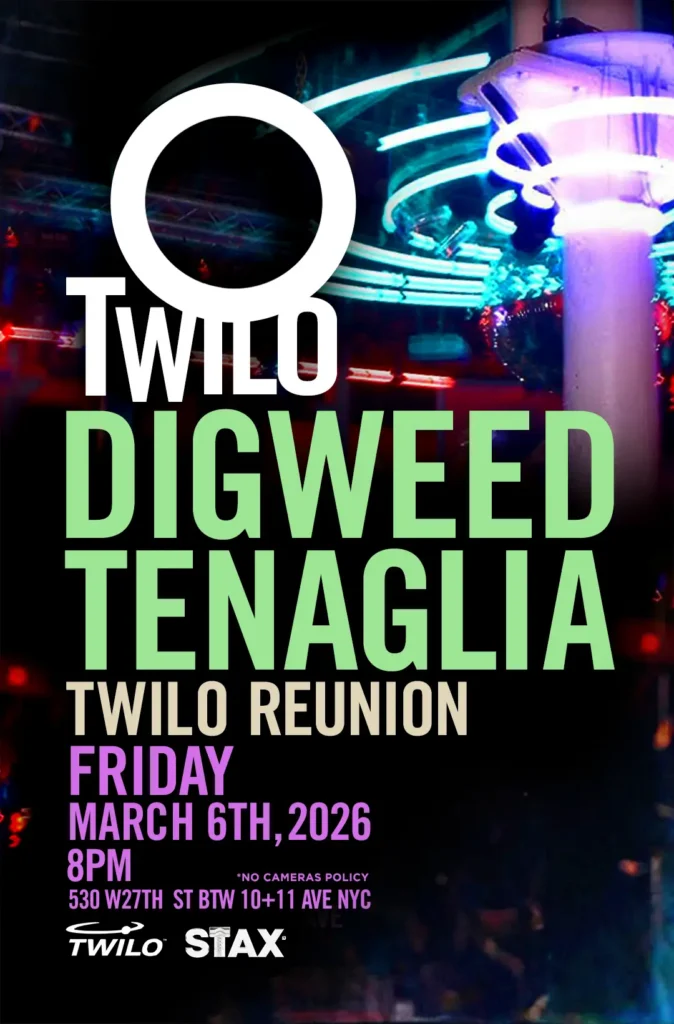
From 1995 to 2001, this cavernous haven at 530 West 27th Street redefined what nightlife could be, transforming weekends into euphoric journeys and ordinary nights into mythic memories. Set inside a former warehouse, Twilo wasn’t just a nightclub—it was a sensory temple.
Its ceilings soared and its walls pulsed with light, while a world-class Phazon sound system, designed by the iconic Steve Dash, enveloped dancers in waves of sonic perfection. Every beat echoed through the space like a heartbeat shared by thousands, binding strangers in a rhythm of unity and freedom. Twilo was a sanctuary for sound lovers, dreamers, and seekers of the sublime.
Its decks became the altar for the world’s most revered DJs—Sasha and John Digweed turned their monthly residency into legend; Paul van Dyk, Danny Tenaglia, Junior Vasquez, Carl Cox, and Richie Hawtin wove musical narratives that lingered long after dawn. Each set felt like a story, each night like a chapter in a sacred book of electronic music history.
What truly set Twilo apart was its crowd. Diverse, open, and electrified by possibility, the dance floor became a living canvas of self-expression. Glamorous goths, wide-eyed ravers, late-night artists, and curious souls moved together in a collective, blissful trance. There were no velvet ropes separating the elite from the ordinary—only music, and the shared surrender to it.
Twilo was not just a place—it was a feeling. A dream cloaked in basslines and strobes, a moment in time when New York City nightlife reached for the stars and found them spinning on a turntable. Though its lights have long faded, the spirit of Twilo lives on—in the echoes of legendary mixes, in the stories whispered between former clubbers, and in every club that dares to dream as boldly.
This set is a tribute to Sasha and Digweed’s epic monthly sessions at the club and the journey they would take lucky souls that dared to venture out into NYC’s vibrant after-hours underground….
Now that you know something of the venue, I’ll describe what it meant to me.
I first went to Twilo in February 1998. Professionally, I was finishing my PhD in physics while developing the company that would become Submedia. Playing ultimate Frisbee was a huge passion, though I had started running marathons.
Growing up I had been nerdy, not one of the popular kids. I didn’t want to be nerdy. Being good at math and science didn’t help. I also credit my father for not great role modeling on sports, interacting with women, socials skills, emotional skills, and some other things I value today. Maybe it was me, not him, but I didn’t have them.
In college, for example, I knew about dance clubs downtown and wanted to go to them but didn’t know how to dress or dance. When people I knew mentioned plans to go, I would try to express interest. They would tell me I wouldn’t like it. I didn’t have the presence to say something like, “I’m not trying to be this way. I don’t want to be this way. I want to be cool too but I don’t know how.” I never ended up going.
Then in my late twenties I got invited to Sasha and John Digweed at Twilo by, of all people, the little sister of a girlfriend I had just broken up with. How that connection happened, I don’t completely remember. I loved the experience. Her group of friends was welcoming. The club was like the description above. I loved the music And taking ecstasy for the first time helped. In one night, my life changed. I danced. I partied. The DJs typically played until Saturday morning. Leaving the club, we had to prepare ourselves for the bright morning light after entering the club somewhere around midnight.
I attended every appearance of Sasha and Digweed of their residency there, which was to play the last Friday of each month, until the club closed, in 2001.
A lot happened in that period. In a roughly one-year span, the following happened:
- I presented the data from my lab work to the main team for the satellite I was working on in Utrecht, Holland. Since it was approved, it became the main part of my thesis.
- I wrote my PhD thesis.
- My ultimate Frisbee team made it to nationals. We reached quarterfinals.
- I ran the New York City marathon the next month.
- I wrote and submitted the patent application for Submedia’s technology.
- I co-wrote Submedia’s business plan.
- We pitched and got our first funding, a $200,000 investment.
- We opened our first office.
- I bought and moved to my first home (where I still live), though stayed with a friend in the East Village temporarily with all my stuff, meaning I moved twice.
- I went out dancing each last-Friday of the month and most middle Fridays too.
- Back to that Utrecht trip, on the way back I stayed with a friend in Amsterdam, in part celebrating the relief of my research being approved. I mention this trip because I was also mugged at knifepoint, though talked my way out of it, partly from the confidence from advancing in my PhD work.
I can’t believe how many things in this period of this magnitude happened. Almost any one of them would qualify as a major life event that could have made for a great year. I mean, playing at Nationals meant lots of practice and tournaments to reach there. Same with running a marathon. In fairness, running it a month after Nationals, for which I trained for sprinting, not distance, led to it being my slowest marathon, at around 4:15.
Dancing at Twilo was transcendent. I wish I could convey the sense of community and fun. As my circle of friends there got tighter, going out evolved from “just” all night Friday to Saturday morning into keeping the party going all day Saturday and taking Sunday to recover. I never missed work. I often ran laps of Central Park Saturday or Sunday with an old friend. I didn’t tell him about the partying. Again, I can’t believe what I pulled off.
Listening to the music below partly recalled those times. Over a quarter-century ago and amid the lack of sleep, many of the memories faded. I don’t expect the music to resonate with others who weren’t into the scene. I expect it will sound repetitive, dated, and intended to be listened to on drugs. I don’t know, but for me it meant liberation from a life of nerdiness into a semblance of coolness or at least social acceptance and definitely enjoying myself on the dance floor.
More than anything else, it brought into my life one of the things I value most and until then didn’t have much of: fun.
Also, some people I partied with then remain some of my best friends today. I came to find these recordings because the space where Twilo operated was recently reopened for one night for a Twilo reunion, maybe more to come. I went and saw a bunch of old friends. We were all older, with all that comes with being in our 50s, or late 40s for many of them, but we remembered. This time I went with a woman I was dating, who hadn’t known about that world or part of my life, and we had a superlative time. I don’t think many people who know me today know about that part of my life, what it meant to me, and how it helped me grow. It wasn’t debauchery, though it included it. It was more maturation.
Related: