
This week I finished:
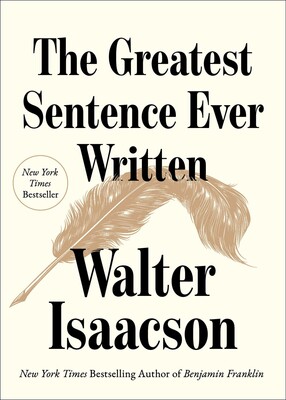 The Greatest Sentence Ever Written, by Walter Isaacson: Wow, the original content of this book is only 41 small pages, not counting empty pages at ends of chapter, with not many words per page, but packs a lot of meaning. It also includes important selections from Locke and Rousseau, as well as Jefferson’s first draft of the Declaration and the full signed Declaration.
Isaacson looks at the second sentence of the Declaration:
We hold these truths to be self-evident, that all men are created equal, that they are endowed by their Creator with certain unalienable Rights, that among these are Life, Liberty and the pursuit of Happiness.
and elaborates on it word or phrase by word or phrase. He considers the writing and editing process by Jefferson first; then a small committee including Benjamin Franklin, John Adams, two other editors, and at least for some time one of Jefferson’s slaves, older brother to Sally Hemings; then by the whole group who signed it. He describes influences from Locke, Hume, and Rousseau. He describes their thoughts on Native American, slaves, women, and foreigners.
I don’t know how he got it so brief. I’ve written and created enough to know that short means more work, not less.
One place where I see things differently, though I wouldn’t say we disagree. He describes the importance of Locke’s clause that you can’t take from nature unless you leave enough as good in common for others. He uses that point to describe the need to create commons and common goods, like libraries and common land, which he describes the founders doing, especially Franklin. He doesn’t clarify not taking from nature things that can’t possibly be left enough as good in common for others, particularly fossil fuels, uranium, and what causes extinctions.
I got the book free, signed by him, by attending the talk at NYU that I posted about where the president of the university violated its own rules in polluting and depleting. I asked him if their understanding of Locke’s provision meant they’d apply it to fossil fuels at that talk’s q&a, but he didn’t address the specifics of my question. He clarified that they all knew Locke intimately and said Jefferson’s marked-up copy is on display at Monticello or another museum, but described what I asked about as tragedy of the commons issues.
Using fossil fuels or uranium is not a tragedy of the commons issue, though, as I wrote in my post Polluting and depleting are not examples of the Tragedy of the Commons. Grass on a commons grows back. Animals can graze a commons and leave enough as good in common for others. Fossil fuels may have once seemed infinite. You could once pick up lumps of coal from the ground. Pools of oil existed on the surface of the earth that animals got caught in, like the La Brea tar pits. Today you need tens of millions of dollars and years of work by many people and companies to extract fossil fuels.
Today’s result is hardly enough as good in common compared to before. We’ve violated our Declaration’s and Constitution’s protection of property rights as the framers, ratifiers, and public understood. No wonder the civic breakdown we see.
Despite his missing that point, I recommend this book.
Slavery—Summary on a Map: Despite the number of documentary and informative videos I watch, I usually don’t post them on my Sunday “This week’s selected media” posts because however informative they are, they usually don’t change my views or lead to insight on the scale of books.
This video’s map-in-time format led me to see the growth and development of slavery in a new way. It seems to have missed some key parts. China’s slavery just pops up with an indication that it had been there long before but the video didn’t show it. It was light on India and showed nothing in the Americas before Columbus, among other things I noticed missing. I’m not an expert so I figure they missed more.
Still, I’ve heard and said many times that slavery existed since before recorded history and in many parts of the globe but couldn’t envision the scope and scale for different manifestations. This video helped. It put the Triangle Trade in context, as well as what happened in the colonies and US.