
This week I finished:
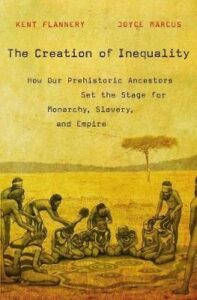 The Creation of Inequality: How Our Prehistoric Ancestors Set the Stage for Monarchy, Slavery, and Empire, by Kent Flannery and Joyce Marcus: Another huge book (648 pages) about anthropology and archaeology, this one from Harvard University Press. Others that I consider similar are Goliath’s Curse, The Dawn of Everything (if you read Dawn of Everything, watch the What Is Politics? videos on it), podcast guest Christopher Ryan‘s Civilized to Death, Guns Germs and Steel, and maybe podcast guest James Suzman‘s book Affluence Without Abundance.
This book is older, from 2012, but according to this review, by very prominent scholars:
Two of the world’s most distinguished anthropological archaeologists, Kent Flannery and Joyce Marcus take on one of the most fundamental archaeological questions of the twentieth century. They ask: how did human societies evolve from a universal stage of egalitarian foragers to a modern world where virtually everyone lives under the sway of affluent leaders, dictators, kings and presidents?
The book covers dozens, maybe hundreds, of societies to represent various stages of equality, past and present, from immediate-return egalitarian hunter-gatherers, to clans, chiefdoms, and so on to empires, That review states the comprehensiveness of this coverage well:
The number of cases that they discuss, the detail that they give each example and the global scope of the cases is simply astounding. Any anthropologist can only be in awe of the depth and extent of their knowledge.
I love how much they cover, but find that they fall short in two ways. First, they don’t adequately explain the sources of differences between societies’ cultures. Why does one create one cosmology or origin myth and another create another? The book seems to get cause and effect backward, or miss root causes. That is, it says that the cosmologies determine how they evolve, but it seems like they evolve based on material conditions, which forms their cosmology.
Second, they attribute more to their choices independent of material conditions than seem merited. The review seems to agree:
They also set aside the materialist causal factors of the 1970s such as population growth, food stress and environmental circumscription. They argue that the key to understanding cultural evolution rests on the unique social logic that lies at the core of every society. In all of their cases, they reveal this social logic and present it as a bulleted list of key points. They assert that the conscious manipulation of this logic creates change and leads to greater inequality and hierarchy in cultures. By the same token, they recognize that conscious human agents also seek to manipulate this logic to maintain egalitarian relationships.
One big conclusion I got from learning about so many societies and cultures was a commonality among all dominance hierarchies and another among all egalitarian groups. That is, though there is a huge range of properties of dominance hierarchies, a huge range of properties of egalitarian groups, and no clear divide between them, I see two broad types of cultures for most of human existence: egalitarian and dominance hierarchy, a division and clarity I see playing a big role in my upcoming book.
I mention “most of human existence” because I think a third type arose recently, about 250 years ago: democratic hierarchy.
Despite how much I learned, I disagree strongly with one of their final conclusions:
The evolutionary progression culminates, as always, in kingdoms (the word they prefer for states) and empires and like University of
Michigan materialists since the 1970s they archaeologically recognize these advance societies by the presence of a four tiered settlement hierarchy. They conclude by asserting that we can create an egalitarian world by putting foragers in charge of global society.
If we put foragers in charge of global society, they wouldn’t change global society. Global society would lead them to follow it. I wrote about how so-called indigenous people in Vancouver, when they regained control over their land, built high-rises in Might the Squamish nation pollute and deplete the most per capita in the world?.
The Wikipedia page Native American slave ownership documents plenty of Native Americans joining slave-owning culture.
As much as I value the anthropology, history, and archaeology of these big books, their solutions seem counterproductive and Leftist, therefore divisive, which prevents collective problem-solving. I think the authors had their proposed solutions in mind before understanding the problem and just propose what they had in mind first, not what solves the problem. Goliath’s Curse promotes standard progressive, New Deal-like proposals. Civilized to Death promotes taking psychedelics. The Dawn of Everything doesn’t seem to promote much specifically, but I read it as promoting anarchism.
I expect my new book to refer to these books for their anthropology, history, and archaeology, but not their solutions.
Quest for Fire, directed by Jean-Jacques Annaud: I sort of remember this movie coming out in my childhood but never saw it. I didn’t know what to expect, but it seemed to fit what I’m reading.
It shows near-humans and humans interacting 80,000 years ago. At first I started picking it apart for inaccuracies. They seemed too violent, not showing enough collaboration. Their anatomy seemed from an earlier time.
Then I thought: the movie is from nearly half a century ago. Tons of discoveries have happened since. Maybe I shouldn’t judge.
Then I started looking at it not to represent history or a scientific understanding of the past, but I tried to look at living in the past from their perspective. Instead of asking how people then lived, I asked what it would feel like to live then.
Then it got intriguing. For example, we know that homo sapiens interacted with neanderthals. Today we get angry when people treat each other as different races because the science shows that whatever differences we see in skin color, hair color, etc, no humans differ enough from any other to qualify as different races. But homo sapiens and neanderthals, as well as many other genuses of homo, actually were different races. They were different genuses within one species and could produce offspring.
It hit me that racism likely didn’t begin as a pseudoscience. People saw clear correlations between differences in appearance, behavior, and possibly other things people thought they could measure, like intelligence. For all they knew, it could be plausible that groups differed enough to be different races. They could test that hypothesis.
What makes racism a pseudoscience is sticking with the hypothesis after evidence contradicted it.
But there were times when our ancestors did face others who were different races tens of thousands of years ago. Today, many groups see other groups as different enough to qualify as different races despite the evidence, and not just white supremacists. Many peoples have names that call themselves first, best, original, etc and everyone else not as good.
Racism has a few problems. One is thinking differences are greater than they are. Another is thinking the differences add up to one group being better than another. Another is coercion, violence, and domination based on those thoughts. Those three attributes are distinct.
 The Underground Railroad Tour of the Merchant’s House Museum: Village Preservation is a local organization I support that maintains my neighborhood’s character, among other things. A great treasure is the Merchant House, now a museum. It is the oldest surviving home, both the interior and exterior maintained.
It was built in 1831. Much of the furniture is original. It’s a look back in time of this nation’s history. It’s not just maintained, but scrupulously and lovingly so.
That status alone would make it a worthy visit. In the past decade, they found that it contains secret passageways and hiding spaces because the man who had it built designed it to help escaping once-slaves on the Underground Railroad to Canada. You can see where people hid and how they arrived. The tour guide was knowledgeable, friendly, and answered everyone’s questions. I’ve lived in this city since the 1980s and this visit was a highlight.
Here is the tour description:
Join us for this special tour of the Merchant’s House Museum.
This tour will focus on the construction and history of the house through the lens of it original builder Joseph Brewster, a staunch abolitionist, who designed the house with a hidden passageway, making it one of Manhattan’s only documented sites of the Underground Railroad. We will also discover what daily life was really like for a wealthy merchant-class family and their Irish servants in the mid-19th century, when New York City evolved from a seaport to a thriving metropolis. The tour covers four floors of period rooms of this landmark late-Federal and Greek revival style rowhouse
For more, here are the Wikipedia page and the museum’s site.
 Raging Bull, starring Robert De Niro directed by Martin Scorcese: I love how the library makes literature and dvds available. I saw this dvd at the checkout when returning Terminator 2. Having just watched Taxi Driver with Scorcese and De Niro and Rocky a boxing movie, how could I resist?
I’d seen this movie before, but had remembered it as a sports movie about a fighter. It’s more an exploration into a troubled man. While I acknowledge the great acting and directing, I didn’t like it.
I struggled because I didn’t find the character compelling or believable, but I know it’s based on a memoir by the actual boxer.
What I didn’t like was that it just showed him doing things that hurt himself and others but revealed nothing of why. I think a lot of people conclude he’s just that way or masculinity is toxic, but few people act that way. Obviously some do, but nothing explains why. He’s jealous and violent well out of statistical norms. If he’s just different, the movie isn’t interesting because he isn’t like you and me. If he’s just like you and me underneath and something drove him to act so differently, what?
He just keeps acting crazy with no explanation. What’s the point unless there’s some shared humanity to connect with?
If he’s just an inhuman monster, I lose interest. If he’s just like us, why is he acting the way he does?
The movie doesn’t answer these questions. It just shows dramatic interactions with compelling direction and editing.