Education


Op/Ed Fridays: Obesity and wonder drugs

The New Yorker this week published an article titled "Diet Drugs Work: Why Won't Doctors Prescribe Them?" I responded (on Hacker News, where you can see discussion on it) More relevant questions: Why don't we stop subsidizing corn so much? Why don't we teach effective nutrition and cooking in school? Why don't we teach effective exercise, sports, and fitness in schools? If we can ban alcohol and tobacco sales to children, why not things like added sugar, hydrogenated oils, corn syrup, etc? If we can ban alcohol and tobacco advertising to children, why not products with added sugar, hydrogenated oils, corn syrup, etc? Why don't we limit advertising on fast and junk "food"? Why don't we provide healthy lunches to school children instead of using…

2 Comments

Coaching highlights from coaching Columbia Business School students: Common coaching topics

[This post is part of a series on Coaching Highlights from coaching Columbia Business School students. If you don't see a Table of Contents to the left, click here to view the series, where you'll get more value than reading just this post.] One of the challenges and joys of coaching is that each client is unique. Even similar issues show up in unique ways with each person. The job never gets boring. Still, you see trends, especially among students taking similar courses at similar stages in their lives, often with similar goals. So what do MBA candidates at a top business school tend to want to work on? First, I'll mention that there is no overwhelming majority. Even the most common areas of focus…

0 Comments

Coaching highlights from coaching Columbia Business School students: Manage Expectations

[This post is part of a series on Coaching Highlights from coaching Columbia Business School students. If you don't see a Table of Contents to the left, click here to view the series, where you'll get more value than reading just this post.] Do you ever have an amazing epiphany about a major change you will make in your life, or how you'll do it, and get excited about how awesome doing it will be? This happens a lot in coaching sessions, especially after their first 360-degree review and coaching session. They often have major realizations and make fantastic, far-reaching plans destined for enduring success. All that is awesome, but this realization came in the privacy of a distraction-free room, working with someone working to…

0 Comments

Coaching highlights from coaching Columbia Business School students: Use your teammates

[This post is part of a series on Coaching Highlights from coaching Columbia Business School students. If you don't see a Table of Contents to the left, click here to view the series, where you'll get more value than reading just this post.] Making change stick means practice and accountability. How do you find people to hold you accountable? The following advice works for everyone, not just business school students. I'll describe how it applies to your life after writing how I tell the students I do lightning coaching with. Leadership requires other people. Every time you work or do anything in a team is an opportunity to lead. For this reason Business School students have to work most of their first year in school-assigned…

0 Comments

Coaching highlights from coaching Columbia Business School students: Practice!

[This post is part of a series on Coaching Highlights from coaching Columbia Business School students. If you don't see a Table of Contents to the left, click here to view the series, where you'll get more value than reading just this post.] I mean practice in two senses here. The first is the more relevant one for the one-hour lightning coaching sessions -- as a coach, I try to find ways for my client to practice their new behavior during the session, all the more important in a lightning session when they won't have access to their coach again. Improvement in leadership means nothing if it only exists in your head and doesn't translate to new behavior. Leadership is fundamentally social, meaning it requires…

0 Comments

Coaching highlights from coaching Columbia Business School students: School protects you so you can try new things

[This post is part of a series on Coaching Highlights from coaching Columbia Business School students. If you don't see a Table of Contents to the left, click here to view the series, where you'll get more value than reading just this post.] Business schools and other vocational schools offer students something supremely valuable not everyone realizes. Everyone knows they give you knowledge, credibility, and a network. They also offer you protection from the outside world. You can do risky things in school that you might not do when your pay check or job depends on not messing up. In school, especially business school, you can risk failing in ways that might lose you your job, promotion, bonus, or other things of value. Many schools…

0 Comments

Get leadership coaching like an Ivy League business school

Do you want to improve your leadership skills? Does this describe you: Highly motivated?Limited time?Want to know top-5 business school culture (or just learn to lead like someone from one)? This series will help you. Columbia Business School provides a service to its students helpful to anyone -- it has each MBA candidate take a 360-degree report and gives each a coach to help interpret the results and create a plan to act on it. I took the program and have been coaching Columbia MBA students through this program for years. Since we have only one hour but the students are so highly motivated, it's like super-effective lightning coaching. Many students have gotten enough value to tell me things like "this is why I chose…

0 Comments

Get leadership coaching like an Ivy League business school

I compiled a series of posts on experiences and lessons from coaching MBA students at Columbia Business School. Click here to read the series. Meanwhile, here's the introductory text: Do you want to improve your leadership skills? Does this describe you: Highly motivated? Limited time? Want to know top-5 business school culture (or just learn to lead like someone from one)? This series will help you. Columbia Business School provides a service to its students helpful to anyone — it has each MBA candidate take a 360-degree report and gives each a coach to help interpret the results and create a plan to act on it. I took the program and have been coaching Columbia MBA students through this program for years. Since we have…

0 Comments

If you’re trying to solve a complex problem, write it down

I coached a client recently who felt like she had a lot on her plate. She was trying to figure out plans for the next year, where many decisions depended on each other and she couldn't figure out which to do first. When she explained them to me it seemed clear the order in which she had to do each, but she was swimming in so much information she couldn't figure out where to start. For that matter, each time I suggested the order that made sense to me, she kept talking about all these details of each, how long each would take, the resources each needed, and all these other things she didn't need to think about now, but was, which was holding her…

0 Comments

Communication skills exercises for business and life

Without effective communication skills and comfort practicing them, whatever awesomeness you have inside you is invisible to the world. You might as well not have it. Other people will nearly always be attracted to people with better social skills. With effective communication skills and comfort practicing them, you can showcase your inner awesomeness to your heart's content. You can attract other people, whether for business, personal, or whatever reason you want. People want to do business with you and invite you to join them because they want people around who communicate well. Anybody can improve their communication skills, including you People today sometimes think I was naturally born socially adept. I'm flattered, but I remember years of sitting in the library on Friday nights, not…

0 Comments

Method acting, leadership, and improving your life, from James Lipton

I've written before about the television show Inside the Actors Studio and how much the young field of leadership training could stand to learn from the longstanding field of acting training. Below is an interview of the host of Inside the Actors Studio, James Lipton, describing the transformation acting training went through with Constantine Stanislavsky. Leadership training stands to benefit from similar changes, and that field inspires me to help those changes. As he described it, about a century ago acting replaced impressing others with expressing yourself, the goal of perfection with authenticity, self-reference and self-reverence with a system of exercises, focus on the external with focus on the internal, making yourself up with seeking truth, well-rehearsed lines with believing what you're saying. Everybody on…

0 Comments
How to lower executive pay
Increasing supply lowers price

How to lower executive pay

The New Yorker this week has yet another article on executive pay, how high it is, how it continues to grow, and how attempts to slow it aren't working. Everybody knows the situation. We've read tons of such articles. We know executive pay is high enough that it isn't getting what shareholders are paying for, but no one can stop its growth. Want to lower executive pay? Basic economics and negotiation tell us all we need to know. Basic economics: supply and demand A CEO's wages have a price in a market. What sets prices in a market? Unless you believe the CEOs are fixing prices or the market isn't competitive, supply and demand set the price. If you want to lower prices either decrease…

0 Comments

Choosing idealism in the face of contrary evidence of what works is a recipe for disaster

I posted the following in response to a bunch of articles I've read about a report co-authored by over a dozen science-related organizations describing how reducing funding for science has led to research and the benefits it brings to society leaving the U.S. --- The writing on the wall became apparent to me with the 1993 cancellation of the Superconducting Super Collider, when I was getting my PhD in physics. I didn't know the numbers for a cost-benefit analysis, but I couldn't then nor can I now see cancellation as helpful to the U.S. The U.S. would have stayed way ahead of the rest of the world in particle physics and all the accompanying jobs, discoveries, and innovation. Instead we look to the rest of…

0 Comments

An example of effective, understated leadership

I wanted to share an example of effective leadership I once saw. When I was in graduate school, Columbia was considering its policy on allowing the military to have programs like ROTC on campus or not and held hearings anyone in the university could attend to speak their mind. I attended one. The President of the university, Lee Bolinger, ran the event. I had strong feelings about risking militarizing the campus and entered expecting to feel critical of the school and to leave outraged. Instead, I left impressed with Bollinger. I could only conceive then of leadership in the form of command and control so I expected he would try to "lead" participants to an intended outcome. Instead, he acted mostly to moderate. More than anything…

0 Comments

Reminder: See my leadership seminar this weekend!

Brought to you by the Distinguished Leaders committee of the Columbia Business School Alumni Club of New York (copying the following announcement from that site): Leadership Through Self-Awareness and Emotional Intelligence In a weekend, learn how to develop your personal leadership skills, self-awareness, and emotional intelligence through the latest advances in cognitive behavioral science, evolutionary psychology, and positive psychology. While business schools and corporations are increasingly focusing on personal leadership, self-awareness, and emotional intelligence as foundations for leading others, many MBAs never had the opportunity to take a formal course in personal leadership. Joshua Spodek, MBA, PhD, has developed a two-day weekend workshop in just this area. His experiential course combines advances in cognitive behavioral science, evolutionary psychology, and positive psychology with successful business leadership…

1 Comment

Taking on the New Yorker on the English Major

Last month the New Yorker wrote a defense of learning and teaching English. It says English Departments are under attack. What kind of fool would take on the magazine many call the best in English about English? I guess I'm that kind of fool. I wrote the following in the comments.  "We need the humanities not because they will produce shrewder entrepreneurs or kinder C.E.O.s but because ... they help us enjoy life more and endure it better. The reason we need the humanities is because we're human. That's enough." This article's length with minimal substance made me feel like someone who likes reading and writing wanted to show others who like reading and writing how good he was at reading and writing. I hoped…

0 Comments

One of the most important lessons I learned in business school didn’t come from a teacher and it applies everywhere in life

I wrote before about "Business school's first major lesson: how to resolve ethical dilemmas." Today I'll talk about another important lesson I learned in business school, also within the first couple weeks, also applying in many places in life I would not have expected from a vocational school. Context First I have to note my mindset before starting business school. I considered the most relevant parts of my life that I'd co-founded a company and I knew more math than probably anyone in the school. I thought business school would be a fun experience filling in a few gaps of how to make spreadsheets and learning some networking skills. What happened One of the major cores of business school is knowing how a business runs…

0 Comments

Leadership problems today and a call to action

[I alluded to this topic before. I still have to write it up formally and edit it more than a daily post allows. I hope it gets the main ideas across. Please contact me if it interests you.] You only have to read the news to see the problems Do I have to convince anyone that we have many people in leadership positions who lead ineffectively? You only have to read the headlines. As I'm writing these words the New York Times' top headline is about a spy scandal in which the top person at the NSA lied to Congress, which is abdicating its Constitutional checks on the President, who is doing the opposite of what he promised the country during his campaign on this…

0 Comments

See me on Leadership through Emotional Intelligence and Self-Awareness

Brought to you by the Distinguished Leaders committee of the Columbia Business School Alumni Club of New York (copying the following announcement from that site): Leadership Through Self-Awareness and Emotional Intelligence In a weekend, learn how to develop your personal leadership skills, self-awareness, and emotional intelligence through the latest advances in cognitive behavioral science, evolutionary psychology, and positive psychology. While business schools and corporations are increasingly focusing on personal leadership, self-awareness, and emotional intelligence as foundations for leading others, many MBAs never had the opportunity to take a formal course in personal leadership. Joshua Spodek, MBA, PhD, has developed a two-day weekend workshop in just this area. His experiential course combines advances in cognitive behavioral science, evolutionary psychology, and positive psychology with successful business leadership…

0 Comments

How failure creates success

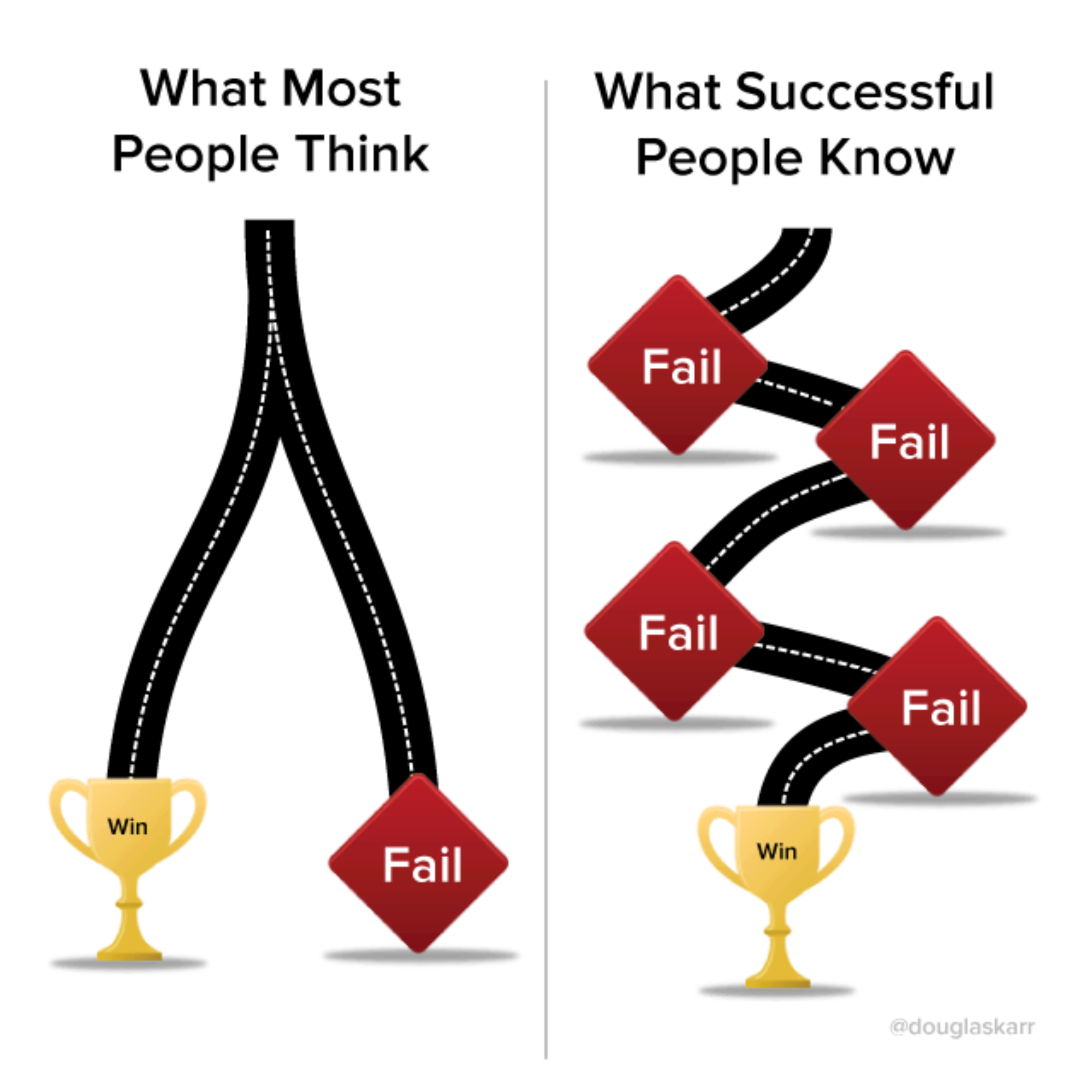
Normally I don't like just posting someone else's work, but I saw this image the other day and found the model it suggests so simple and useful I couldn't help posting it. I've found and often say the people who succeed use the word "failure" like other people do, but it doesn't mean the same thing to them. It means something positive. Not even a necessary evil, but part of a learning process... a desirable outcome.

0 Comments

Columbia’s 2013 Commencement

Last month Columbia invited me to walk in its big commencement for the twentieth anniversary of graduating college there. I don't often get to dress in my medieval-looking PhD cap and gown, so I accepted. If you've never seen a Columbia commencement, it's a great, stately affair with tens of thousands of graduating students and their families, all the more so when you realize how few spaces like its campus New York City has. Naturally they had me sit beside the President of the University, all of us on stage looking like a bunch of popes in our prestigious caps and gowns, discussing important matters of science and philosophy. And why have a web page if not to share the grand experience )and my cool…

0 Comments

“Needs as understood”: How to start sales presentations — and conversations where you want to influence someone

I've written before about a student group from Columbia Business School I still contribute to long after graduation called InSITE that promotes entrepreneurship and connects students at several schools including Columbia, NYU, Harvard, and Stanford to entrepreneurs. A recent post on InSITE's blog by Lukasz Strozek, Stanford Business School 2014, described a challenge common in product development and entrepreneurship. It reminded me of a great solution I'll write below applicable to many situations where you want to influence people. The challenge Read that post for the details, but broadly it points out We care about products we create We want to get feedback from customers and potential customers Pitching the product gets closed answers, not broad understanding of a customer's needs or interests So the…

0 Comments

Video on creativity

I've written a lot on creativity and when I do I often mention the professor whose class on creativity I took, Jacob Goldenberg. He recently gave an online talk with Columbia Business School about his research. If you like creativity, learning some unexpected properties of it, and improving your creativity, I recommend it. It's not as polished as a TED talk, but as informative. Here it is: video platformvideo managementvideo solutionsvideo player Here is the link to the original page. Enjoy!

0 Comments

A model for balancing pushing myself with enjoying life

[This post is part of a series on "Mental models and beliefs: an exercise to identify yours." If you don't see a Table of Contents to the left, click here to view the series, where you'll get more value than reading just this post.] Do you work hard to improve your life -- studying hard, working long hours, being patient with a significant other, etc? If you're always pushing, when do you get to enjoy life? But if you're always enjoying, do you ever improve? Do you wonder if you're slacking too much or working too hard? Do you wonder how to balance both aspects of your life? Today's model shows how I think about how I balance pushing, trying, and improving with enjoying, relaxing…

0 Comments

A model for strategy

[This post is part of a series on "Mental models and beliefs: an exercise to identify yours." If you don't see a Table of Contents to the left, click here to view the series, where you'll get more value than reading just this post.] Strategy is a fundamental study for many fields, including leadership, military, games, and plenty areas of business. If you're reading this page, you don't need motivation to understand its value. I've read a bunch on strategy, taken classes, written a book on strategy and North Korea, and lived through my share of strategic situations. I play chess decently too. Of all the resources I know, one stands above, the book Competition Demystified: A Radically Simplified Approach to Business Strategy, by Bruce…

0 Comments

End of content

No more pages to load