Podcast


688: Maya K. van Rossum, part 1: Green Amendments for the Environment (State and Federal)

Some context leading to my conversation with Maya: When I first thought of a constitutional amendment to protect us from pollution, I thought the idea was crazy, but I couldn't stop thinking about it. The more I did, the more it made sense. Since learning about the Thirteenth Amendment prompted me to think of it, I first spoke to previous guest James Oakes about it. Since it involved constitutional law, I spoke to previous guest (and Nobel Prize holder) Seth Shelden, who put me in touch with his constitutional law professor and previous guest Michael Herz. Besides my conversations with them one-on-one, I also spoke with Michael and Jim together. I recommend listening and watching those conversations for context. My conversation with Maya: Then I…

0 Comments

687: Should We Amend the Constitution for the Environment?: A constitutional scholar (Michael Herz) and American abolition historian (James Oakes)

See the video for this episode here. I speak about the concept of a constitutional amendment on the environment with former guests on this podcast: Michael Herz: Constitutional scholar and former lawyer for the Environmental Defense Fund (Michael's podcast episodes) James Oakes: US historian, focusing on the Revolutionary War to Reconstruction (James's podcast episodes) We approach the concept from many perspectives, especially comparing it with the Thirteenth Amendment. This is my first conversation with two experts on a topic I'm just starting to learn about based on very detailed fields, including law, history, abolitionism, and politics. I have to start somewhere. We recorded this conversation months ago and I've learned tremendously since. The United States Constitution

0 Comments

686: Gautam Mukunda, part 1.5: Can Humans Thrive Without Modern Technology?

In the first part of our conversation, we start by reviewing Gautam's commitment to sailing, which seemed and still seems a good idea to him. but maybe too much for now. We revisit what motivated him and come up with a new commitment. The second part gets more exciting. Gautam expresses that we need to develop technology to help people who aren't living as well as us so we can help them. (I may not have summarized accurately; listen to his recorded words for his precise meaning.) This view is like waving a red flag to me since I used to think things like that but now see otherwise. We engage in different views on technology, progress, how humans used to live versus how we…

0 Comments

685: Chris Bailey, part 3: Dropping the latest iPhone for a flip phone

Chris returns to share his experience with the Spodek Method. He did something different than he committed to: he stopped using his smart phone---the latest Apple iPhone---in favor of a simple flip phone hearkening almost back to the nineties. What happens? Does his life fall apart? Does he find more calmness? Should you simplify your life by avoiding the call for the latest and greatest? He shares his experience and you can find out (I'm not sure he did it for this podcast, in that I think he was planning to do it anyway. Still, he shares his experience).

0 Comments

684, Simon Michaux: Do Governments Understand Energy? How Unprepared Are We?

Simon is a mining engineer who both researches the minerals and mining necessary if we were to try powering our culture with various sources. His work has brought him to work with government teams, especially economists and politicians around the world. He shares in our conversation that we will transition to a low-energy future, what it will take, and how little we have tried to figure out if we can do it. It's worrying to hear how poorly we understand the problem, how unprepared we are now, and how poorly we are preparing ourselves. What he shares is challenging to process considering the risk for catastrophe coming up. Situations like he describes is why I act so much. If you think scientists, engineers, politicians, or…

0 Comments

683: Alan Ereira, part 3: More about Kogi life and culture, contrasting with ours

The more I move toward living sustainably, the more I learn about cultures that haven't become as polluting, depleting, addicted, and imperialist as ours. I grew up thinking they were stuck in the Stone Age, but they aren't. Conversations with Alan help me learn about the Kogi, with whom he's lived in the mountains of Colombia and made two documentaries with the BBC. The relevant differences is that compared to us, they live sustainably, free, and in abundance. Alan shares more in our third conversation about what he's learned from them, including how they see us, which is sobering.

0 Comments

682: Gautam Mukunda, part 1: Teaching Passion for Leadership at Harvard

I've made it no secret that sustainability lacks leadership and leaders. If you want to help on sustainability, I suggest that the most valuable thing you can do is learn to lead. If you know how to lead, improve it. Nothing can change as much as leading cultural change. Gautam's passion is to learn how leadership works, how to teach it, learning more about it, writing about it, the military, most relevant to our conversation: conveying what he knows and that passion. The upshot: someone who knows as much as anyone about leadership, what works, what doesn't, learning more about it, how to teach it, and passionate to convey what he's learned. He also knows and has befriended some of today's most effective leaders, whom…

0 Comments

681: Albert Garcia-Romeu, part 1: Psychedelic Reseach and Time in Nature

Regular listeners know I've been asking people what the environment means to them as part of the Spodek Method. Many people respond with touching answers that I would call something close to life-altering. Maybe more like life-guiding, life-enhancing, or giving meaning and purpose. I've heard of increasing research into psychedelics recently. Reading reports of people who took psylocibin in clinical settings with guides for the experience, I was struck by how similar their effects to those of quintessential moments in the environment. Both talked about oneness, awe, humility, understanding, feeling understood, connectedness, and similar things, though, of course, each experience was unique. Many said that the effects of their experiences lasted sometimes years, potentially permanently. Many could stop addictions overnight without relapsing. Some improved relationships…

0 Comments

680: Wolfgang Lutz: A Primer in Demographics and Global Population Projections

Wolfgang Lutz is one of the world's experts in projecting global population levels and demography. I contacted him to help understand the differences between projections based on demography like his and the United Nations' versus systemic ones like in Limits to Growth. He gave a comprehensive overview of who projects and how, at least as much as can be covered in under an hour. Some highlights: Who projects based on demography: the UN, International Institute for Applied Systems Analysis (IIASA), and the Wittgenstein Center, among others. He described what and how demographers project: Assumptions, methods, variables of age, sex, education, migration, fertility rate, mortality rate. He consistently repeated the importance of education. On Limits to Growth, he pointed out that systems analyses include feedback mechanisms,…

0 Comments

679: Alan Ereira, part 2: The world through Kogis’ eyes

I was very curious to learn more about the Kogi and Alan's interactions with them. Alan is deeply involved with their joint project to learn to restore nature as they have shown they can. "Restoring nature" doesn't do justice for what they are doing. They are also sharing different ways of seeing and interacting with the world, which, as I understand from Alan, is not how they see the world. Alan starts with a couple descriptions of how the Kogis view things differently than Europeans, including in ways we wouldn't have suspected were different. How does a medieval castle look to someone who has never seen a stone building? If they see something a typical European sees daily, how much else are we misunderstanding? What…

0 Comments

678: My talk to the International Society of Sustainability Professionals

The International Society of Sustainability Professionals invited me to speak to their New York Chapter. Here is that recording. We "whooshed" out the participants' words, so it's just my speaking. Their mission is "ISSP empowers professionals to advance sustainability in organizations and communities around the globe." I described my work, my path to get here, intrinsic versus extrinsic motivation, how you can't lead others to live by values you live the opposite, and concepts relevant to sustainability leadership. I didn't take them to task as much as I could have for living unsustainably, undermining their credibility and trust.

0 Comments

677: Roz Savage, part 1: It’s Doable and You Can Do It. One Oar Stroke at a Time

Roz could have stopped at rowing solo across oceans to world records, awards, and national honors. She didn't. She had done those things for a purpose: helping make our world more livable, less polluted. They gave her greater skills to appreciate her purpose and implement it better. As with most people, the challenges looked insurmountable to her. But unlike most people, she had once made a list to row across an ocean and, finding no impossible steps, she did it. Over and over. It's easy to look at her today and figure, "of course she could do it. She's an ocean rower. She was born that way," or something like that. But before she did it, she was a disgruntled employee and spouse looking for…

0 Comments

676: Paulina Porizkova, part 1: No Filter

One of the most famous supermodels, Paulina needs no introduction. She's here because mutual friends introduced us and her recent book, No Filter, that tells a different story than you'd expect of the once-most-highly-paid model. As she describes in our conversation, she spent formative years behind the iron curtain, ingraining in her how to thrive with less, not more, which she caries with her until today. She also wasn't always considered beautiful. I'll leave you to read the book to learn about the toilet bowl incident we allude to in our conversation. In any case, you'll hear someone much more approachable, humble, and resilient that you'd expect. We recorded in the winter. She agreed to meet me in Washington Square Park to pick up litter…

0 Comments

675: Derek Sivers, part 1: Leading versus Exploring Frontiers

I bring leaders from all areas to sustainability. The challenges to changing culture to sustainability aren't in technology, science, journalism, activism, or politics, though all those fields are relevant. Their practitioners generally aren't skilled in what changes culture: the social and emotional skills of leadership. Most people don't know that living more sustainably improves their lives, not the reversion to the Stone Age or Mad Max apocalypse our culture teaches us to fear. From the start of the conversation, Derek distinguished that he sees himself as an explorer, not a leader. He's exploring the frontiers of life following his whim or what he finds around him. He suggests that leaders give more direction to others to help them follow. He acknowledged with a "touché" that…

0 Comments

674: Oliver Burkeman, part 1: Time Management and Sustainability for Mortals

Oliver's book Four Thousand Weeks deserves the incredible praise it gets. I've recommended it to many friends and can't for the life of me put into words how he refines and changes how I look at time, priorities, how to choose what to do, why, and how to feel about it. The best I can come up with is that instead of worrying what I'm missing or craving doing what I can't, which leads to a life of feeling like I'm missing out and scarcity, it leads me to construct and build, which makes me feel abundant. I can enjoy what I am doing instead of missing what I'm not. It forces me to think deeper questions than just what would increase my productivity. Productivity…

0 Comments

673: Jim Oakes, part 2: Can We Go From Abolition to Anti-Pollution?

My passion for the possibility of doing for pollution what abolitionists did to slavery: transform it from something normal, as if part of nature, to forever seen as wrong. The more I learn the difficulty of conceiving of the Thirteenth Amendment, banning slavery, let alone passing it, the more possible a parallel amendment on pollution seems. Jim and I continue our conversation on abolition's history, mainly from the vantage point of his book Freedom National. I understand a lot more of the history of thirteen slave colonies becoming thirteen slave states then a nation of free and slave states, then with the Thirteenth Amendment, a free nation of thirty-six free states. Jim knows it backward and forward. He helps clarify that history for me and…

0 Comments

672: Chris Bailey, part 2: How to Calm Your Mind

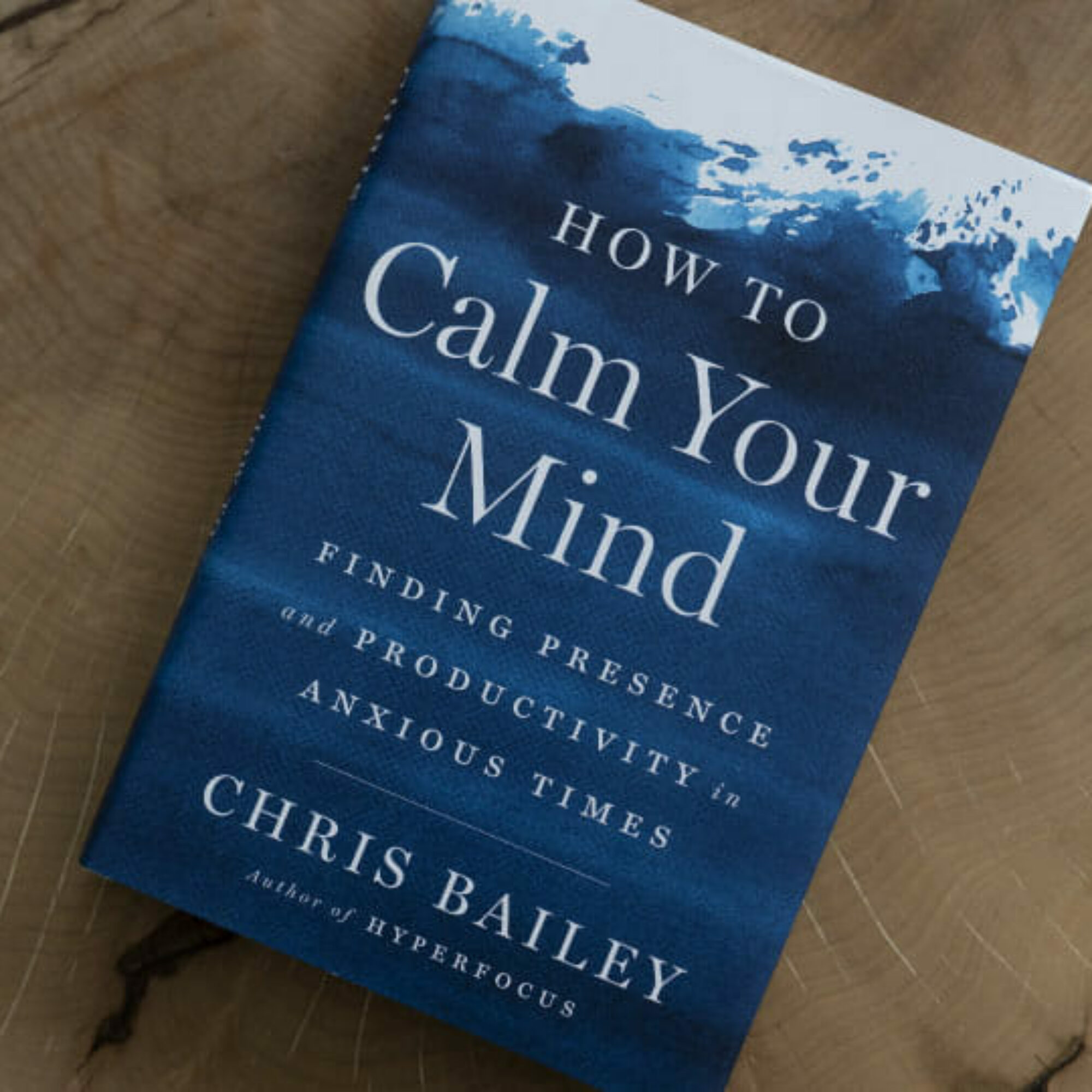
Bringing back Chris for first time since five years ago. Since then, his last book got big, as we briefly discussed. We started talking about meditation and at a high level, framed the conversation to come on how the mind works, outside our control, though we don't notice. More framing: we talk about intention and action, meaning and purpose. The topic of his new book How to Calm Your Mind is interesting to me because I see billions of people on autopilot, sleepwalking into polluting ourselves into oblivion. We spend most of our lives reacting, avoiding the feelings of powerlessness, anxiety, and often guilt and shame keeping us from facing that we are powerful, not powerless. Chris shares a moment of anxiety, becoming burned out…

0 Comments

671: How Pulling Off a Challenging Day Off Grid Feels

Last night I had trouble falling asleep because before getting in bed, I noticed I had to record two podcast episodes first thing in the morning but I wanted to cook some stew, the forecast was for rain all day, and didn't think my battery had enough charge to pull everything off. Plus I had lots of computer work to do, which would use more energy from the battery. I could always rely on my "cheat" to charge my computer and phone at NYU, but I prefer not to. I'm trying to avoid polluting. I also didn't have enough time between calls and obligations to walk to NYU without possibly missing the beginnings of calls. I found more and more ways to avoid needing battery…

0 Comments

670: Jeffrey Shaw: Self-employment and Sustainability

Do you want a job working in sustainability? If you want to wait for a job in the field, you're going to wait for a long time. Most businesses' models depend on growth, extraction, and exploiting resources. Many of the biggest and most profitable are built on exploiting people too. I hope I didn't surprise you with news you didn't know. Most places with positions like Chief Sustainability Officers or groups like Sustainability Committees are greenwashing at best, judging by how we're extracting ever faster, nearly all ways places claim reductions are scams like carbon offsets or net zero claims that are the equivalent of creative accounting, and most targets are so far off as to be unaccountable. Yet billions of people want leadership. They…

0 Comments

669: David Loy: Ecodharma: Zen Buddhism and Sustainability

What can we learn from Buddhism to understand and respond to our ecological crisis? This question is the heart of David's focus, as I understand it. We started by describing his journey from a more mainstream American childhood to Zen Buddhism and forming the Rocky Mountain Ecodharma Retreat Center near Boulder, Colorado. Then we talk about humanity's disconnect from nature and his work to restore it, in the context of his Buddhist path. We also talk about reconnecting with nature, letting go of the cultural forces to disconnect. He shares his work to help people handle these problems and their grief. We talked about how we handle what we humans are doing to our world and what we're doing about it, including from a Buddhist…

0 Comments

668: Christopher Ketcham: Growthism Versus Sustainability

Reading Christopher's story in the Pacific Standard, The Fallacy of Endless Economic Growth What economists around the world get wrong about the future, made me contact him. It was one of the only reviews of criticism of our culture's attempting to grow the economy and population forever that didn't prioritize growth dogma over understanding. The article centered on the book Limits to Growth, its analysis, and the unhinged criticism of it. I had to look up his other work too. I recommend following up at his page, which links to his writing and Denatured, his journalism nonprofit. From the moment he starts talking in this conversation, he lays down basic, common sense understanding of our culture's fundamental tenets, which he calls growthism. To my ears,…

0 Comments

667: James Oakes, part 1: Sustainability and Abolition in the United States

The only was I can see how we can avoid environmental disaster leading to human population collapse is by changing our culture---every unsustainable culture but America most, as the most polluting per capita large nation. Can we do it in time? Humanity has changed on a global level within a few generations at least once before. Slavery was legal, normal, and seen as good around the globe since before written history. Then in the late 1700s, abolition increased until within a century people widely viewed it as wrong. Not long after, nations made it illegal nearly everywhere. Jim Oakes is one of America's leading historians of America's abolition movement. I met him at his office, where we spoke about American abolition, Abraham Lincoln, the Thirteenth…

0 Comments

666: Mark Plotkin: Learning From Indigenous Cultures, the People Not Just Our Projections

Every step I take toward sustainability leads me to learn how much humans have figured out how to live sustainably. I'm far from living sustainably, though I've come a long way. We are wiping out the cultures living sustainably these cultures, now hanging on by threads. Besides practices and viewpoints, I'm learning humility. We don't have all the answers. Far from it. They may not either, but at least they can help us restore lost values of community we're jettisoning in favor of isolation and humility to nature we're jettisoning in favor of ignoring that our attempts to dominate nature are accumulating unintended side effects hurting us more than helping. Such are my views. I haven't lived among indigenous cultures and don't expect to. Mark…

0 Comments

665: Tony Hiss: Rescuing the Planet: Protecting Half the Land to Heal the Earth

Tony turns out to live a few blocks from me. I met him at his home, where we recorded. He shared his experience knowing E. O. Wilson, who, as Tony described, conceived of the plan to protect half the Earth's land to protect biodiversity and more to sustain Earth's ability to sustain life. I'd heard Wilson describe the plan many years ago and had seen some analysis that it could protect up to ninety percent of biodiversity if implemented effectively, whereas saving less land or implementing ineffectively might save markedly less, which could put humanity at risk, not to discount the value of other species' existence independent of humans (I confess to valuing humans more than others, but still value other life). I hadn't heard…

0 Comments

664: Rodrigo Cámara-Leret: Learning how the Kogi heal the land

Ethno-botonist Rodrigo Cámara-Leret first describes how podcast guest Alan Ereira chose him to live and work with the Kogi, who want to share, in my language, how to stop wrecking the biosphere. He has visited them and seen behind what they show of themselves in the documentaries. Unlike typical scientific research, he will bring his family and learn beyond what they plant. The condition of their environment is the physical manifestation of their culture, as is ours to ours. They aren't living in the Stone Age or as noble savages. They are living appropriate to their environment, sophisticated in their understanding of nature. Rodrigo and the organizations supporting him are approaching the Kogi with humility, as I understand, not trying to teach them or assimilate…

0 Comments

End of content

No more pages to load