
This post describes how to face a challenge we all face in a way that leads to deep reward, though it requires introspection that may feel uncomfortable in the short term.
When I talk to people about hurting others less by reducing how much they pollute and deplete, they talk about themselves. They might say something about helping people by spreading culture or education or their mother being sick, but they want to fly. They may say something about other people not having access to fresh produce, but they want takeout, and the concern for others is just a smokescreen or diversion from their personal responsibility.
Mention personal responsibility to anyone regarding pollution and depletion and they’ll launch into huge diversions about BP if they’re on the Left or China if they’re on the Right. All distractions. They’re ultimately justifying why it’s okay for them to pollute and deplete.
Let’s switch contexts to consider systems were other people do things that benefit themselves but necessarily harm others. I recently finished The Gulag Archipelago, so that’s a relevant example, or slavery in the US. The mechanism causing the suffering differs in each case, but in each case the person causing the suffering can act unilaterally and others can’t escape it. I’ve written before on how much more people are suffering from pollution and depletion today than did in US slavery or USSR Stalinism. It isn’t even close, as these two posts show, along with one graph from them:
- The Scale and Pollution and Depletion’s Effects on People: Here, now, not future projections
- The Timeline for Pollution and Depletion’s Effects on People
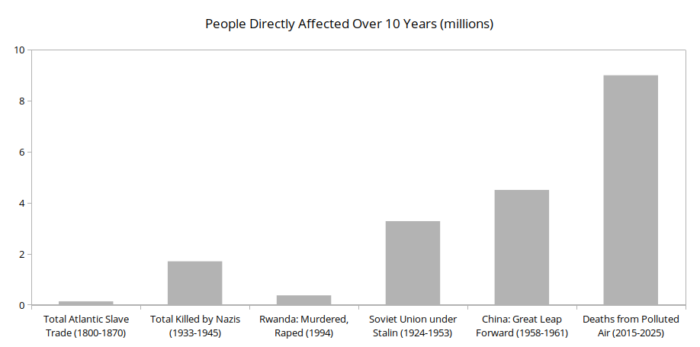 I suspect you’d be more interested in reading slave narratives like those of Frederick Douglass, histories of what Harriet Tubman did, or accounts of the lives of slaves than the plantation owners’ excuses for enslaving them. The Gulag Archipelago is long, but I bet you’re more interested in it than an account written by someone near the top of that hierarchy rationalizing and justifying imprisoning and enslaving millions of people to save their own skins.
People who pollute and deplete today focus on themselves and avoid learning about the people they harm through their actions. When they look at other people harming others, they want to learn about the people being harmed.
We could fix our system more if we switch the order:
- Today to look at those we harm so we can feel compassion and empathy to motivate us to stop harming them and stop focusing on ourselves and the perks that we fear losing from being at the top of a dominance hierarchy
- For past oppression, to focus more on the people harming others to learn more about the parts of ourselves we cringe at so we can learn to change ourselves.
Only if we face the parts of ourselves we don’t like can we do anything about them. Self-awareness is critical to lead ourselves. The point isn’t to make ourselves cringe. It’s to empower ourselves to act from different parts of ourselves, specifically empathy, compassion, the desire to help those less fortunate, and the reward from delivering that aid.