
When I started doing Turkish Get Ups, I struggled with a 25-pound kettle bell. Over the years, I worked up to where I comfortably do them with a 28-kilogram one, which is 61.6 pounds. My next heavier kettle bell is 70 pounds, which is a big jump. I wondered if I would ever be able to do it. I dented my floor when I lost control of a kettle bell and I once injured a rib that way, so I respect the exercise’s potential for injury, or rather, the need for safety and form.
Personal Best #2
Today I did my first 70 pound Turkish Get Up, one on each side.
For those who don’t know what they are, here are many posts. In a couple sentences, “The get-up is an elegant exercise that combines almost every shape your body needs to move through and every motor pattern necessary for human development and function. There is a reason this exercise has been around for such a long time.” I found this post most helpful for those who want to start. Here’s a schematic:

Why did I try the big jump today? Because of my personal best Monday:
Personal Best #1:
When I bought my 70-pound kettle bell in September 2021, I wrote “I don’t know what exercises I can do with this one. I know I can do farmer’s walks. Probably swings, maybe suitcase deadlifts and squats, but who knows? Not Turkish get-ups for a long time since I dropped lighter weights. With my body’s potential strength decreasing every year, will I be able to use it for long even if I can now?”
I don’t think I could then bench press one rep with it—that is, one arm at a time, like this, which I guess I should call a floor press since I don’t have a bench.
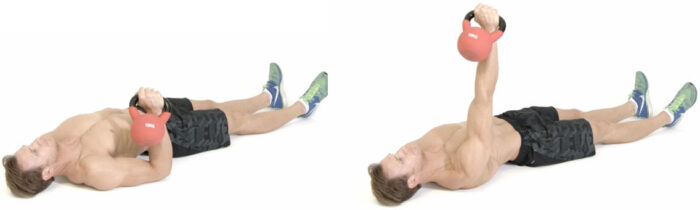
Over the years I worked up to floor pressing once or twice, then kept going. At the beginning of this year, on my lifting days, I’d do three sets, each to failure: the first one maxing out at 7 reps, then 6, then 5.
Then I hurt my arm and could only do two or three again. As the injury healed I worked back up to 7-6-5.
Monday I did my first set of 8-7-6. It may have been 8-6-6. I don’t write these things down. I just know that I did 8 reps in the first set and didn’t do fewer in the next ones.
I didn’t plan to do it. I just felt I had another rep in me after finishing the seventh. One of the great values of SIDCHAs, standard procedures, and consistency in general is that they make you sensitive to subtlety and nuance.
Context
I’ve followed my six-day exercise cycle for at least a decade, as distinct from my twice-daily calisthenics.
Almost exactly a year ago, I wondered how long I’d keep up my level of exercise in On considering when to decrease my daily exercises started over a decade ago, now in my 50s. As I get older, my body’s physical potential decreases. You could read in the quote when I bought the 70-lb bell that I didn’t know how much longer I could use it.
Meanwhile, I have only increased my calisthenics in number of burpees and other exercises, though I haven’t increased them in a few years and I probably take more time to do them. The lifts in my exercise cycle have only increased. If my total exertion has increased or at least remained constant but my potential has decreased, I keep reaching more potential.
To clarify, I’m not trying to be a body builder or set records. I just have a minimal level of fitness and enjoy finding the minimum time and money to achieve it. As I calculate below, the average American spends more than 6 times the time on social media than I spend on all my fitness combined, and I don’t use social media. Buying that used kettle bell was all I remember spending in over ten years.
Meaning and Purpose
I expect when I’m 80 I won’t be able to do what I do today. What about by 60? I’m already past 50. I like the idea of planning subtle changes over the course of years to decades, but how do I decide when to decrease?
One way to decide would be injury. I’m not being tough or macho here. Exercise means injury as much as trying anything means failure. Learning means failure. Still, my usual response to injury is to recover and I know that I’ve recovered when I can do what I did before the injury.
Over the years, as I improved my ability to do Turkish Get Ups, I wondered if I could bridge that 8.4 pound (3.8-kg) gap from the 28-kg (61.6-lb) to the 70-lb kettle bell. I haven’t been able to go from curling 35 pounds to 45 pounds. While ten pounds is a bigger jump and even bigger percentage jump, I haven’t even come close to making it and curls don’t risk injury like having 70 pounds above my face.
I started wondering if I could do a 70-lb get-up. As my floor press re-increased after my injury earlier this year, I could sense I might one day do a set of 10 reps.
Maybe, I thought, I could do a 70-lb get-up and, if I did, maybe I could consider that achievement the victory I could choose as my high point to descend from. I could switch my exercise goals from always increasing, however slowly, and finding more potential, thereby serving as a big part of my life, to more of a supporting role.
I’ll always maintain a minimal level of fitness. I spent too many years unfit as a child to go back. But I’m fatigued all the time. I don’t want to risk fooling myself that I’m more fatigued now than before. When I played ultimate I exercised much more, but I was sore and injured all the time then, so maybe I’m not that tired now.
For a few months, I started telling myself that when I did a get-up with 70 pounds, I could declare victory and choose to ramp down. I figured it could take years, though, not months. Since I worried about injury and breaking my floor, I wondered if I’d have to take the kettle bell to a place I could safely drop it if necessary, like my building’s ground floor gym, but then I’d have to carry it down four flights first, exercise in itself which might decrease my ability to do the greater weight. Would I carry it downstairs one day, leave it there overnight, and try it the next day? That planning violated my principle of my exercises being simple.
The police precinct has a gym. Could I try it there? I checked and I forgot the heaviest kettle bell there, but it was less than 28 kg. I was really looking for something between 28 kg and 70 lb to bridge the gap, but I remember thinking I couldn’t even test a weight I knew in a new place with a different floor. I’m not sure if it matters to others, but the floor’s smoothness or stickiness affects my form and therefore safety.
I could try a get-up in a park, but again, I’d have to farmer’s walk the kettle bell all the way there and back, plus the stairs, plus the ground wouldn’t be as level.
So all these challenges, however minor for someone who belongs to a well-stocked gym, combined with my dented floor and rib from past get-ups, added up to not knowing if I’d ever do a 70-lb.
Unexpected confidence
Unexpectedly doing that set of 8 floor presses Monday prompted me to think about trying. Months with 31 days give me an extra day outside my six-day exercise cycle to try other things. I thought about trying yesterday, but a few things made yesterday not work.
We had several hot days over 95 degrees (35 C) and humid. Without air conditioning, I hadn’t slept well in days, plus it’s harder in heat and humidity to lift and to concentrate, concentration being important when a weight will be above my head. Plus the day before yesterday was a fast day. It probably wouldn’t matter, but when I think safety first, I want to minimize potential risks.
Yesterday it rained, the temperature and humidity dropped, and today felt like worth trying. The first step of a get-up is a floor press. I knew I could do that much (eight times, in fact). The last step is a split-squat and I do three sets of eight of them with the 70 pound weight on my lifting days, so I knew my legs could do it. I do the split squats with my arm at my side, not overhead, so I didn’t know if all the little muscles that stabilize the weight could keep the weight stable, or if my legs could lift me and the weight smoothly enough.
The step I thought would be hardest was the second step, going from my back on the ground to up on my elbow. It risked less injury than the last step, but uses more muscles in more groups, or at least feels that way. It feels more complex. I’d tried it before and failed so I expected to try it today, not succeed again, but learn from the experience what I’d have to practice to enable it later.
To my surprise, I got up on my elbow no problem. Maybe I didn’t try enough before. Maybe my confidence from Monday’s personal best helped more than I expected. In any case, after getting up on my elbow, I felt more confident about all the other steps. I reminded myself not to feel overconfident, that I had already stepped into new territory and was now taking yet more.
Then I got all the way up. There I felt accomplished, but remembered the risk of injury on the way down. That first step back before the downward split squat can easily become a misstep and cause the weight to move beyond the range I can keep it up.
Then I brought it down. When the kettle bell was back on the ground, my heart was literally pounding from the physical effort (it’s amazing how much even one Turkish get up can make the heart pound) and figuratively bursting with pride at the effort. I also knew I had to do the other side. I do the side I feel more confident on second, so mostly felt more confident in doing that side, but also knew that even if I haven’t worked my other side’s muscles, even one get-up can drain my overall reserves and ability to concentrate. I couldn’t take the other side for granted, but I did it and it went like the first.
Future Steps
Until I did it, I didn’t know if I would ever do a 70-lb Turkish get up. I knew in principle I could if I devoted myself to it, but all of my exercise and other efforts are elements of my mission on helping restore America’s lost values. Going out of my way and devoting extra resources didn’t fit in that mission.
Until Monday’s best, I thought even if I did it, it might be next year or so, since I’d have to find intermediate weights or other places to practice. Instead, I did it sooner than expected.
Another life lesson kicked in. As I wrote in 2017, The bigger your achievement, the more it’s a beginning. Quoting myself, “Every big accomplishment is a new beginning, a platform to build on.” Doing one rep with 70 pounds reminded me of my first time doing one rep with 28 kilograms. I was amazed I could to that weight and now I do a couple reps with it every six days and have for years.
Instead of thinking, “At last, I’ve achieved something beyond my expectations. I can decrease on my own terms,” I’m thinking, “Now that I’ve done one, faster than I expected, and easier than I expected, can I work up to two reps?” To clarify, I’ve achieved freedom, mental freedom, which you can’t buy or find from any place outside yourself. Whatever I do next, it will still be on my own terms.
I’ll leave the question open and close with one of my favorite quotes, from Arnold Schwarzenegger:
A well built physique is a status symbol. It reflects you worked hard for it, no money can buy it. You cannot borrow it, you cannot inherit it, you cannot steal it. You cannot hold onto it without constant work. It shows discipline, it shows self respect, it shows patience, work ethic and passion. That is why I do what I do.
Skip this section if you don’t whine about privilege
People whine about what I do taking too much time or money or being unavailable to people without privilege or some other self-serving rationalization. I guess if they never grew up in a ghetto, haven’t been mugged many times with no recourse to justice, and haven’t seen their mother in tears because she didn’t know how to feed her children that day, then life hasn’t taught them to make do.
For the record, my total expenses on all fitness for the last decade is a few used kettle bells from Craigslist, so maybe fifty dollars. I’ve bought no special clothes, memberships, other equipment, etc. My total time for calisthenics is about fifteen minutes twice daily. For the six-day cycle, it’s about an hour on my lifting day, another 20 minutes on my gross day (the day for gross anatomy exercises that don’t target specific muscles), and sometimes 30 minutes on cardio days, though I’ve almost completely switched cardio days to fasting, for reasons I described here, and fasting saves time, but I’ll call it even. So I calculate (15*2*6 + 60 + 20) / 6 = 260/6 = 43 minutes per day.
The average American spends over 5 hours per day on social media. I wish I spent half that time on fitness, but I spend less than one-sixth that time.
Anyone can apply in their lives based on their values in their ways what I have in mine. It may look different. Maybe they learn to play an instrument, sing, or a sport. Anyone can always do something, just ask Helen Keller or Stephen Hawking. I’ve got nothing on them.
This Post Has 0 Comments