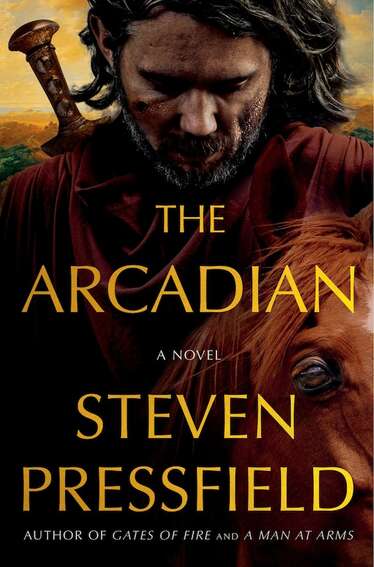
I finished The Arcadian by podcast guest Steven Pressfield yesterday. I found the whole book gripping, but one passage stood out as relevant to my work and upcoming book.
A big part of my upcoming book is what happens to us when we are induced to act against our values—that is, when we are corrupted from our values. We didn’t ask to be born into a culture that makes it impossible to get past eating breakfast without hurting people—for example through plastic packaging and transporting food across continents when our ancestors just walked to it—and causing more of it—for example, by funding future extraction and lobbying for more—but we were. The result: we tell ourselves multiple times per day every day for decades whatever it takes to feel good: “legitimizing myths.” Here’s a page of dozens, including many you tell yourself: TYMCALM: Common and Advanced Legitimizing Myths around polluting and depleting.
Steven wrote about warriors. In the best case warriors play a necessary role in a society, defending it from attack, heroes risking their lives to keep others safe. Even in that case, even if they know that everyone they know supports their actions, they still have to kill people.
I quote a scene in the book where three warriors share the effects on their minds of their heroism. It begins with what happened to their bodies, which seems the visible counterpart of what happens to their minds, not counting those who were killed and aren’t there to be seen or heard.
As gruesome as the internal effects on their minds, this passage builds up to the last paragraph. I recommend not skipping to it, but reading everything leading up to it. The paragraph about pissing, pickling, and kicking show what people do when we’ve been corrupted from our values. Steven describes warriors doing things after the one-on-one intensity of killing another man when you can smell his breath, wanting him to die so he doesn’t kill you, doing it over and over, then living with it for the rest of your life.
People are quick to talk about how cars “solved” the problem of horse manure flooding cities. I treated a few cases in But Aren’t We Solving Things? How can efficiency increase pollution?. Cars increased the amount of pollution in the world, but they dispersed it so we didn’t see it. Our culture, which we fund, collectively kills more people every year than Hitler did in years or US slavery did over centuries.
Do you believe that we aren’t affected by the results of our behavior? We experience the results of our actions differently than the warriors in the passage below, but you better believe we are affected by what we help cause. When you read what these warriors do, you’ll see the pattern in ourselves. Just as our culture’s need to kill others to maintain itself is more diffuse than theirs, so are our ways of responding to the horror we cause.
As usual, I point out these wounds and horror not to make people feel bad, which would be the result if there were no solution. My upcoming book presents a solution that is practical and desirable. It’s not my idea, it’s the practice democracy is founded on, in this nation embodied in the Declaration and Constitution. I point out these wounds to motivate acting on this solution. Sorry to leave you hanging on the content of the book, but if I could write it shorter than the book itself, I wouldn’t be working so hard to write it.
Beside and above her on the slope sat a number of grizzled characters, all male—almost all, it seemed, maimed and disfigured. One in particular, his face deformed by a hideous mutilation, addressed the assembly with animation.
“Indeed, the bond of brotherhood between soldiers,” he was saying, “has its seat in heaven. No one who has served under arms may contest this. But the issue of this concert is the produce of hell.”
The man paused and scanned about, meeting the eyes of his listeners. “How many households and farmsteads of the poor have you and I put to the torch, brothers? How many sons and fathers have we brutalized, extracting information, or wives and daughters defiled, from which violation they may never again be made whole? So we loved each other, warrior-to-warrior! So we gave our lives for the men at our sides!
To what end?”
In this era, as in centuries past, many second and latter sons of wealthy and well-educated families took to the profession of arms as the only avenue of ambition left open to them by the ordinance of primogeniture. Many enlisted under aliases or nombres de guerra. Three who perched in the foremost ranks were of this order. They called themselves now only by the site of their most grievous woundings. Thus: “Avila,” “Toledo,” and “Guadalquivir,” or simply “G.”
The first had lost his right leg below the knee and been blinded in the left eye. He wore a mask of iron that covered his sheared-off cheek as well. A prosthesis of horn and ivory extended inside his knee-top riding boot.
The second of the trio had served as a wing captain in the Order of Calatrava, one of the three societies-at-arms in service to His Holiness, before the sovereigns Ferdinand and Isabella incorporated these private armies under the royal standard. He had been wounded in an explosion that shattered his left hip and rendered his manhood inoperante. He joked of this, styling himself sin suidado, “free of all care.”
The last of these was a Jew of Guadalquivir, a converso who had accepted baptism and taken the Holy Faith. He had done this at age eleven after witnessing his mother and sisters raped and murdered by officers of the Inquisition, and his father, after signing all his property over to the Primate of Sevilla, dragged from his home and burned alive in the street. He later served—not yet as “G,” but under an Hispanicized name—in this same company of officers. His wounds were of the face and limbs, received as an arquebusier, a musketeer, at the Battle of Villarreal in service of the caudillo of that city, revolting against the Catholic Majesties. Having vowed clemency to the insurrectionists and taken their surrender, the forces of the Crown in ten hours, to the accompaniment of flute girls and players of timbrels, crucified or impaled over twelve hundred, ceasing only when their siege of slaughter left them too physically spent to continue.
It was the warrior Avila who now spoke. “When I was a boy, I was on fire to run away to war. I read of Achilles and Alexander. To be like them! To slay the foe! To achieve glory and honor!” He laughed darkly and glanced about the fire. “But, brothers, as only he knows whose sword or lance has stripped the life from another, this act, however righteously intended, however valorously enacted, damns the soul at one blow and kills the killer as surely as if his blade had carved out his own heart. Cut me short, friends, if I narrate falsely.” No voice contested this. “From that instant, my body has abided here beneath the sun but my soul has made its home in hell . . .”
The man called Avila broke off, unable to continue. His mate, Toledo, spoke immediately and in reinforcement. “It is one thing,” he said, “to slay a man at a distance with cannon shot or musket ball . . . or to learn only in the after course of some action, as the undermining of a wall or the laying of a snare, that has produced the extinction of the foe at a later hour. That is one thing. It is another entirely to grapple with your antagonist breast to breast, to peer into his eyes, to smell the stink of his breath, to feel his fear through your shaft or blade as you steer it with all your own rage and terror, seeking his vitals. Die! Die! the voice in your head screams as you drive your steel into his belly, wishing only that this moment be over, as if the passage of the instant could wipe from your soul the horror of the deed. Vain hope! Your foe has become your brother in that instant. He is closer to you, now, than wife or father or child. Closer than God. And he never leaves you, does he, friends? Return home from war, take a wife, beget children. At the hour of your death, you will see not their faces, but his . . . not their loving eyes, but his, in anguish and despair.”
None about the fire took issue with this. None spoke at all. “Some of us sought to submerge the memory of this first murder by following it with a hundred others . . . a thousand! Did it work?” The warrior Toledo laughed, as his brother Avila had—such a yelp and grimace as a corpse might offer. Both men turned to their comrade, Guadalquivir, called G.
“No rationale can exonerate such actions as we have all performed,” this warrior declared. “They are the labor of brutes and savages. But that is what war turns a man into, does it not?”
The girl, listening, shifted position to achieve a fuller view of the speaker. The man had lost his left eye, she could see, and the same arm below the elbow; a grisly, hook-like appendage served as an artificial limb. The warrior fortified himself with spirits, which he took down from an iron goblet that seemed to be the socket of a pike or the head of a lance.
“I have seen soldiers,” he said, “piss into the open mouths of the dead or slice off the genitals of the foe and pickle them for fun. Why? Horror. Soldiers are human. The horror overwhelms them. The mortal heart cannot stand that which war demands of its practitioners. So a man will crack wise, mock the dead . . . he will kick the head off a corpse and dribble it along the ground like a ball on a playing field, and laugh the while, he and his comrades. They have to or they’d go mad, the horror is too great for their souls to bear.”
Repeating from above, do you believe that we aren’t affected by the results of our behavior? We experience the results of our actions differently than these warriors, but you better believe we are affected by what we help cause. When you read about these warriors defiling and killing to retain their sanity, you’ll see the pattern in ourselves. Just as our culture’s need to kill others to maintain itself is more diffuse than theirs, so are our ways of responding to the horror we cause.
Read again:
“Some of us sought to submerge the memory of this first murder by following it with a hundred others . . . a thousand! Did it work?” The warrior Toledo laughed, as his brother Avila had—such a yelp and grimace as a corpse might offer. Both men turned to their comrade, Guadalquivir, called G.
“No rationale can exonerate such actions as we have all performed,” this warrior declared. “They are the labor of brutes and savages. But that is what war turns a man into, does it not?”
As usual, I point out these wounds and horror not to make people feel bad, which would be the result if there were no solution. My upcoming book presents a solution that is practical and desirable. It’s not my idea, it’s the practice democracy is founded on, in this nation embodied in the Declaration and Constitution. I point out these wounds to motivate acting on this solution. Sorry to leave you hanging on the content of the book, but if I could write it shorter than the book itself, I wouldn’t be working so hard to write it.

This Post Has 0 Comments