Leadership


More inspiration from Martin Luther King, especially if you haven’t achieved much yet

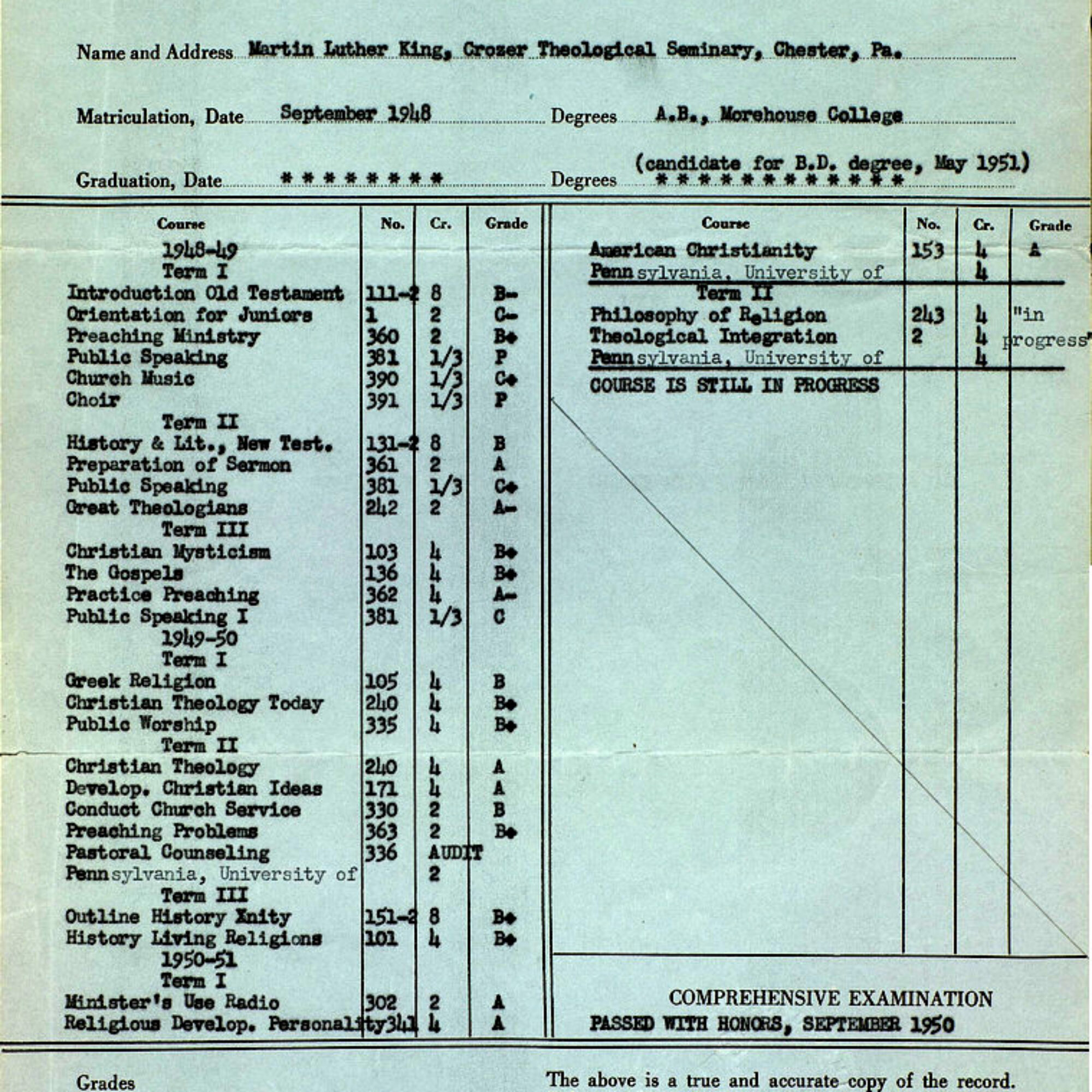
Perhaps the best honor one person can give another is to understand them and continue their legacy. I'm writing today's post to suggest you can do that with Martin Luther King more than you think. Many people believe Einstein got bad grades, but I understand he didn't. Martin Luther King, Jr got bad grades. He started graduate school at a school near Philadelphia called Crozer. Note among his grades -- the grades of one of the premier public speakers I've heard of -- he got a C in Public Speaking one term and a C+ in another term. He also got a C+ in Church Music and a C- in another class. Now look at his college grades. They are hard to read, but you'll…

0 Comments

Sold to capacity

With bittersweet feelings, I report that Saturday's seminar, "How to Lead People So They Want You to Lead Them Again," is at capacity for the venue. I expect we'll book future seminars on the topic. I look forward to seeing everyone there. Previous sessions have gotten great reviews. I plan to deliver a great seminar tomorrow.

0 Comments

A leadership position doesn’t make someone a leader

Many of my clients tell me they want leadership positions. Come to think of it, many of them are already in what most people would call leadership positions. They manage people, direct them, decide on bonuses, hiring, and firing, and so on. But they aren't satisfied with their current positions. They don't know why. They just think they'll like things more when they are higher on the organizational chart or running a company they started. They misunderstand leadership, confusing a position or title with having control over their lives. The more your role consists of obligations over which you have no control, the less you are a leader and the more you're a follower, no matter how high your salary or vaunted your title. You…

0 Comments

Master introversion AND extroversion

Yesterday I wrote about freeing yourself from constraining beliefs. Today I'll expand on creating new beliefs to free yourself from such constraints. I wanted to illustrate at least one alternative to the standard one-dimensional model of introversion and extroversion that I find impedes self-awareness, understanding, and personal growth and development. Many people continue to believe it because they have no alternative that helps their life more. Others rigidly hold on to their old belief because they can't distinguish between the belief and the object of their belief -- for example, telling people who disagree with their view that they don't understand the definition of introvert or extrovert, not recognizing a definition describes a model not people. If you reject the model, those definitions don't matter.…

0 Comments

“How to Lead People So They Want You to Lead Them Again” — My January 18 Leadership Seminar in NYC

Want to motivate people more effectively? Come to my January 18 seminar, "How to Lead People So They Want You to Lead Them Again," with the Columbia Business School Alumni Club of New York, which will be held at NYU-Stern, conveniently located in Greenwich Village. Past attendees of this seminar rated it very highly. Below is the text from the CBSACNY announcement: Effective leaders motivate people from the inside — so people they lead contribute fully and thank the leader for giving them the opportunity to work with them. You can learn this skill too. Isn't someone thanking you for motivating them to work hard on your project the holy grail of motivation? People remember effective leaders their whole lives. If you had leaders and…

0 Comments

How to bring happiness and emotional reward to your life by analogy with pleasure—the series

I've written, thought, and acted on distinguishing between pleasure, happiness, and emotional reward. I like them all, but sometimes life creates situations where sacrificing one will get more of another. Knowing their differences and similarities helps you figure out how to create the optimal balance of each in your life. For example, lately I've been experimenting with cold showers, although the following applies for any other SIDCHA or challenging activity. It's incredibly important for improving your life if you prefer living to sitting on the couch eating ice cream. Everybody I tell about them who hasn't tried them evaluates the idea of cold showers in terms of physical pleasure only. I did too before I did it -- their obvious physical discomfort stands out above…

0 Comments

The Self-Imposed Daily Challenging Healthy Activity (SIDCHA) series

I'm so swept up by SIDCHAs I made a series for them. Click here for the SIDCHA series. Do you want success or failure? Do you want to lead yourself or to follow others? Do you want a shot at greatness or mediocrity? Do you want resilience from feeling bad when things don't go your way or do you want your emotions to wreak havoc with you when things inevitably don't go your way? The Self-Imposed Daily Challenging Healthy Activity (SIDCHA) is the foundation for success, personal leadership, your shot at greatness, emotional resilience, and more. While a SIDCHA alone may not achieve all those things, it gives you such a strong foundation for them, you'll probably find yourself achieve them. I don't have evidence…

0 Comments

An inspirational SIDCHA video

[This post is part of a series on the Self-Imposed Daily Challenging Healthy Activity (SIDCHA). If you don't see a Table of Contents to the left, click here to view the series, where you'll get more value than reading just this post.] [It's also part of a series on Cold Showers. If you don't see a Table of Contents to the left, click here to view that series, where you'll get more value than reading just this post.] About twenty-five days into taking thirty days of cold showers I watched the following video by the guy whose blog motivated me to try it in the first place, Joel Runyon. I found this video the most meaningful description of the reasons to try it. Well, the…

0 Comments

After a difficult decision affecting your team: Eisenhower and the paratroopers before D-day

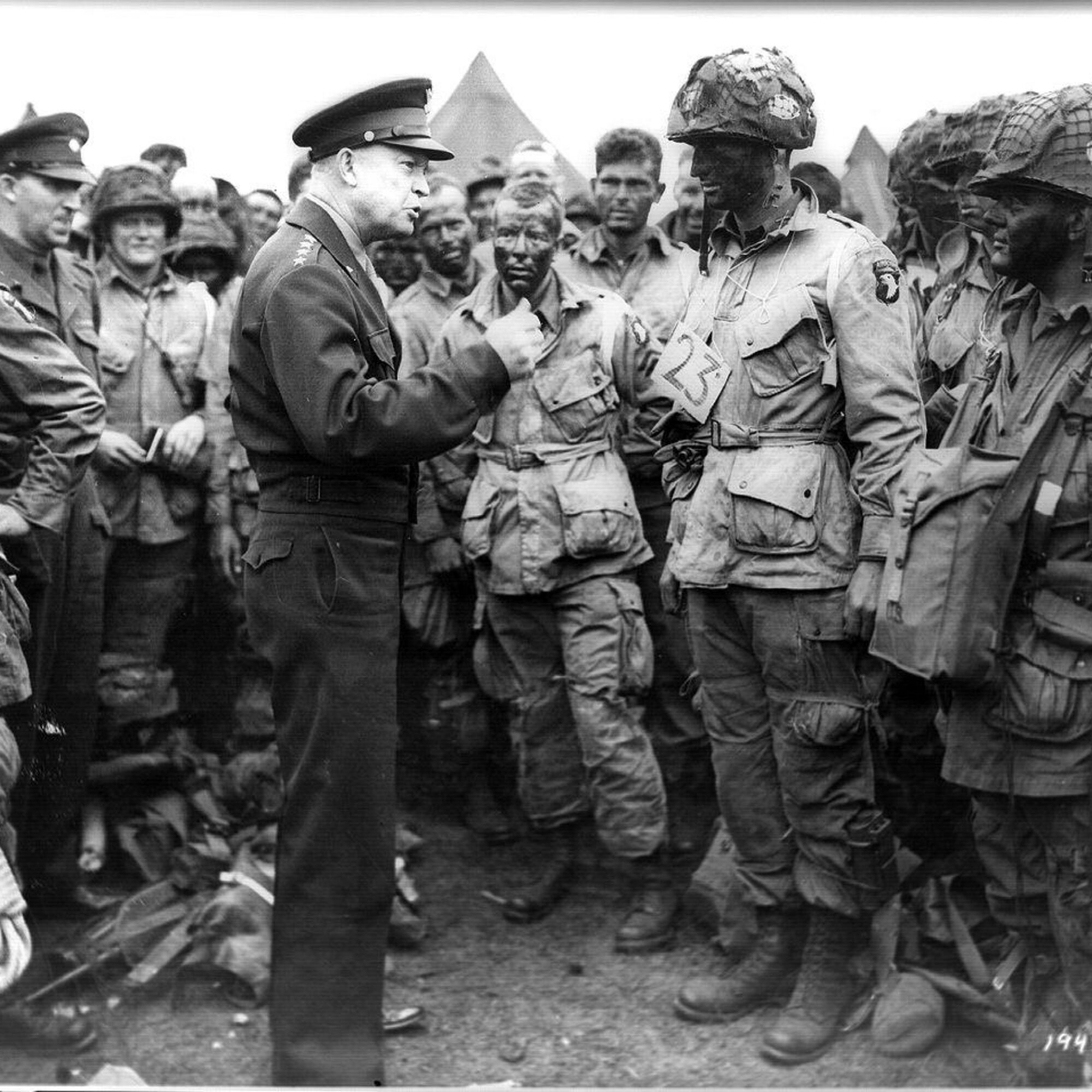
Yesterday's clip on Ike deciding whether to risk sending tens of thousands of men into potentially pointless suicide missions with losses up to seventy percent didn't show how he followed up. Those paratroopers were the first wave of the invasion, to jump the night before the amphibious invasion. He decided to send them. What do you do when you decide to send tens of thousands of young men possibly to become sitting ducks--seventy percent of them? Ike had spent most of the months preparing for launch working with Generals, diplomats, the King, the President, and so on. The military chain of command took care of soldiers going to battle. Ike had little fighting experience. But on the night before D-Day, he drove to the paratroopers…

0 Comments

Eisenhower, D-Day, and keeping teams strong while making hard choices

If you think making decisions is hard, how about ones where the lives of thousands of people depend on your choice? Or possibly the free world? I find learning how people succeeded in difficult cases makes doing things well in my world easier. Today's post shows a dramatization of a decision then-General Eisenhower, Ike, had to make in preparing for D-Day. This scene stuck with me since I first saw the movie for a leadership class at Columbia Business School during a unit on decision-making. The context: The clip shows two scenes--one two days before D-Day, the other the next morning. The allies have been preparing to invade Nazi-held Normandy for months and have only one day the moon and tides allow. They can possibly…

0 Comments

Kareem Abdul-Jabbar on John Wooden — one of the best basketball players on one of the best coaches

You can learn a lot about leadership from what great leaders say about people who led them. I'll show a video of Kareem Abdul-Jabbar on his college coach, John Wooden, and then describe how it teaches a lot about leadership -- specifically motivating others. First a few words on each. Who are Kareem Abdul-Jabbar and John Wooden? Abdul-Jabbar ranks among the best basketball players (and athletes of any sport) ever. According to Wikipedia's page on him, he was a record six-time NBA Most Valuable Player (MVP), a record 19-time NBA All-Star, a 15-time All-NBA selection, and an 11-time NBA All-Defensive Team member. A member of six NBA championship teams as a player and two as an assistant coach, Abdul-Jabbar twice was voted NBA Finals MVP.…

0 Comments

The Method: the series

I posted The Method on how to use The Model---my model for the human emotional system designed for use in leadership, self-awareness, and general purpose professional and personal development---in series form. Here is a link to it. I find the Model and Method the most effective and valuable foundation for understanding yourself and others and improving your life. The Model tells you how we work. The Method shows you how to use The Model to lead yourself and others and create the lifestyle you want. I recommend reading The Model Series first, then reading this series for how to use the Model. Click to read it!

0 Comments

The Model — the series

I posted The Model -- my model for the human emotional system designed for use in leadership, self-awareness, and general purpose professional and personal development -- in series form. Here is the link to it. I find this Model the most effective and valuable foundation for understanding yourself and others and improving your life. Why? A model's value comes not from its accuracy but how well it serves its purpose, which improves from effective filtering of information. Street maps, for example, are more useful for driving for having less detail than, say, a satellite picture. Subway maps are more useful for their purposes for having yet less detail. For leadership, self-awareness, and general purpose professional and personal development, I find this model has an optimal amount…

0 Comments

The Method: the series

[EDIT: I covered this series in more depth in Leadership Step by Step, so I recommend the book, but the core is here. I use this technique as a part of my life, basically daily.] Here is The Method on how to use The Model---my model for the human emotional system designed for use in leadership, self-awareness, and general purpose professional and personal development---in series form. I find the Model and Method the most effective and valuable foundation for understanding yourself and others and improving your life. The Model tells you how we work. The Method shows you how to use The Model to lead yourself and others and create the lifestyle you want. I recommend reading The Model Series first, then reading this series…

0 Comments

Coaching highlights from coaching Columbia Business School students: Two months in Tibet

[This post is part of a series on Coaching Highlights from coaching Columbia Business School students. If you don't see a Table of Contents to the left, click here to view the series, where you'll get more value than reading just this post.] Two months in Tibet is a technique that complements accountability for the long-term part of leadership and personal development. It overcomes a major source of resistance for many people trying to change. Some background: One of the major sources of resistance when you try to change is other people. They know they old you. If they like you they like the old you. Changing your behavioral patterns without warning may confuse them and prompt them to worry if they will lose the…

0 Comments

USA morale down because of NSA — Washington Post

Yesterday's Washington Post reported "NSA morale down after Edward Snowden revelations, former U.S. officials say". I commented the following at Hacker News, which got voted as the top comment, and, as a testament to the ethos of tech-savvy people, at least in that community, one of my highest overall voted comments ever (see discussion here, and I recommend reading the comments on the Post's page too). More like "USA morale down after Edward Snowden revelations, much of U.S. population says," I'd say. That happens when you do something most people would feel shame for. A major difference between NSA employees and the rest of us is that they can easily stop what they're doing. Let's hope their pitiful loss of morale leads them to develop…

0 Comments

Coaching highlights from coaching Columbia Business School students: For changes to stick, change both beliefs and behavior

[This post is part of a series on Coaching Highlights from coaching Columbia Business School students. If you don't see a Table of Contents to the left, click here to view the series, where you'll get more value than reading just this post.] How do you start to plan? You've figured out a change you want to make in your life. How do you start to plan? You've always done X and now you want to stop it. Or maybe you've never done Y and you want to start. Or you want to do something differently. Coaching sessions with students often hit a break after we finish interpreting their feedback reports and they've chosen a leadership behavioral skill they want to work on and change.…

0 Comments

Coaching highlights from coaching Columbia Business School students: Assertiveness does not mean aggressive, domineering, or trying to influence

[This post is part of a series on Coaching Highlights from coaching Columbia Business School students. If you don't see a Table of Contents to the left, click here to view the series, where you'll get more value than reading just this post.] As an earlier post in this series mentioned, assertiveness ranks highly as a skill students at Columbia want to develop as part of their leadership training. Most recognize it as an important skill for leadership -- that if they don't assert themselves, instead of leading they'll end up being led by others who assert themselves more. Most haven't had or created the opportunities to assert themselves professionally, having had few leadership roles. I find one of their biggest hurdles to asserting themselves…

0 Comments

Coaching highlights from coaching Columbia Business School students: Common coaching topics

[This post is part of a series on Coaching Highlights from coaching Columbia Business School students. If you don't see a Table of Contents to the left, click here to view the series, where you'll get more value than reading just this post.] One of the challenges and joys of coaching is that each client is unique. Even similar issues show up in unique ways with each person. The job never gets boring. Still, you see trends, especially among students taking similar courses at similar stages in their lives, often with similar goals. So what do MBA candidates at a top business school tend to want to work on? First, I'll mention that there is no overwhelming majority. Even the most common areas of focus…

0 Comments

Coaching highlights from coaching Columbia Business School students: Manage Expectations

[This post is part of a series on Coaching Highlights from coaching Columbia Business School students. If you don't see a Table of Contents to the left, click here to view the series, where you'll get more value than reading just this post.] Do you ever have an amazing epiphany about a major change you will make in your life, or how you'll do it, and get excited about how awesome doing it will be? This happens a lot in coaching sessions, especially after their first 360-degree review and coaching session. They often have major realizations and make fantastic, far-reaching plans destined for enduring success. All that is awesome, but this realization came in the privacy of a distraction-free room, working with someone working to…

0 Comments

Coaching highlights from coaching Columbia Business School students: Use your teammates

[This post is part of a series on Coaching Highlights from coaching Columbia Business School students. If you don't see a Table of Contents to the left, click here to view the series, where you'll get more value than reading just this post.] Making change stick means practice and accountability. How do you find people to hold you accountable? The following advice works for everyone, not just business school students. I'll describe how it applies to your life after writing how I tell the students I do lightning coaching with. Leadership requires other people. Every time you work or do anything in a team is an opportunity to lead. For this reason Business School students have to work most of their first year in school-assigned…

0 Comments

Coaching highlights from coaching Columbia Business School students: Practice!

[This post is part of a series on Coaching Highlights from coaching Columbia Business School students. If you don't see a Table of Contents to the left, click here to view the series, where you'll get more value than reading just this post.] I mean practice in two senses here. The first is the more relevant one for the one-hour lightning coaching sessions -- as a coach, I try to find ways for my client to practice their new behavior during the session, all the more important in a lightning session when they won't have access to their coach again. Improvement in leadership means nothing if it only exists in your head and doesn't translate to new behavior. Leadership is fundamentally social, meaning it requires…

0 Comments

Coaching highlights from coaching Columbia Business School students: School protects you so you can try new things

[This post is part of a series on Coaching Highlights from coaching Columbia Business School students. If you don't see a Table of Contents to the left, click here to view the series, where you'll get more value than reading just this post.] Business schools and other vocational schools offer students something supremely valuable not everyone realizes. Everyone knows they give you knowledge, credibility, and a network. They also offer you protection from the outside world. You can do risky things in school that you might not do when your pay check or job depends on not messing up. In school, especially business school, you can risk failing in ways that might lose you your job, promotion, bonus, or other things of value. Many schools…

0 Comments

Get leadership coaching like an Ivy League business school

Do you want to improve your leadership skills? Does this describe you: Highly motivated?Limited time?Want to know top-5 business school culture (or just learn to lead like someone from one)? This series will help you. Columbia Business School provides a service to its students helpful to anyone -- it has each MBA candidate take a 360-degree report and gives each a coach to help interpret the results and create a plan to act on it. I took the program and have been coaching Columbia MBA students through this program for years. Since we have only one hour but the students are so highly motivated, it's like super-effective lightning coaching. Many students have gotten enough value to tell me things like "this is why I chose…

0 Comments

End of content

No more pages to load