Choose easier by visualizing choices, part 2

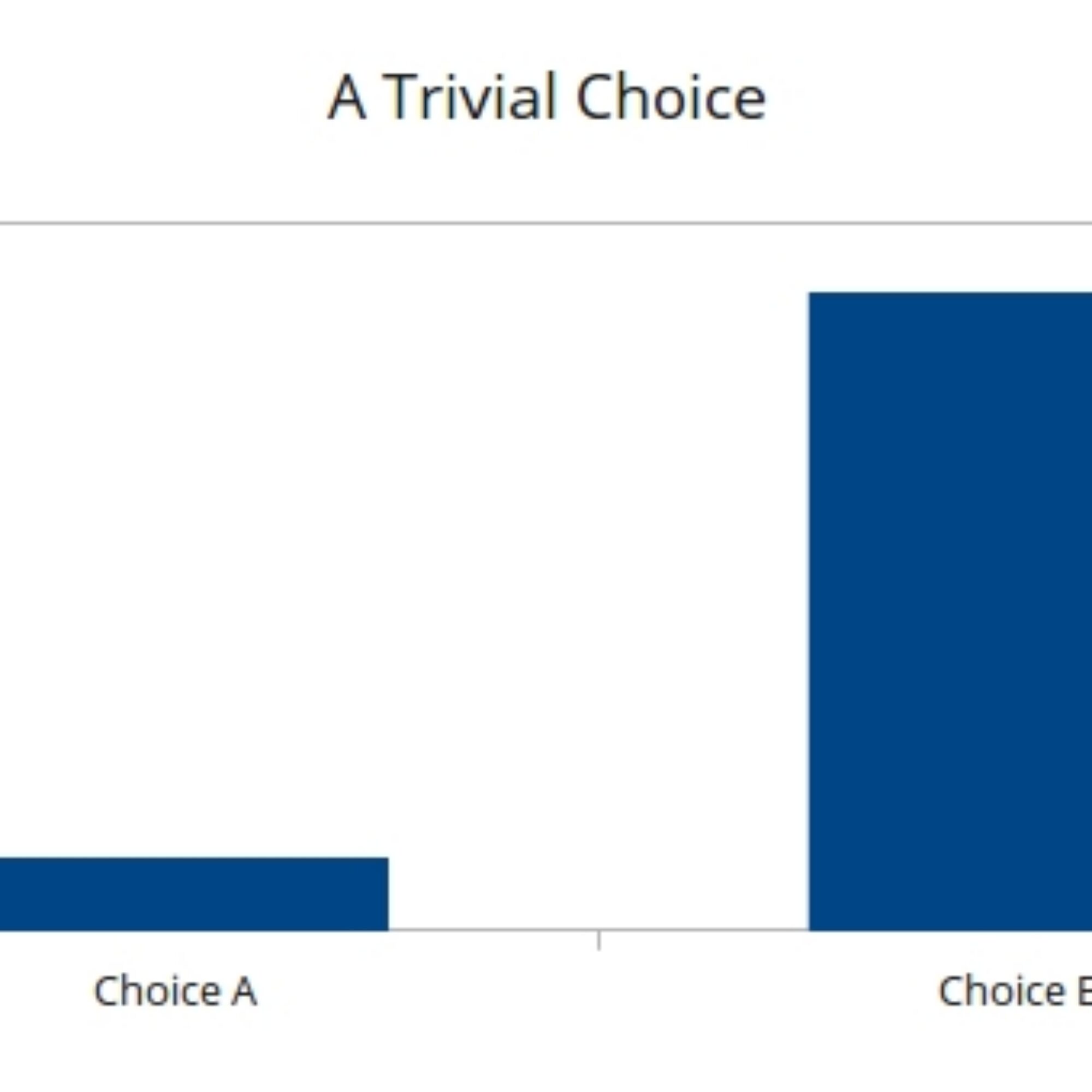
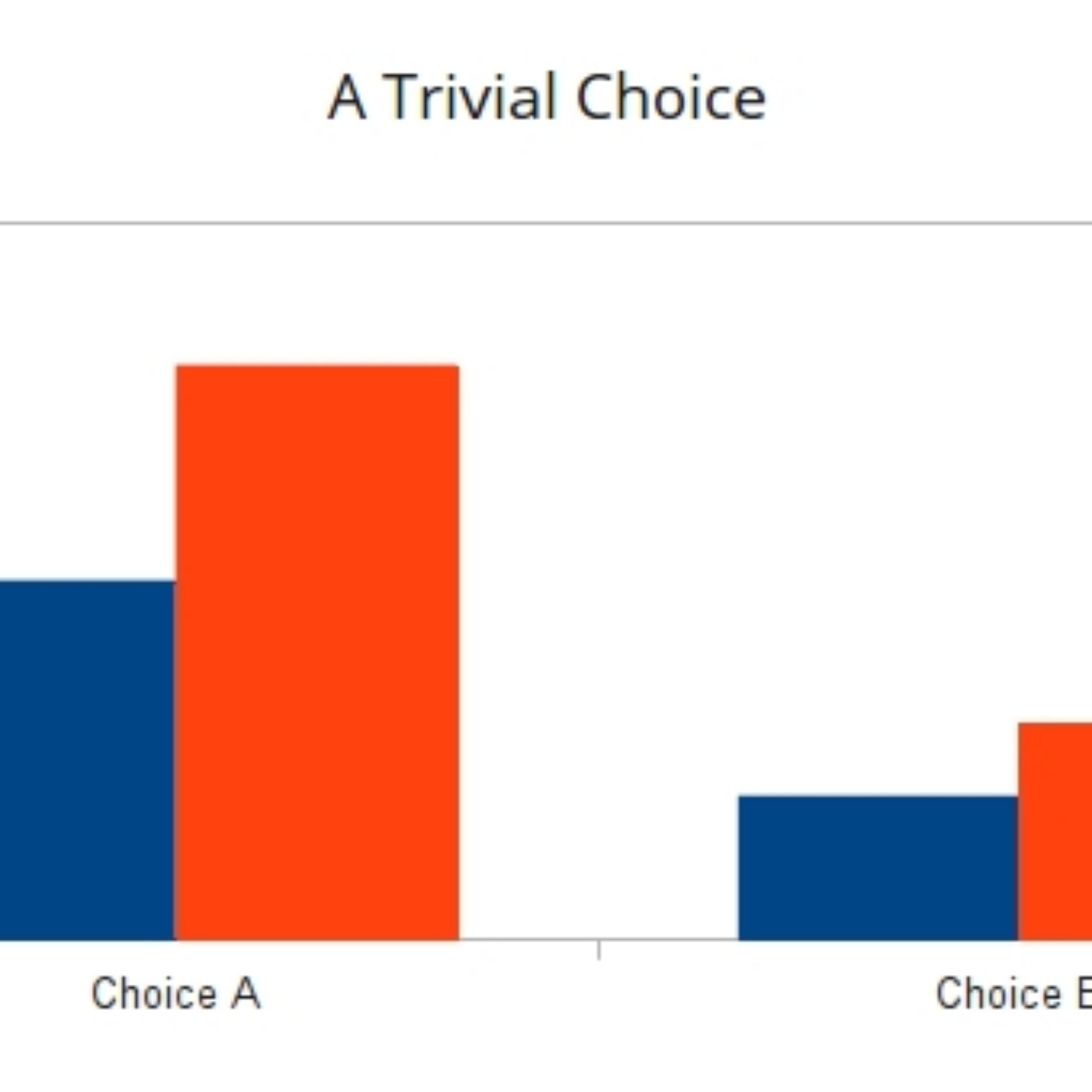
Multiple factors Not all options have only one decision factor. Many have two or more. For example, do you prefer a job with higher pay but lower chance of promotion or higher chance of promotion but lower pay? You have to look case-by-case, but let's see how our visual representation shows them. A trivial choice The easiest two-part case is when you prefer both parts of an option to both parts of the other. Consider if you had to choose between A high-paying job with great benefits and A low-paying job with no benefits. This graph illustrates such a choice. All else being equal, you'd choose the first option. Again, this illustration is simple, but we're just seeing how the visual model works with two…

0 Comments

Choose easier by visualizing choices, part I

You know choosing can be hard. I've written about it before from a few angles: Why are decisions hard? Difficult life decision? Here's how to look at it. How to decide among close options A belief to choose without getting mired in indecision Today I'll give you a tool to simplify decision-making more with a way of visualizing the challenge that shows the hard part. Partly I'm following up on how I visualized emotions in the Passion-Attraction Model, which I recommend looking at if you like this post. I find modeling difficult things with visual representations makes them easier. I'll start simple and build complexity, leading to the more helpful insight as I develop the ideas. A trivial choice Not all choices are hard. If…

0 Comments

Leadership, community, and how I got Hacker News’s second-highest average karma

Leadership creates community. I'm writing today on leadership and creating community in a specific context for clarity, but it applies to anyone's participation in any community, online or off. I expect you can translate everything below to your world easily enough. If not, comment below and I'll clarify. An effective measure of your leadership skills is how much community you create. Another is how much your community appreciates you. Online communities that track upvotes quickly tell you how your behavior influences them, which can help you improve your communications skills. I don't want to imply participating in one little online community is a big deal, but why miss an opportunity to learn and improve one's communication and leadership skills with immediate feedback at no cost?…

0 Comments

You tell me what you do best. I’ll tell you what you do worst.

Today I'll cover an exercise I do in my seminar and when I address a group of professionals. You can do it while reading this post. It teaches you about Yourself Self-awareness Teamwork, especially team building I can cover it in a few minutes or can use it to discuss teamwork, self-awareness, and my experience for thirty-minutes or more. Introduction I start by telling the group "I'm going to ask you to tell me what you do best. Then I will tell you what you do worst." I say it provocatively to get a response and set expectations high. A few people respond incredulously. I point out that someone did the exercise with me. I was equally surprised -- how could someone tell a room…

0 Comments

A reader responds: A Question to Help You Intuitively Prioritize and Stop Procrastinating

I reader emailed me a model he uses along the lines of the models and beliefs I put in my series on beliefs and now my book on the same topic. I'm honored and flattered that he used my format. I recommend looking at your beliefs and understanding them. In his email he described how his belief evolved as he wrote it -- an effect I found too. Just writing them raises your self-awareness, editing all the more. I understood it as soon as I read his name for his model/question, which I expect to adopt and use myself. I suspect it will resonate with others as it did with me. I hope to hear from other readers about their beliefs. Here is his belief:…

0 Comments

How do you decide when your decision affects other people? Involve them in the process.

People struggle over decisions they know will affect others. Their concern for other people sounds important for building and maintaining relationships. Their anxiety, on the other hand, suggests they're missing its source. If they don't know what causes their anxiety, they'll miss the otherwise obvious solution. For some reason, people in challenging situations often withdraw from others. Typical such situations include Figuring out how to tell a client news they don't want to hear You're going to finish late and someone depends on you You broke or lost something someone else values and needs You don't know how to solve a problem Figuring out what restaurant or movie to go to with someone You can come up with plenty of situations They're anxious because they'll…

0 Comments

Advice to someone starting a long-term project

Following up yesterday's advice to a client, here is advice I gave to another client who was working on an independent program I've found helpful (again, edited for anonymity). I think what I wrote could help anyone starting a long-term project, especially before you can see the light at the end of the tunnel, so I'm sharing it here. (Regular readers will note it resonates with the quotes in my post "A master speaks on creative expression," or at least I hope it does.) I'll tell you what I saw in what you wrote that tells me that if you stick with the exercises you will have the success you want. I saw that you are doing the exercises fully, with dedication and discipline. I…

0 Comments

Just showing up can be the best strategy: One of my life’s greatest moments

Do you have a great passion? Something you devote several hours a day four to six days per week for twenty years? Something where pain and injury makes you like it more? If you have something like that, you'll know what playing Ultimate Frisbee meant to me. If not, you'll have to imagine. And I hope you some day build yourself a passion for something like I did for Ultimate. Anyway, toward the end of my competitive playing career I played on an elite team with some of the best players to have played the sport. I learned a lot from how I made that team. In late summer of that year I was looking for a team to play with. A friend said he…

0 Comments

Insults describe the person giving them more than the person receiving. How you can learn from yourself when you insult.

I overheard some people talking about another group as "douchebags" with "popped collars" who called everyone "bro" or "brah." Okay, I get that some people can find others annoying, but to call them douchebags is just mean. You've insulted others for other reasons. People call others losers, sluts, assholes, and so on. More importantly to you, if you've ever insulted someone or thought about it, which covers everyone on the planet, is that the insult says something about you: When you insult someone you evaluate them by your values, which you impose on them. You judge them. You think "I'm better than them" or "I'm right and they're wrong." If they judged you by their values you'd look terrible too. If you considered your thoughts…

0 Comments

Writing emails from the inside out, making them more effective even if you aren’t particularly sensitive or a people person

You probably write better emails than I do. I've been getting better and thought I'd share a process that's helped me improve. It came from experience and I thought about it writing an email just now. I wrote today's post secondarily to show how to improve emails if you write like I do before the last step, but primarily to illustrate a mindset: My mindset when communicating with others: To put the other person first when writing, and to think of them first as a human being with feelings, not as an agent to complete your task. In other words: Build a relationship. Tasks come and go. Businesses come and go. Relationships last, and they get things done. They also make doing business fun and…

0 Comments

A curious way to measure intimacy and an effective way to increase it

I'll share today an unexpected and curious way to tell how much intimacy you have with someone and an effective way to increase it. By intimacy, I mean any kind of intimacy, which could be in a professional, friendly, romantic, or any other type of relationship. Intimacy increases trust and decreases friction between people so it's valuable to have. Knowing how much you have tells you how closely you can interact. Being able to create it can deepen and strengthen relationships and make them more productive. Intimacy has its risks too, as does today's tool. Used effectively, it will create intimacy and its benefits. Used ineffectively, it can ruin relationships. Getting close to someone always risks inviting pain or other problems. If you're easily offended…

0 Comments

How to hate less and grow in the process, simply

Today's post is a new exercise I made up that I found improved my thought patterns. It's simple and takes no time, money, or other resources. Just your attention. It combines three things that work for me: changing words to change you thoughts, celebrating what you accept, and a property about truth. Ingredient 1: changing words changes your thoughts I've written about simple exercises to change a few words here and there that can change how you think. For example Avoiding starting responses with "No," "But,"or "However" (from Marshall Goldsmith) Judging people less I'm amazed at the effectiveness of such small changes in changing your thoughts. But when it works it works. Ingredient 2: what you can accept you can celebrate I also wrote a…

0 Comments

“That’s not art. I could do it.” — A new interpretation that activates art and yourself

We've all heard someone say "That's not art. I could do it." Maybe you said it yourself. The comment can lead to interesting discussion on what makes art, but rarely. It can lead you to realizing that the value of art doesn't depend on how hard it was to create. The usual response is "Well, you didn't. And they did it first." I suggest a new response. If the person who says it, perhaps yourself, sees beauty or truth in the work of art, suggest that they re-create it. Seriously suggest they do what they say they can do. They could have a museum-quality work of art on their wall if they do, for only the cost of materials. When you look at art with…

0 Comments

Sometimes going the opposite way works best

A pattern I've noticed works a lot in life: When everyone is going in one direction, try going as far as you can in the opposite direction. Some examples: When car companies kept making bigger and more dominant SUVs, the Prius did well. In retrospect it seems obvious, but the car appeared nearly alone and successful in the U.S. market for years before other cars competed meaningfully. Now Smart Cars and related little cars seem to be doing well. The other day I wrote about how boxed cereal companies try to offer as many kinds of flavors, textures, and box designs. I prefer simple oats with a few toppings. When mp3 players first came out they looked technical and complex with lots of buttons. The…

0 Comments

More ways to annoy someone you’re talking to

The other day I wrote about how annoying someone saying "Why are you getting hung up on just one word?" sounded. Then I noticed a friend using some other annoying words and phrases in conversation that sounded annoying and decided to share them here. I don't think she realized how annoying she was. So I put a few more annoying things, not as a how-to, but for people who might not realize they are provoking others and so if someone says them to you, you can avoid being annoyed as much. Provocative things to say that belittle the other person's values Why are you offended? Why are you so hung up on such a little thing? I didn't realize you were so sensitive. You're hung…

0 Comments

Communications skills exercise 12: Avoiding starting responses with “No,” “But,” or “However”

[This post is part of a series on Communication Skills Exercises for Business and Life. If you don't see a Table of Contents to the left, click here to view the series, where you'll get more value than reading just this post.] I've written a bunch of times on the exercise I made up to avoid using judgmental words, particularly good, bad, right, wrong, and evil, but also balanced, better, worse, improve, acceptable, and a bunch of others. I'm not sure if I wrote where I got the idea from. I got the idea from another exercise as simple and surprisingly effective that I learned from Marshall Goldsmith. Reading it will seem trivial. Doing it is nothing like you expect. The exercise The exercise is…

0 Comments

Daily models and beliefs that work

[Today's post is an alternative introduction to my series on beliefs and how to change them. It gives a different, more team-oriented approach.] A major tool of leadership is setting the common beliefs and models of your team. Some examples: The head of a corporation may decide that the company's highest priority is product quality when it used to be customer service. Or may decide it is a consumer electronics company instead of a business-to-business company. The coach of a sports team may decide the team is a defensive team where it used to be offensive and before that it fed the ball to its star player. A person in a relationship may decide love means understanding and supporting their significant other where they used…

0 Comments

Who or what is a Cathedral-builder and why should I care?

[This post is part of a series on "Mental models and beliefs: an exercise to identify yours." If you don't see a Table of Contents to the left, click here to view the series, where you'll get more value than reading just this post.] The great business guru Peter Drucker illustrated how different people find different value and meaning from their work (and lives) through the parable of the three stonecutters. An old story tells of three stonecutters asked what they were doing. The first looked unhappy. He said, "I'm making a living cutting stones." The second looked happier and proud. He kept on hammering while he said, "I'm doing the best job of stone-cutting in the entire country." The third one looked up with…

0 Comments

Managing difficult teammates, managers, employees, and people

We've all had to deal with difficult team members. Those who have led have had to deal with difficult people reporting to us. Most of us have had to deal with difficult managers and bosses. We've also had to deal with difficult people in general. When someone makes our jobs and lives difficult we want to influence them to stop challenging us and start helping us, or at least getting out of the way (and sometimes to be open to them influencing us, accepting that sometimes we are the difficult ones). When the difficult person is our manager or boss, many of us feel powerless to do anything to influence them. You can influence anyone. I'm writing today's post to increase your ability to influence.…

0 Comments

Communication skills exercises, part 11: Quick and dirty escapes from conversation lulls

[This post is part of a series on Communication Skills Exercises for Business and Life. If you don't see a Table of Contents to the left, click here to view the series, where you'll get more value than reading just this post.] Don't you hate getting stuck in a conversation lull? Neither person knows what to say. The conversation loses momentum. If you just met the person, you start to wonder if the relationship will never get off the ground -- a serious problem if you're working on a sale, trying to get hired, trying to attract someone. Compounding the problem, not knowing what to say tends to happen more when you consider the other person more important than you. People often feel that way…

1 Comment

A question to ask all the time: “Is this making my life better”

I watch my share of television. I eat my share of unhealthy food. I find plenty of ways to waste my time. But I'm decreasing those things all the time. I think a lot of people decide what to do or not based on the thing or activity in question. Will that chocolate cake taste good? Will I enjoy watching that show? Do I want to go to that party? The problem with that approach is that it leads you to do things based on the qualities of that thing. Most things come your way because someone thought you'd enjoy them. They probably also benefit from your participation, so they show you it most attractively. Then you get caught following your nose, doing whatever comes…

0 Comments

“Needs as understood”: How to start sales presentations — and conversations where you want to influence someone

I've written before about a student group from Columbia Business School I still contribute to long after graduation called InSITE that promotes entrepreneurship and connects students at several schools including Columbia, NYU, Harvard, and Stanford to entrepreneurs. A recent post on InSITE's blog by Lukasz Strozek, Stanford Business School 2014, described a challenge common in product development and entrepreneurship. It reminded me of a great solution I'll write below applicable to many situations where you want to influence people. The challenge Read that post for the details, but broadly it points out We care about products we create We want to get feedback from customers and potential customers Pitching the product gets closed answers, not broad understanding of a customer's needs or interests So the…

0 Comments

What is morality?

The concept of morality is for many people a complex topic. I like to simplify complex things, as long as the simplification works. If the simplification doesn't work I drop it, but sometimes the simplification works well. Longtime readers of this blog know I avoid using terms like right, wrong, good, bad, and evil and have an exercise to avoid them that taught me a lot, decreased how many arguments I got into, and benefited me in other ways. So the less I communicated judgment, the more I questioned the value of anyone communicating judgment and the more I started paying attention to how people used the word and concept of morality. I came to substitute the model that morality just meant someone telling someone…

0 Comments

A model for one of the most valuable skills related to beliefs

[This post is part of a series on "Mental models and beliefs: an exercise to identify yours." If you don't see a Table of Contents to the left, click here to view the series, where you'll get more value than reading just this post.] This series covered a lot about flexibility with your beliefs -- the ability to try out believing something new and letting the new belief crowd out the old one. Doing so is hard because believing means believing something is right. If you don't get it, changing beliefs is hard because you'll think it means believing what you thought was wrong is right and vice versa. I made a point of undermining beliefs being absolutely right or wrong -- it's impossible for…

0 Comments

A model for learning potentially painful, embarrassing, challenging skills

[This post is part of a series on "Mental models and beliefs: an exercise to identify yours." If you don't see a Table of Contents to the left, click here to view the series, where you'll get more value than reading just this post.] Do you ever hold back from trying to learn something because you know you'll have to try several times to get it right? Are you afraid of falling, failing, getting hurt, and getting laughed at? Today's model addresses that, giving you a model for trying new things. It gives a great visualization for people who master a difficult task, as difficult, painful, publicly viewable, and challenging as any project you'll take on. You've likely done this harder challenge yourself. A model…

0 Comments

End of content

No more pages to load