
This week I finished:
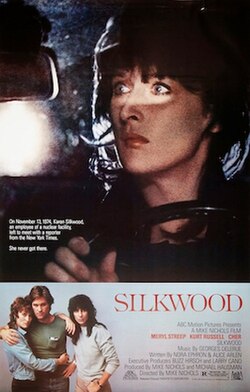 Silkwood, directed by Mick Nichols starring Meryl Streep: I saw the dvd at the library so borrowed it. I had seen the title in my recent posts about nuclear disasters. It even mentioned Hanford as a place that the plutonium processed by the characters in this movie was sent.
I understood this movie to have come out very close to when Three Mile Island partially melted down, therefore culturally important, but I confused it with The China Syndrome. In any case, Silkwood featured three big stars and a big director.
I expected an exposé but it mostly showed a set of roommates nearly close enough to be a family where they all worked in a facility that processed plutonium with shoddy, horrific labor practices. In principle one character becomes a whistle-blower and union champion, but most of the rest of the workers shun her for risking their jobs. The facility would move away if it had to stop cutting costs and it was the largest local employer.
I didn’t mind watching it, but didn’t find it that compelling as a movie. All the actors shined so I recommend it as a quality work, but I didn’t feel it made history the way Dog Day Afternoon or Matewan did.
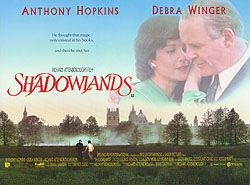 Shadowlands, starring Anthony Hopkins and Deborah Winger: I read a couple C. S. Lewis books lately—The Abolition of Man and The Great Divorce—plus That Hideous Strength was covered by an online Hillsdale course I took.
I forget what prompted me to this movie, but it’s free from several places on YouTube, so I downloaded it and watched it. It must have come from watching Remains of the Day, which somehow I didn’t post that I watched, but did recently, so I’ll include it in the title of this post.
I learned more about Lewis. I didn’t know almost anything about him, but he married an American woman, formerly communist, atheist, and Jewish. Descriptions I read before watching this movie said it was a tearjerker. It is, but when prepared, I didn’t find it as evocative as I expected. Maybe my expectations were set too high.
People who like C. S. Lewis seem to love C. S. Lewis. I’ll read a couple more of his books. I remember The Chronicles of Narnia being around the house when I was a kid. I’m pretty sure I read all of them, but I don’t remember. It would have been the 1970s.
“It’s Only a Penis”: Rape, Feminism, and Difference, by Christine Helliwell: While preparing for the podcast I recorded with Christopher Ryan (still being edited) I came across a conversation he recorded with a friend of his—a male model who was raped by a gay man high up in the modeling industry. In that conversation, Ryan mentioned a paper by a female feminist anthropologist about a situation she observed in Borneo where a man entered a woman’s home intending to have sex with her. She kicked him out. The community laughed about what she, the anthropologist, considered rape. When she asked them why they weren’t taking it seriously, one of the responses was “It’s only a penis. How can a penis hurt anyone?”
I found that description intriguing so read the article. Here’s the beginning of that article, so you don’t have to rely on what I remembered:
In 1985 and 1986 I carried out anthropological fieldwork in the Dayak community of Gerai in Indonesian Borneo. One night in September 1985, a man of the village climbed through a window into the freestanding house where a widow lived with her elderly mother, younger (unmarried) sister, and young children. The widow awoke, in darkness, to feel the man inside her mosquito net, gripping her shoulder while he climbed under the blanket that covered her and her youngest child as they slept (her older children slept on mattresses nearby). He was whispering, “be quiet, be quiet!” She responded by sitting up in bed and pushing him violently, so that he stumbled backward, became entangled with her mosquito net, and then, finally free, moved across the floor toward the window. In the meantime, the woman climbed from her bed and pursued him, shouting, his name several times as she did so. His hurried exit through the window, with his clothes now in considerable disarray, was accompanied by a stream of abuse from the woman and by excited interrogations from wakened neighbors in adjoining houses.
I awoke the following morning to raucous laughter on the longhouse verandah outside my apartment where a group of elderly women gathered regularly to thresh, winnow, and pound rice. They were recounting this tale loudly, and with enormous enjoyment, to all in the immediate vicinity. As I came out of my door, one was engaged in mimicking the man and climbing out the window, sarong falling down, genitals askew. Those others working or lounging near her on the verandah–both men and women–shrieked with laughter
When told the story, I was shocked and appalled. An unknown man had tried to climb into the bed of a woman in the dead, dark knew what this was called: attempted rape. The woman had seen the man and recognized him (so had others in the village, wakened by her shouting). I knew what he deserved: the full weight of the law.
…
” I said, “although you didn’t want to. He was trying to hurt you.” She looked at me, more with pity than with puzzlement now, although both were mixed in her expression. “Tin [Christine], it’s only a penis,” she said. “How can a penis hurt anyone?”
The article isn’t that long. I’ll let you read it and conclude what you want. One of the main ideas was how different cultures with different ideas of masculinity and femininity can conclude different things about rape.