Choosing/Decision-Making


More effective than willpower

As much as I advise people not to do it, I catch myself relying on willpower when it won't work all the time. Willpower is when you do something counter to what your emotional system motivates you to do. If you put a chocolate bar in front of someone who loves chocolate, their motivational system makes them want to eat it. If they are trying to avoid sugar, it takes willpower not to eat it. Or when you're running a marathon, your emotional system makes you want to stop and rest. It takes willpower to keep going. Willpower runs out, so it works for limited time. Put that chocolate bar in front of the chocolate lover long enough and they will eat it. People who…

0 Comments

What are you doing that’s exciting?

A question today: What are you doing that's exciting? Or rewarding, satisfying, fulfilling, invigorating, or whatever you want out of life? Is your life purely reactive, in that you only have time and resources to do what other people tell you to do, to pay rent, etc? If so, maybe you have no choice. Or do you have time for other things? Do you watch TV, play games online, etc? If so, then you have time to do other things. Then you have a choice of what to do. Do you choose exciting things to do? Or rewarding? Or anything like that? Nobody can stop you. Except yourself, I guess. But you can't blame anyone else for you not choosing exciting, awesome, rewarding, satisfying, or…

0 Comments

The problem determines the solution

"Which is more important as a leader, to work alone or to work in groups?" I heard that question asked of a panel of business leaders last week. The panelists all answered something like "in this day and age you have to be able to work in groups. That's where you get everything done" with some acknowledgment that you had to be able to work solo too sometimes. As soon as the moderator asked the question I thought, "You're asking about solutions in the abstract. The problem determines the solution." You can best solve problems that take solo work to solve solo and problems that take group work to solve by group. We've all seen solutions that were designed by committee that show input from…

0 Comments

When to choose not to connect with people

A reader wrote to ask about choosing not to meet or make connections with people. I thought others might find the answer useful. Hey Josh. I was just wondering. You seem to place a lot of value on having relationships with people. Are there times you don't want a relationship with someone? I suppose in negotiations it is in your own interest to have a good relationship for at least the duration of the negotiations. Are there times when you think, "I just don't like this guy, fuck him"? I think I remember you talking about people being worth your time or something like that. I might remember wrong. I guess it's a lot different in business, than in just normal life. What's your thoughts…

0 Comments

Marathon burpees

It's just past midnight, meaning I'm about fifteen minutes into Saturday, November 1. Tomorrow, Sunday, is the marathon. I've trained for it pretty well for months. I've wondered what to about my burpees. Some people suggested skipping burpees on days I run the marathon. I see it otherwise. Those are the most important days to do them. What's the point of doing something only when it's easy? The benefit comes when it's hard. Arnold Schwarzenegger has a quote about how your development all comes from the last reps you do, that everything before that only sets up those reps. Ah, here's that quote, not that I'm competing at his level. The last three or four reps is what makes the muscle grow. This area of…

0 Comments

Sunday Nonjudgmental ethics: Is It Cheating to Compete Against Younger Runners?

Continuing my series on responses to the New York Times column, The Ethicist, looking at the consequences of one's actions instead of imposing values on them, here is my take on today's post, "Is It Cheating to Compete Against Younger Runners?" I am a 60-year-old competitive distance runner who likes to win. Typically, races group runners by age and sex to balance competition. But senior runners often outperform younger runners. This is not as strange as it sounds: Seniors generally have more time to train than younger runners. Because I often stand a better chance of beating younger athletes, I am tempted to enter myself in a younger age group. I figure the natural competitive advantage bestowed by youth compensates for any misrepresentation on my…

0 Comments

Successful behavior comes from little tricks more than lofty ideals

There is a one-hundred percent chance I will work out this morning. It's raining. I'm cold. I'm hungry. I have a lot of work to do. I have emails to catch up on. So many distractions. How do I know I'm going to exercise? Because I put on the lycra shorts I wear when I row on the rowing machine and every time I wear them I row. They aren't that comfortable for anything else, so there's no point in putting them on except to row. And switching to wearing something else feels like defeat, so once I put them on, it's easier to row than not. The decision to put on the shorts takes no effort. I just do it. In the back of…

2 Comments

Motivation = expectation of success compared to now, research shows

It's Friday night. You planned to meet some friends for a night out. You haven't seen them in a long time and looked forward to it. But this week at work was exhausting. Most weeks like this you'd just want to sit on the couch, relax, and take it easy. You feel like you have no energy. Do you go out? Some people feel like hanging out with friends will relieve the exhaustion and improve their lives. Others feel like the work it takes to go out isn't worth it. The activity doesn't have to be going out with friends. It can be going to the gym, doing your laundry, cooking dinner, doing your taxes, whatever. Wouldn't it be interesting to learn that we can…

0 Comments

No time to exercise? I bet you do, but you don’t want to make the effort.

I get it. Exercise is hard. At least useful exercise is. I wrote about it in yesterday's post, "Defining moments." I know the feeling before starting exercising. You don't want to. But rarely do people tell me they don't exercise because it's hard. Far more often people tell me they don't have time to exercise. If you want to exercise and you think you're not doing it because you don't have time, you'll have a hard time overcoming the problem. You'll work on irrelevant goals. Nearly everyone can spare ten minutes a day. You can exercise during commercials while watching TV. A few minutes of burpees will do it. If you aren't exercising because you haven't yet figured out how to overcome your internal resistance,…

0 Comments

Defining moments

Have you stood on the edge of an open airplane door, looking at the sky beneath you and the ground miles below it, parachute on your back, trying to will yourself to jump? Have you stood outside your boss's door, after days and weeks working up the courage and what to say to ask for a raise or promotion, trying to will yourself to knock and enter? Have you sat behind the wheel of your car on a rainy evening after a long tiring day at work on a day you told yourself you would go to the gym no matter what, yet thinking only of going home, sitting on your couch, and eating comfort food ... trying to will yourself to drive to the…

0 Comments

Eisenhower on deciding, resolving conflict, and uniting a divided team

People often ask me about resolving conflicts and how to handle them as a leader. This clip shows Eisenhower, played by Tom Selleck, handling a conflict two days before D-Day. It's dramatized, but not so much that we can't learn from it. Context Eisenhower and his team have been planning the Normandy invasion for months. They want to launch in the next couple days, but two major unknowns split to leaders on one aspect. The unknowns are the weather and the German army's preparations. The decision is whether to drop the elite paratroopers and gliders behind enemy lines the night before the amphibious invasion. Hundreds of thousands of lives hang in the balance. There is no way to decrease the uncertainty. The Conflict Using these…

0 Comments

Empathy Gaps — one of the most insidious barriers to getting hard things done

If you want to change something important in your life, you'd better understand the concept called "empathy gaps." An example of an empathy gap is when you say in December you'll go to the gym twice a week for the next year, that you have the fortitude to do it and will simply will yourself to do it no matter what, then find yourself in February saying you're not in the mood and you'll get to it later. Or you say you'll ask that person out with confidence, but when you go to approach you lose your nerve. An empathy gap is when you feel one way in one situation, like when you plan something and feel enthusiastic and confident, then when the situation changes…

0 Comments

Choose easier by visualizing choices, part 2

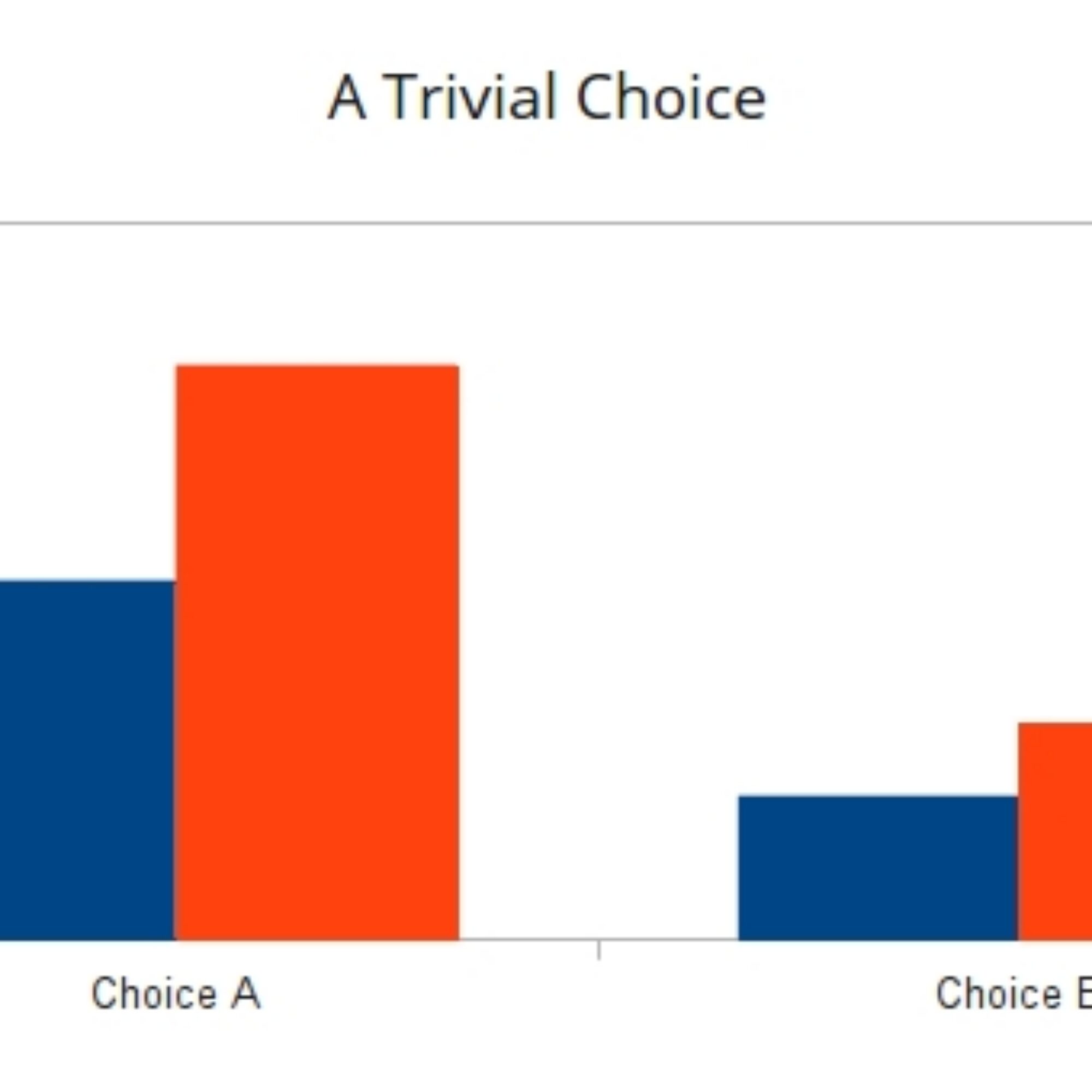
Multiple factors Not all options have only one decision factor. Many have two or more. For example, do you prefer a job with higher pay but lower chance of promotion or higher chance of promotion but lower pay? You have to look case-by-case, but let's see how our visual representation shows them. A trivial choice The easiest two-part case is when you prefer both parts of an option to both parts of the other. Consider if you had to choose between A high-paying job with great benefits and A low-paying job with no benefits. This graph illustrates such a choice. All else being equal, you'd choose the first option. Again, this illustration is simple, but we're just seeing how the visual model works with two…

0 Comments

Choose easier by visualizing choices, part I

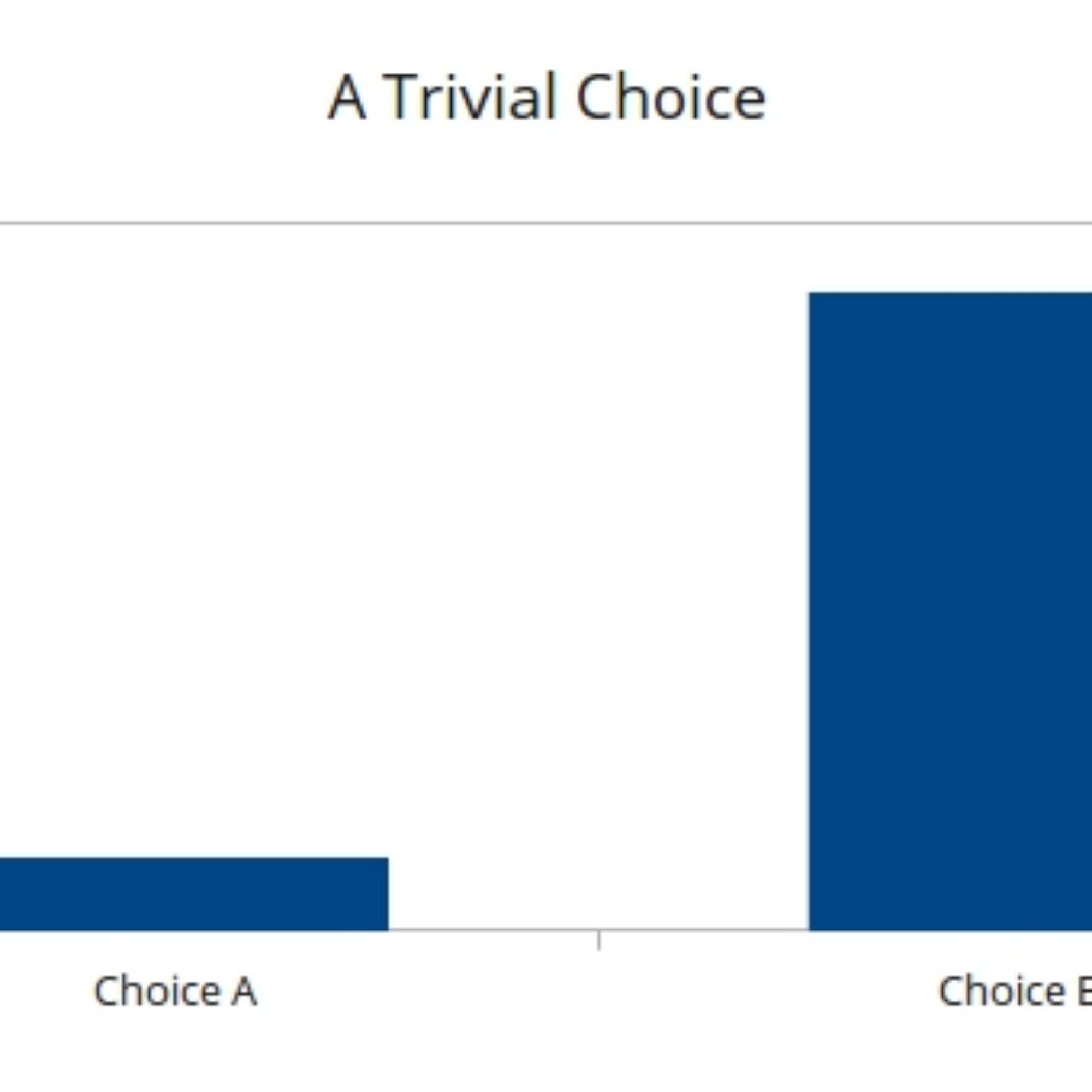
You know choosing can be hard. I've written about it before from a few angles: Why are decisions hard? Difficult life decision? Here's how to look at it. How to decide among close options A belief to choose without getting mired in indecision Today I'll give you a tool to simplify decision-making more with a way of visualizing the challenge that shows the hard part. Partly I'm following up on how I visualized emotions in the Passion-Attraction Model, which I recommend looking at if you like this post. I find modeling difficult things with visual representations makes them easier. I'll start simple and build complexity, leading to the more helpful insight as I develop the ideas. A trivial choice Not all choices are hard. If…

0 Comments

A model for balancing pushing myself with enjoying life

[This post is part of a series on "Mental models and beliefs: an exercise to identify yours." If you don't see a Table of Contents to the left, click here to view the series, where you'll get more value than reading just this post.] Do you work hard to improve your life -- studying hard, working long hours, being patient with a significant other, etc? If you're always pushing, when do you get to enjoy life? But if you're always enjoying, do you ever improve? Do you wonder if you're slacking too much or working too hard? Do you wonder how to balance both aspects of your life? Today's model shows how I think about how I balance pushing, trying, and improving with enjoying, relaxing…

0 Comments

A model to improve your environment

[This post is part of a series on "Mental models and beliefs: an exercise to identify yours." If you don't see a Table of Contents to the left, click here to view the series, where you'll get more value than reading just this post.] How would you like for everything in your life to look better and for everyone to treat you better? For everything in your life to improve? Today's belief is one of the most powerful you can have, as is the strategy it leads to. People also happen to oppose it the most. When I state it simply and abstractly, they agree with it. When I apply it to them, they push back against it. You will too. If I can take…

0 Comments

Hopeless or worth it? When should you give up on a project going nowhere?

Discretion is the better part of valor yet quitters always lose. When do you give up on a project you love that's going nowhere and when do you give more to make it work? Both ideas make sense in different situations. I learned an answer that has worked well for me every time. Entrepreneurs face such questions all the time. Small companies often walk the line between abject failure and outstanding success. How long do you walk the line before giving up? The question arises everywhere. Do I stay in this relationship in the hopes it improves or give up? Do I keep working for this terrible boss who might get better or leave? The list goes on. You leave when you realize you can…

0 Comments

How to make persistence pay off more effectively

A couple people emailed me today's long New York Times article Do You Suffer From Decision Fatigue?. One pointed out that it echoed my post that English and romantic languages reflect the difficulty in deciding in the root -cide. On choosing The article reports research in choosing. This blog emphasizes not mere research but applying it to improve your life. I love reading research, but enjoying learning pales in comparison to applying it to improve your life. The article points out people choose less effectively after a while. Great. So what? It didn't mention my first thought. This finding reinforces that persistence pays off -- but the article implies persistence pays off better if you persist for a while in the moment. It gives examples…

0 Comments

I have low standards the first time

This post on doing things you love even if you're not good at it prompted discussion -- or at least people asking me about doing things that feel scary or are hard. For most people, the challenges are internal. Most people aren't risking health and safety doing something like climbing Everest -- they're thinking of trying out for that senior position, singing karaoke, going to a gym for the first time, or asking that guy or girl out. Their risking losing social standing -- aka embarrassing themselves. Why people don't try new things Their biggest fears are based on beliefs of imagined futures. People don't predict the future effectively, all the more when projecting fearfully, so they tend to project worst case scenarios. Even if…

0 Comments

End of content

No more pages to load