Relationships


More roots: an ancestor who worked with George Washington and on the Continental Congress

In 2011, I posted Roots—I descended from seventeenth-century Salem puritans!, about some of my family tree, in particular a part on my mom's side in which one direct ancestor sailed to the colonies from England in 1635. It's neat to have family that arrived here before the nation formed. On my dad's side, my grandparents came over about a century ago from Europe, where they were born. The relatives they left behind likely went up in smoke in Auschwitz or a similar camp, but no one I know of has found any records. Back to my mom's side, a relative found a site about a Varnum house in Rhode Island, which seems to be a many-times-great uncle of mine. He sounds remarkable, having worked with…

0 Comments

What artificial intelligence does to our minds

Say you want to run a marathon. Someone says they developed an amazing exoskeleton. They tell you that when you wear it, it can help you run. You'll be able to finish a marathon in one hour. In fact, it helps you so much, you won't even break a sweat. Running a marathon with an exoskeleton doing the work for you achieves the opposite of the point of running a marathon. Crossing the finish line faster isn't the point. Likewise if you used an exoskeleton to lift weights and could bench a thousand pounds or to play tennis so could beat Federer, etc. Using the exoskeleton transforms an activity designed to build coordination, fitness, and strength achieves the opposite. While "lifting" heavier weights, your muscles…

0 Comments

Parents just don’t understand

George Washington, Andrew Jackson, and Jesus Christ didn't have kids, but JD Vance said about "people without children," that "How does it make any sense that we’ve turned our country over to people who don’t really have a direct stake in it?" I guess Vance isn't a fan of Washington or Christ, though he was referring at the time to Kamala Harris, Pete Buttigieg, and AOC as leaders of the Democrat party. If he disagrees with their politics, that's his prerogative, but why the venom against people without children? Why the claim that people without children are less connected to humanity's future? [EDIT: I had the idea to write this post months, maybe years ago. I kept not writing it because I wasn't sure it…

0 Comments

Artificial Intelligence isn’t improving people’s lives. It’s helping them fulfill their roles, which rarely improves their lives.

[Note: I wrote the post below before last week's post Artificial Intelligence and atrophy of mental ability like intelligence, self-awareness, emotional regulation, and expression, which it overlaps. I held back on posting it because of the question in the last paragraph. I'm finishing the third volume of The Gulag Archipelago and studying the effects of dominance hierarchy, which artificial intelligence is forming. People who criticized Stalin didn't fare well. Should we worry about criticizing the people and machines who may be at the top of a steepening dominance hierarchy?] There may be some people who can't talk to other humans, maybe because of a birth defect, that artificial intelligence can help directly. Then again, it may not actually help in the long run, but even…

2 Comments

Artificial Intelligence and atrophy of mental ability like intelligence, self-awareness, emotional regulation, and expression

I see more and more ads for artificial intelligence. This evening on the subway one ad promoted how AI could turn the workplace task of creating a slide deck from two weeks of many sub-tasks like compiling data and designing slides into one prompt followed by a complete slide deck. The task would take minutes now. I've heard a lot of uses for artificial intelligence. I haven't heard of one that improves people's lives. I'm sure they exist, but I haven't seen them. Most are like the one above. It's tempting to point out that it saves time and likely improves the quality of output, that it enables the person to focus on what they want to, not low-level mundane work like making sure the…

2 Comments

The futures that futurists imagine are what I envision: Yet more evidence living without polluting or depleting isn’t regression

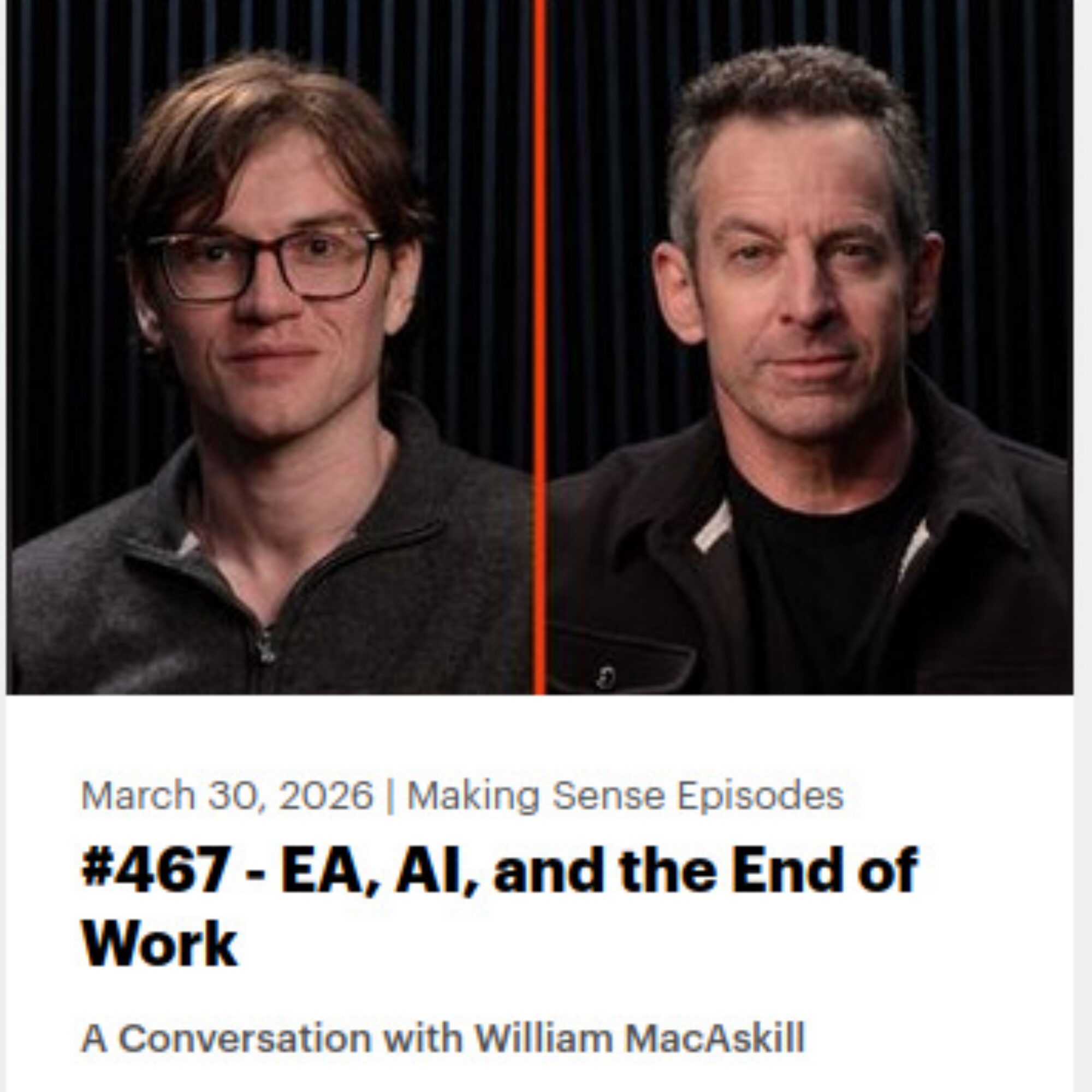
People consistently refer to life without polluting and depleting as returning to the Stone Age. The lack of historical awareness and imagination staggers the mind, or it would mine if I didn't realize that humans fill our minds with lies, or legitimizing myths, when we are induced to act against our values, to mollify our feelings. I was listening to William MacAskill (bio below) on Sam Harris's podcast. I'm not sure they would describe themselves as futurists, but they aren't far from it and in the part of the conversation I quote below, they were exploring what if artificial intelligence worked out. I quote several minutes of the conversation and share the audio, but I'll call attention to a few comments of what they imagine…

0 Comments

How are government incentives for larger families not socialist, New Deal-type programs?

I keep thinking more about what I covered last month in my post Heritage Foundation promoting socialism, as usual. Charlie Kirk did too. Many factors go into how many children people have. One of them is finance: can someone afford to raise kids. I think a lot of people think it's not fair that it should be harder for people with less money to have kids. Oddly, people also react to me when I say that polluting and depleting save money and time that not having kids, somehow I can't know what it's like. But I grew up expecting to have kids. Financial considerations factor heavily in my choice not to have kids so far. These people never offer me consolation or empathy for what…

2 Comments

Something important missing in my life

I was talking to a coaching client about leadership, which works with people's intrinsic motivations. Since our greatest motivations and passions tend to be our greatest vulnerabilities, we tend to protect ourselves by hiding them. A challenge, then, for the leader who wants to go beyond just managing, beyond just leading, to inspire people, is to learn their deepest motivations, which they often protect the most. I was working with the client on how to make people feel comfortable sharing their vulnerabilities. As much as we protect them, since they are passions we care about, we want to share them... as long as we feel the person we're talking to will support us, not judge us, make fun of us, manipulate us, or otherwise use…

0 Comments

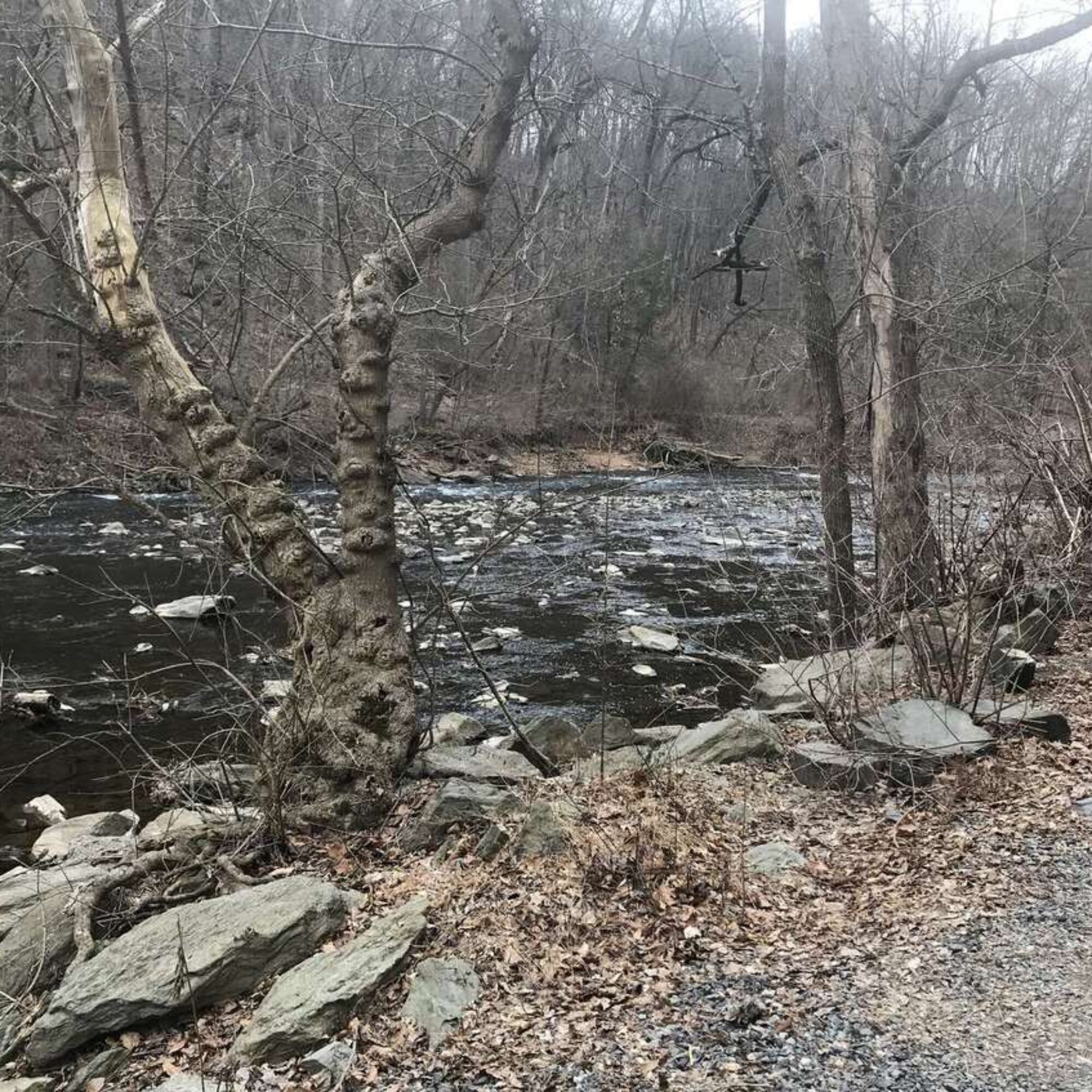
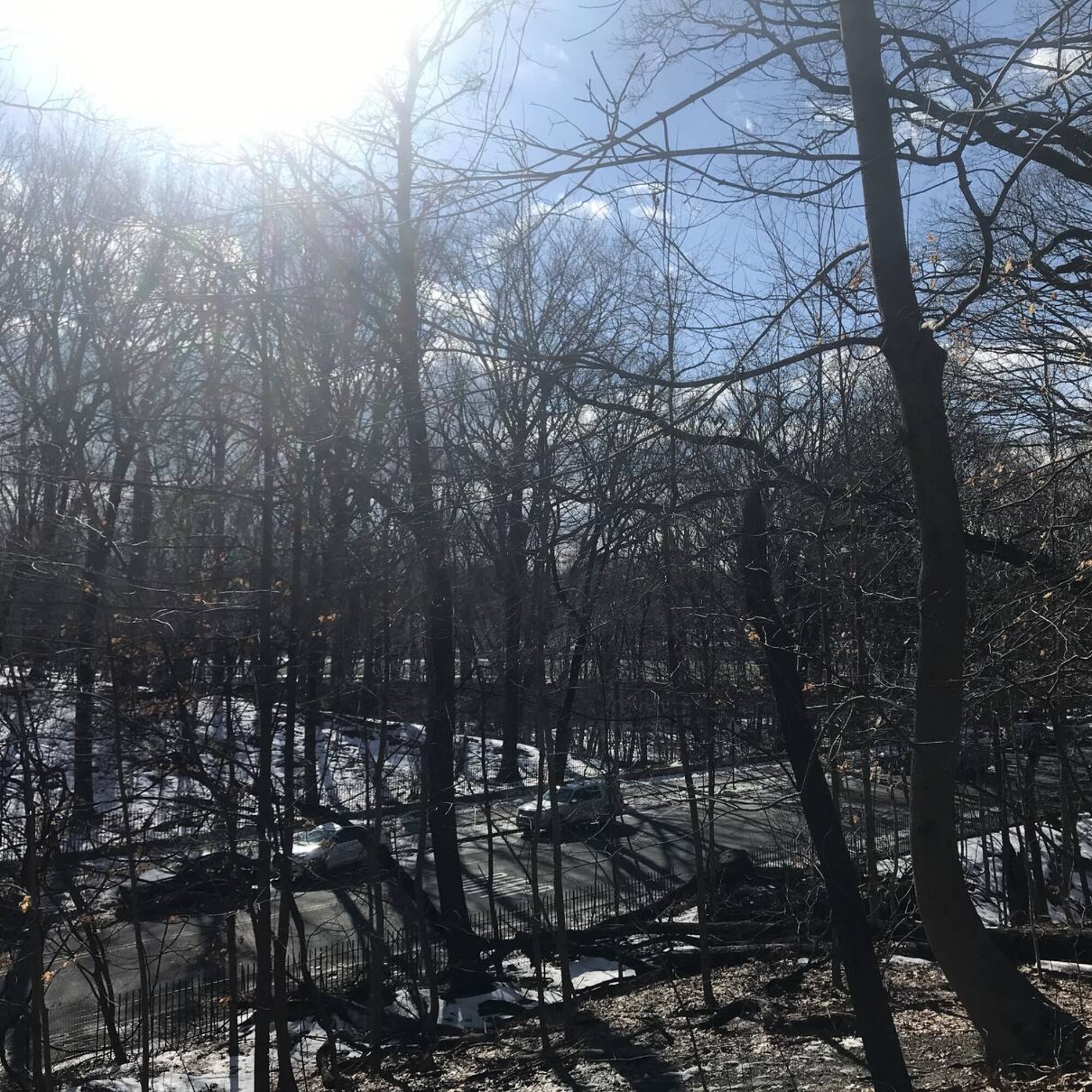
Another walk in the park with family Spodek Method commitment

I posted last month about a Spodek Method commitment to walk in a park with my sister in Queens based on walking in the park with my dad. Yesterday, I walked in the same park I did with my dad, this time with my other sister, plus her husband and son, my brother-in-law and nephew. To refresh your memory, that post, Another Spodek Method commitment: a walk in the park with family, began: I’ve done a lot of Spodek Method commitments. I’ve loved them all, at least I don’t remember disliking any, but haven’t recorded many of them here, but liked posting My Spodek Method commitment to make water ice from snow: A photo essay last month. I did another one over the weekend and…

0 Comments

Leslie Jones and the Daily Show getting votes for Trump

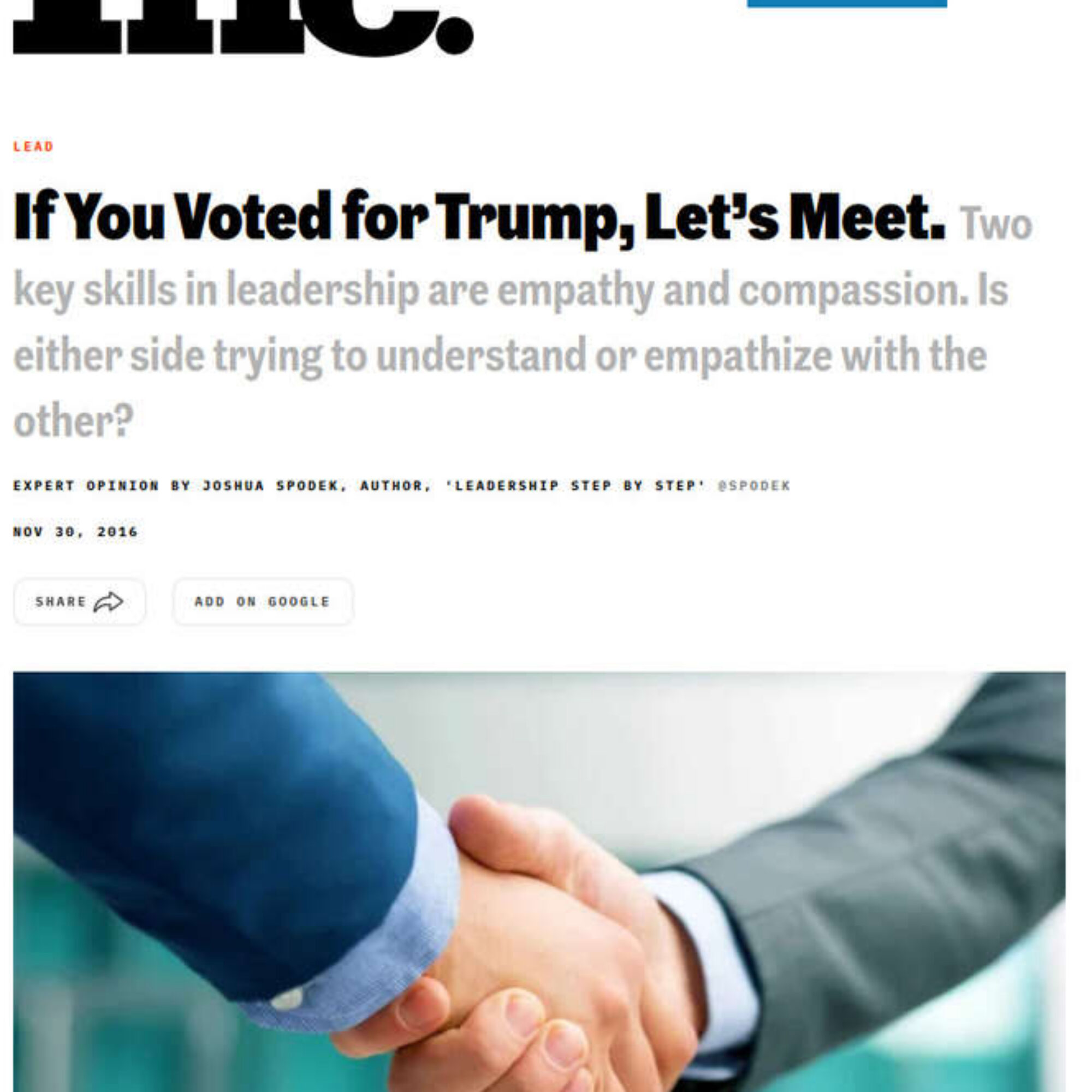
When Donald Trump was first elected President ten years ago, since I didn't know many Trump voters, I posted in the column I wrote then with Inc.com, "If You Voted for Trump, Let's Meet." The post led to several conversations with Trump voters across the US. I found the conversations informative and lovely. How could people who promoted compassion and tolerance so much be so mean? One comment that one Trump voter said stuck with me. She lived in San Francisco, where nearly everyone she knew disliked Trump. Many despised him. She told me she had to hide her voting choice out of fear of social repercussions. Yet all these people who attacked Trump voters with disdain claimed to value compassion and tolerance. Her comment:…

0 Comments

The importance of doing and talking about unimportant things

I wrote something last week in Another Spodek Method commitment: a walk in the park with family that prompted reflection: Talking while walking in a park is different than in the city or indoors when multiple family members are figuring out who sits where and what to do for dinner and all that nicknack stuff that goes into events. It’s peaceful, meandering, and unimportant in a way that makes it more important for life, just not for what drives much of American life, like productivity, efficiency, GDP growth. The prompt to reflect came from my contrasting what made for meaningful and delightful conversation with raising the GDP, efficiency, and innovation. Many people consider these last topics as core important topics for conversation. When I compare…

0 Comments

Some of the most thrilling words I’ve read in literature

The library near me displays books, changing them every day or week or so. Today they had Roots by Alex Haley. I read the book in college, I think in my first year, which would mean 1988-89. It wasn't for class and it's a long book so I don't know how I found time for it. I don't remember much of it, but there are a few words in it that nearly brought me to tears. I'm pretty sure I found the book compelling. I don't have to tell you what it's about, but I remember a pattern of telling about a person's life and times, starting with Kunta Kinte, then shifting to a descendant, telling that one's life and times, and so on. I…

0 Comments

What Makes Things Meaningful in Life

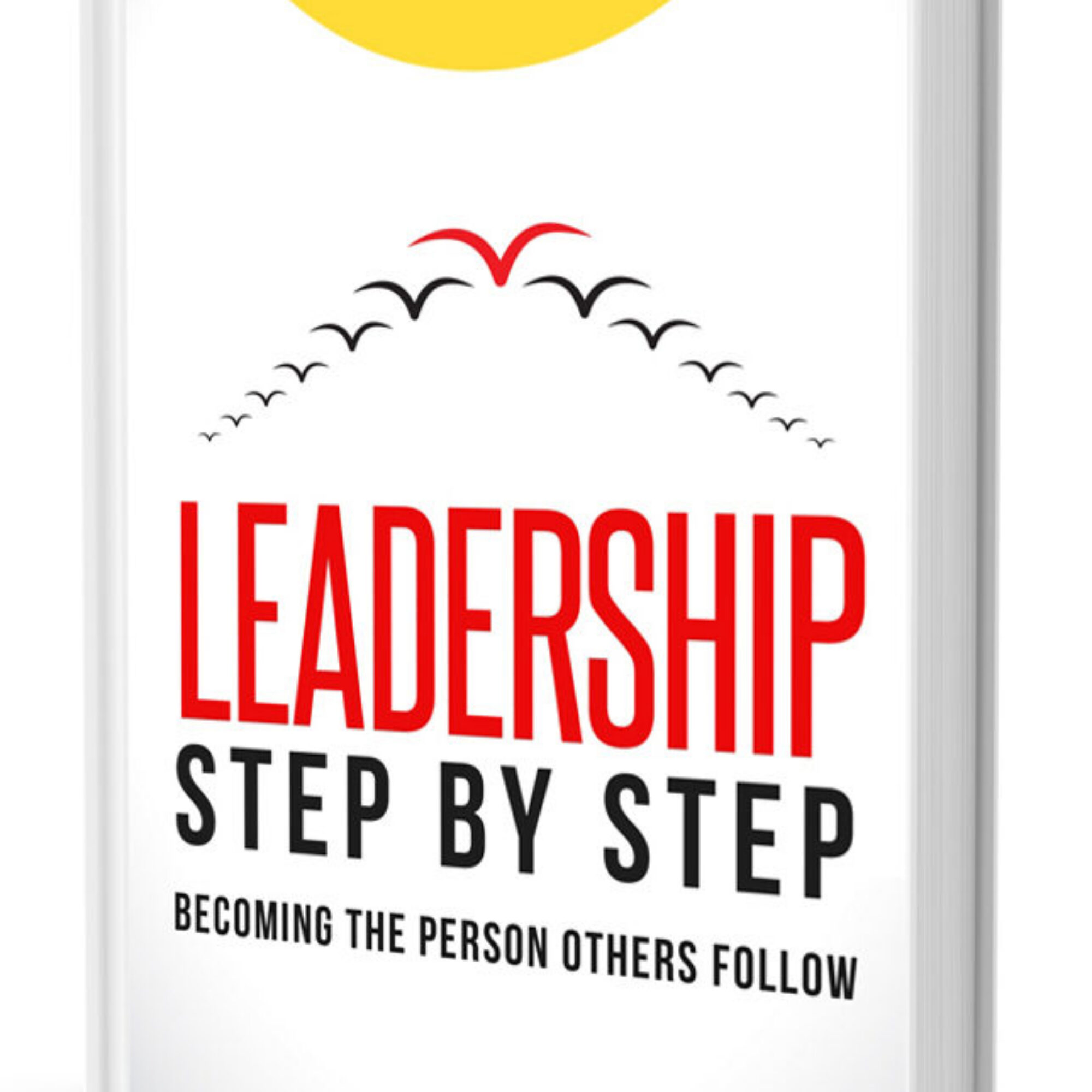
Do you like for experiences in life to have meaning? What makes an event or experience meaningful? It's tempting to say it's difficult to define. The dictionary defines meaningful as "Having meaning, function, or purpose" and meaning as "significant quality, especially: implication of a hidden or special significance." Those definitions seem vague to me. They just substitute the word quality for meaning. They don't suggest how to make something more meaningful. I've been using a definition that works for me since I wrote Leadership Step by Step based on the model of emotions in it. The model says that emotions have qualities like intensity and pleasure. If I haven't seen a girlfriend in months, the emotion of missing her may be intense. If I haven't…

0 Comments

If you want to travel, the opposite of what you should do is to fly

The more I see flying from the outside, the more I see it as the opposite of travel, or of achieving what people want in travel. First, if you walk somewhere, or bike or even ride a horse or sail a boat, you are traveling. That is, you are actively causing yourself to move from one place to another. When you get in a vehicle like a plane, train, or car, you aren't really doing anything. People talk about the magic of getting into a plane and then you appear on the other side of the world. Then you aren't doing anything. You're passively being transported. Second, it may have once been the case that the remote place you visited differed culturally from where you…

4 Comments

Family, flying, and Facebook-like visits

People are talking about flying to visit family these days. There's a running joke about the weird uncle or someone who is hard to get along with. I hope you're having a better time with family than the people I hear about, and they're not the people I work with who are living more sustainably. I'm talking about mainstream people talking about their usual holiday plans. Before flying, we used to spend time with family. Now our visits are more like Facebook interactions. We have come to see family members as problems. We only see them a few hours a year. We used to solve problems together. Now we cover up differences, biding time until we part and don't have to deal with them. We've…

0 Comments

Democracy, wedge issues, and calm

People's language and emotions get intense around wedge issues like abortion, gun rights, and tax levels. One side says the other wants to control women's bodies, the other says the one wants to kill babies. Such characterizations, mischaracterizations, and seeing the other from your view not theirs makes finding common ground nearly impossible. I call this pattern the worst problem in the world. Yet we have to live together. Secession didn't work so well in 1861. That's at the national level. At the individual level, if we can't talk calmly to our neighbors or think calmly, we can't become calm in the rest of life. Being angry all the time, or being stuck in emotions in that direction, doesn't make for a fulfilling life. My…

2 Comments

My short conversation with a guy injecting heroin into his neck in broad daylight, steps from my front door

I walked past this fire truck the other day. It was bright daylight, not nighttime, like when I took this picture. I saw a guy standing about where the "18" is on the truck's bumper, facing toward the truck, doing something with some stuff on the bumper, keeping it hidden, looking at himself in the reflection on the chrome on the grill. He was focused on what he was doing so didn't notice that I stopped to look more carefully at what he was doing. You know from the subject of this post what he was doing, but it was pretty obvious he was doing something secretive with the stuff and, given that we're in the United States in 2025, it was likely drugs. In…

0 Comments

The average American spends 5 hours per day on social media but claims not to have time to cook. Yeah, right.

The title says it all. Anyone who spends more than an hour a day on Instagram or Facebook is lying to themselves and others if they claim they don't have time to cook. It's the addiction speaking. Claims you're spending time with family are lies too. I'll be happy if you correct me if I'm wrong, but history, anthropology, and personal experience tell me that f your children are older than five---that is, older than children in hunter-gatherer cultures hunt animals with bows and arrows---they can shop for food and cook it. Again, correct me if I'm wrong, but it seems to me that if you don't let them, you're retarding their development and holding back love and support. Did I miss anything?

0 Comments

The paradox of homelessness and dependence nobody seems to see

Why are some people homeless? Why does the problem persist throughout time and across cultures? Learning about dominance hierarchies as systems helps see patterns beyond just what the eye sees. Take, for example, the observation that some cities in the US have greater homeless populations than others. People are quick to assign causality to correlation. To understand helplessness and homelessness, it helps to understand freedom. If freedom is ability to walk away without coercion or fear or risk of retribution, then people who lived where food and other resources were evenly distributed and all know how to live off of them, than egalitarian hunter-gatherers had more freedom than we do. That distribution also put personal responsibility on every individual to maintain mutually agreeable relations with…

0 Comments

The joy of understanding people we disagree with

The paragraph and three questions below appeared in a recent post about learning from people whose ideas and views I don't know enough to agree or disagree with. After writing them, I thought they deserved their own post. Part of why I'm posting and practicing these things is how clear disagreements become when one seeks to understand everyone independently of taking a side. Have you heard of the trend to counter the concept of a Fear Of Missing Out with Joy Of Missing Out? I want to counter the fear of understanding someone we disagree with implying we support them with the joy of understanding them leading us mutually to resolve conflicts. Anyway, I wrote in the post: I’m trying to understand people on their…

0 Comments

How we act when at the top of a dominance hierarchy: Learning from Thomas Jefferson

I've written many times about Thomas Jefferson embodying American culture today. He said all the right things about freedom and liberty. He considered slavery wrong. He still practiced it. His rationalizations and justifications are ours. I link to a bunch of those posts at the bottom of this post. I recommend them. If you want to understand how you sound to someone who lives by values you likely say you do, like do unto others as you would have them do unto you, live and let live, leave it better than you found it, and love your neighbor as yourself, read Jefferson's rationalizations and justifications. You know they're bogus. He knew they were bogus. He just about said he knew he would go to hell…

0 Comments

My comment on the media pooh-poohing “bros”

I wrote this letter to the editor of the New Yorker. It's been long enough that I doubt they'll print it, but I wanted to share my thoughts. Everyone knows our culture misunderstands women. I think men could use more compassion and that doing so won't hurt any other group. To the editor, Andrew Marantz's article The Battle for the Bros perpetuates a subtle but common double standard: when society conflicts with men, there's something wrong with men and they need fixing, but society conflicting with women means there's something wrong with society and it needs fixing. It shows up more among liberals and overcoming it would help answer the article's question "Young men have gone MAGA. Can the left win them back?". It appears…

0 Comments

More cultural exchange because of not flying: plinking and target practice

I don't know your views on guns, but I value both exploring different cultures and not polluting, which destroys life, liberty, and property. When my friend invites me to go to target practice at his shooting range outside the city, I'm happy to explore a culture as different from Greenwich Village, NYU, and Columbia as most places on earth. Unlike nearly anyone I know, I find cultures as diverse as any without flying and polluting. Many people I know look the other way at polluting, depleting, and homogenizing other cultures. Flying detracts from the values traveling is supposed to deliver. This one remains a constitutional right too, and I only took commuter rail to meet my friend. I didn't have to work months to save…

0 Comments

Democrats and Republicans are dancing together on sustainability for their mutual benefit, avoiding action, rallying their bases

A brief political history of sustainability [If you've watched my Short Course on Sustainability Leadership, you'll recognize the following from my session on the political opportunities. I'm putting only the main points here. I'll develop it more in a future post. I wanted to start writing. If you haven't watched the course, I think you'll find it one of the most important resources on our culture, the environment, sustainability, and leadership.] Scientists discovered our environmental problems/symptoms. They proposed solutions. Since academia skewed liberal, so did their proposals, even if they didn't intend to advance their politics. They just proposed what made sense to them. Conservatives saw their proposals as advancing liberal causes, all the more since they weren't practicing their proposals, so reacted against the…

0 Comments

End of content

No more pages to load