Education


Coaching highlights from coaching Columbia Business School students: find a relevant exercise

[This post is part of a series on Coaching Highlights from coaching Columbia Business School students. If you don't see a Table of Contents to the left, click here to view the series, where you'll get more value than reading just this post.] No matter what you want to improve about yourself, no matter how important the insight of feedback, and no matter how much you can learn from books, ultimately you have to practice to improve meaningfully. Find an exercise I think one of the greatest values a coach can add, especially in a short session, is to give someone who has identified an area to improve and indicated wanting to improve an exercise to have them experience improving in their desired area. A…

0 Comments

Coaching highlights from coaching Columbia Business School students: figuring out what to start with

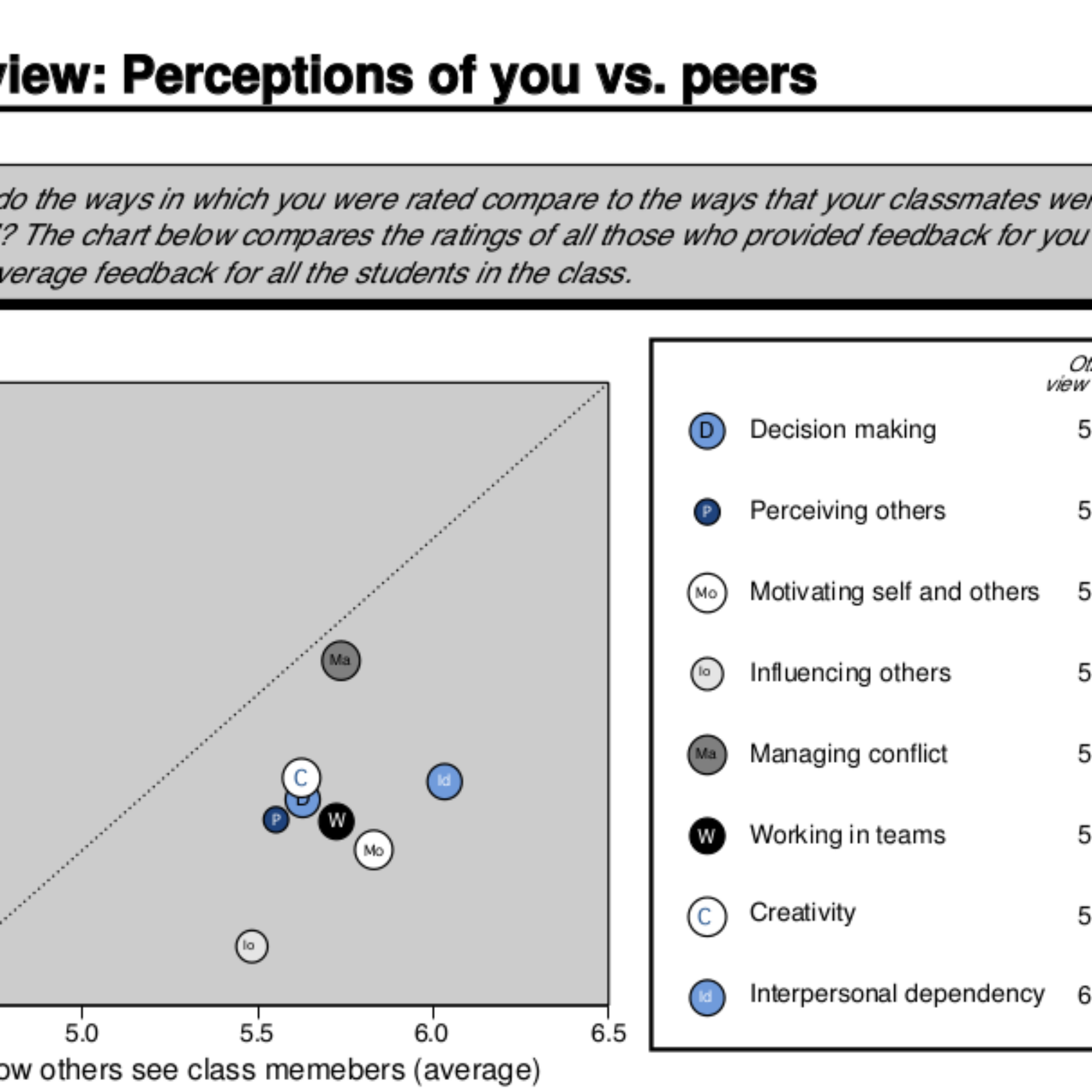
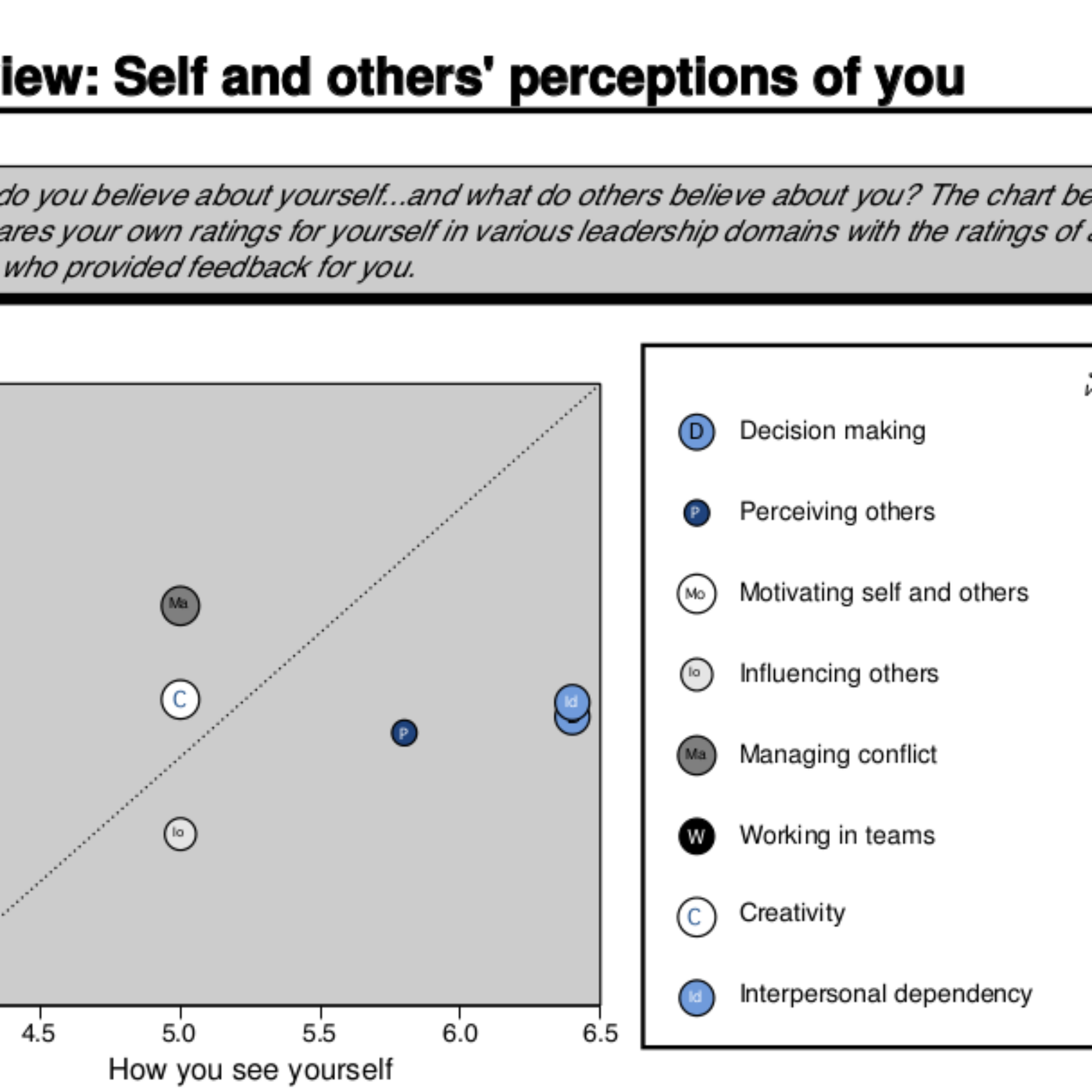
[This post is part of a series on Coaching Highlights from coaching Columbia Business School students. If you don't see a Table of Contents to the left, click here to view the series, where you'll get more value than reading just this post.] When your 360-degree feedback report features this chart and you want to start improving something, what do you start with? Keep in mind, you don't need a 360-degree feedback report to have to decide what to work on. Today's post applies to any time you want to pick something to improve yourself. You know from two days ago to focus on one meaningful thing at a time, but which? Nearly all the students I work with pick the farthest down dot, in…

0 Comments

Coaching highlights from coaching Columbia Business School students: Personal development skills

[This post is part of a series on Coaching Highlights from coaching Columbia Business School students. If you don't see a Table of Contents to the left, click here to view the series, where you'll get more value than reading just this post.] Leaders learn and push themselves to develop personally constantly and consistently. They don't see it as a burden, just something they do. Nor do they feel compelled from outside to do it. They enjoy learning. Nor do they feel like they need to accomplish some goal. They just enjoy doing things better. At least that's what I've seen and experienced. One of the reasons stems from an effect of yesterday's post that working on one complex, long-term thing at a time --…

0 Comments

Coaching highlights from coaching Columbia Business School students: Improve one thing at a time

[This post is part of a series on Coaching Highlights from coaching Columbia Business School students. If you don't see a Table of Contents to the left, click here to view the series, where you'll get more value than reading just this post.] A lot of students see the dots on the charts in their reports and decide they want to improve a few. In this chart, for example, they'll look at all the dots below the line, think "Uh oh, I'm behind my peers in everything," and decide to work on everything at once, or at least a few things. Most coaches I've talked to about it agree working on one area at a time makes the best progress not just in the area…

0 Comments

INSEAD leadership seminar

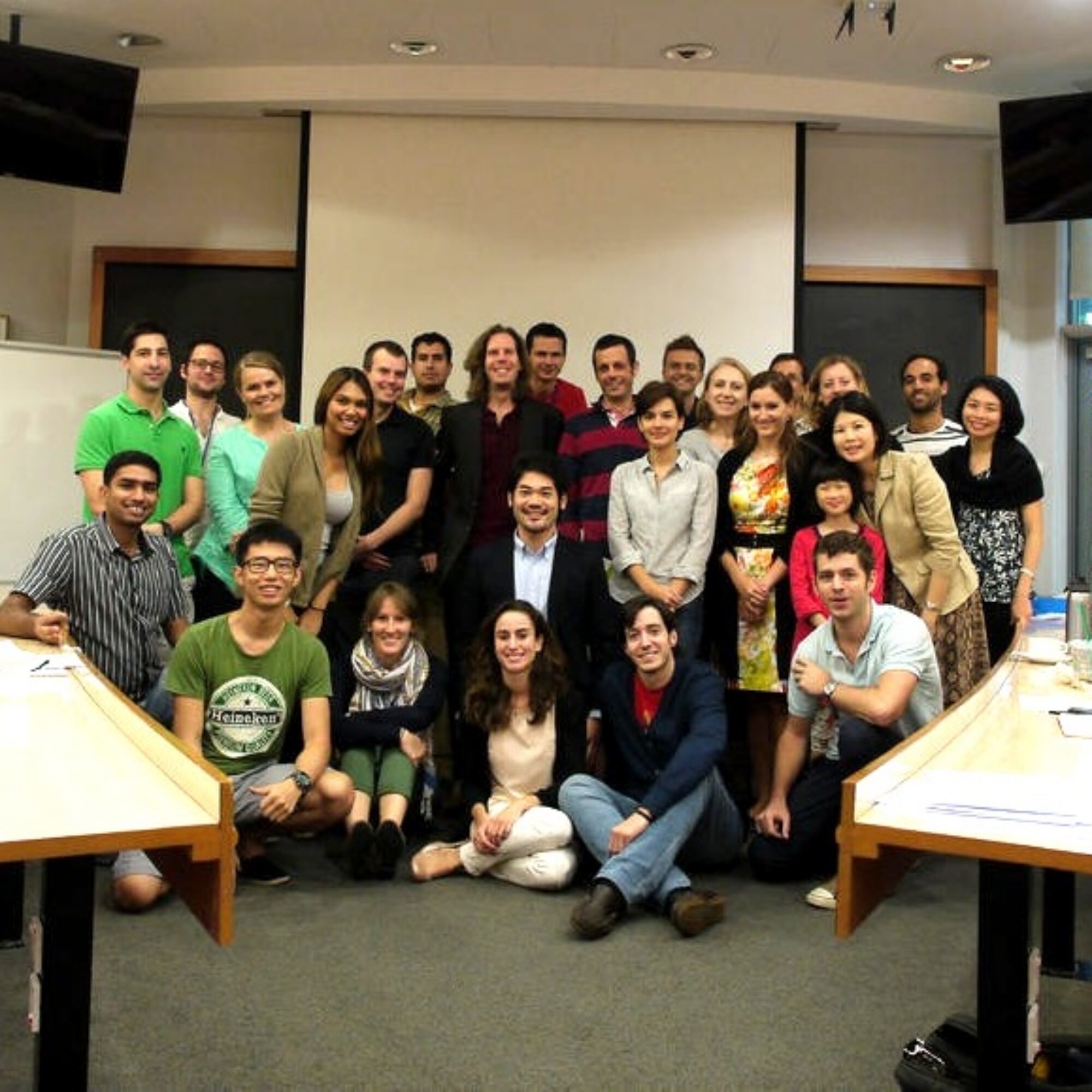
When I met Jose Gaztelu, my business school classmate and friend who did the bulk of the organizing for this weekend's INSEAD leadership seminar in Singapore, at the hotel Friday, he asked how many people I thought were signed up. When my flight had taken off that morning from Shanghai it was ten or twelve so I guessed about a dozen. "Thirty-two" So the attendees filled the room -- a great group. They were attentive, asked great questions, and started applying the material before the seminar ended. When I mentioned burpees, they wanted to get me to do a few and all started clapping to force me to do it. I said I would if they would. So about half the room did five burpees…

0 Comments

A sample 360-degree feedback report: qualitative feedback

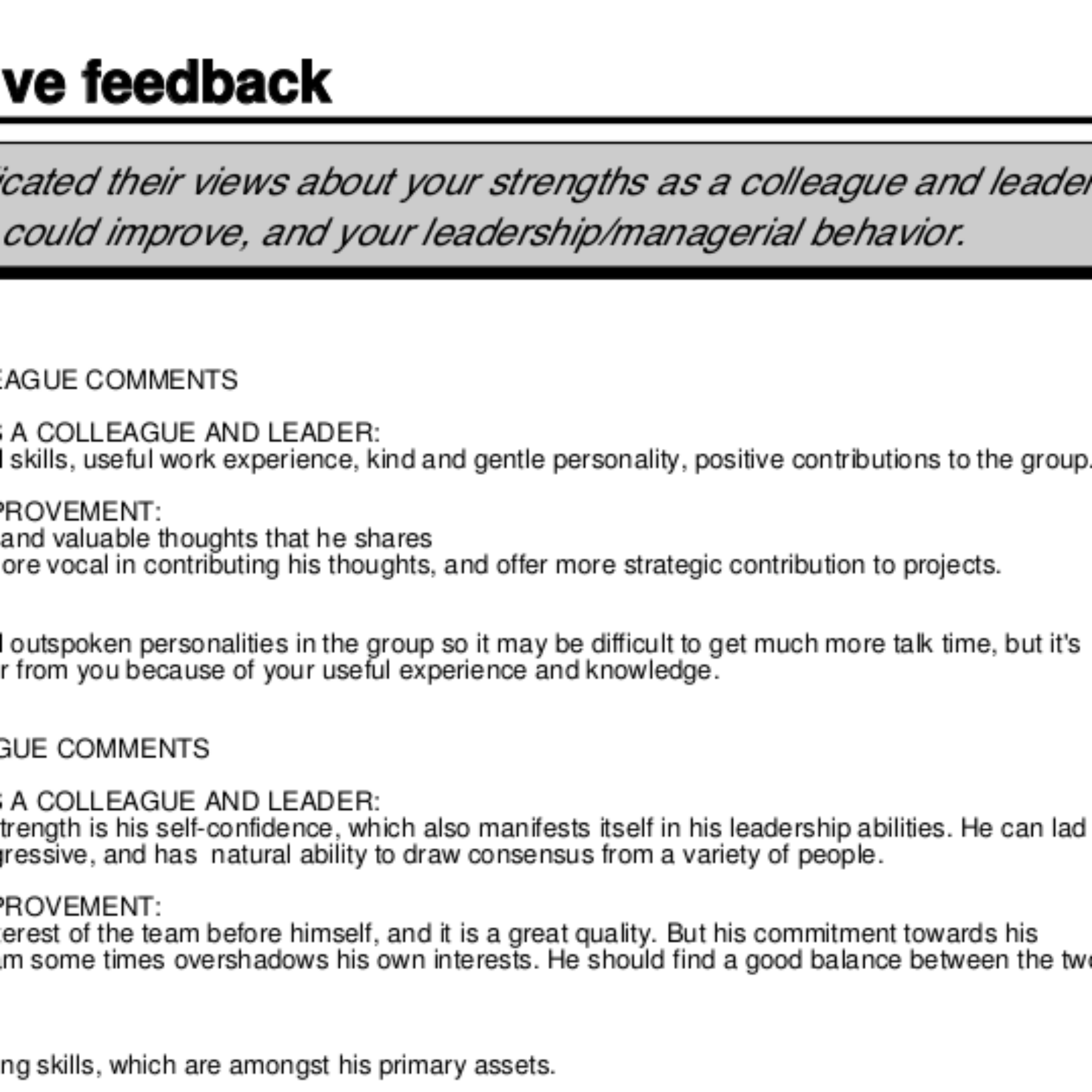
[This post is part of a series on Coaching Highlights from coaching Columbia Business School students. If you don't see a Table of Contents to the left, click here to view the series, where you'll get more value than reading just this post.] Any feedback report has to include qualitative feedback -- that is, free form feedback that describes how the subject performs and how to improve. In my experience the feedback I've seen hasn't been as useful as feedforward. It's been more feedback, which generally means evaluation of an unchangeable u, but feedback can still be useful. In any case, here are examples of qualitative feedback. It can't b e combined with other quantified results, but can give you some of your most useful…

0 Comments

A sample 360-degree feedback report: more detail

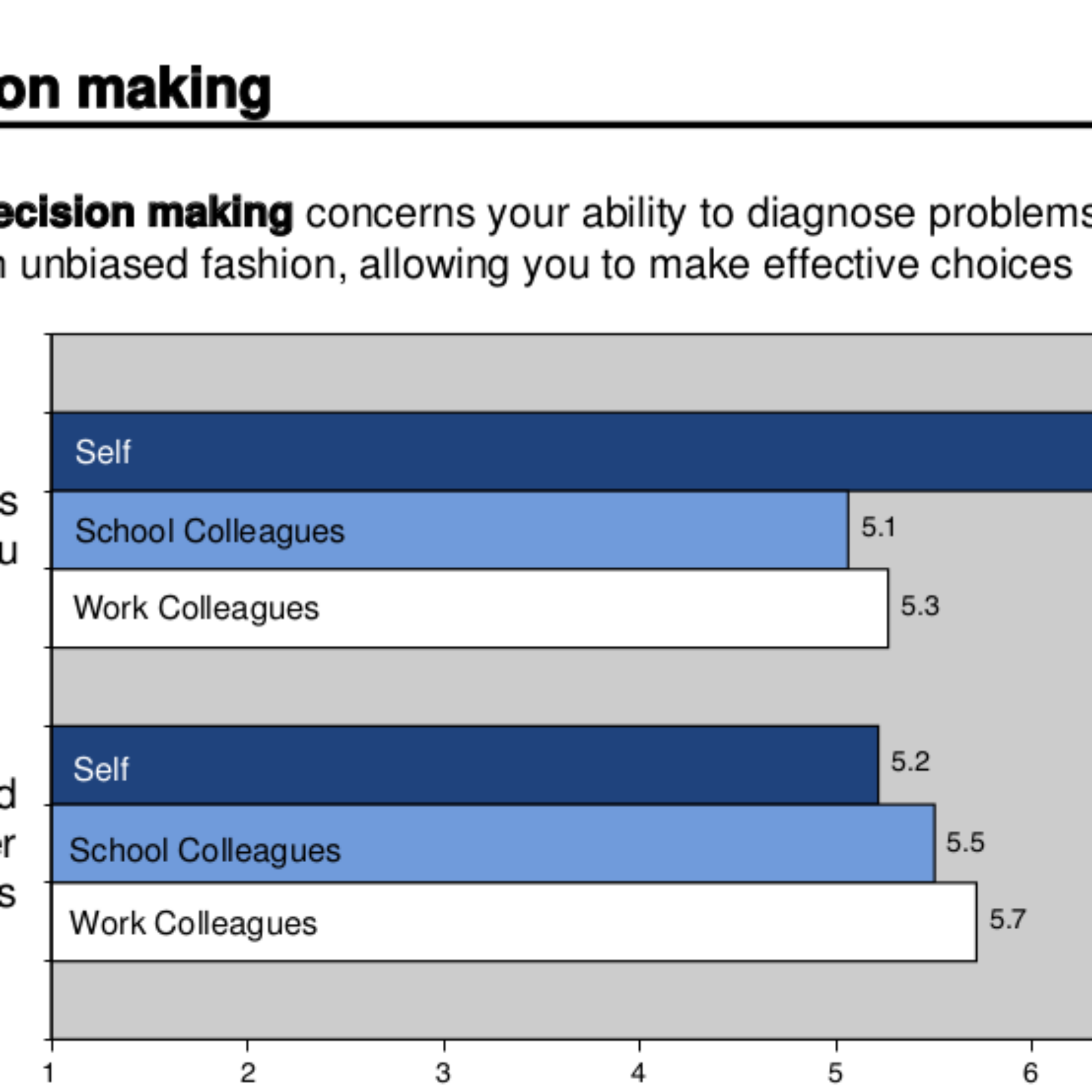
[This post is part of a series on Coaching Highlights from coaching Columbia Business School students. If you don't see a Table of Contents to the left, click here to view the series, where you'll get more value than reading just this post.] Yesterday's post covered what for most people are the highlights of a 360-degree review -- charts comparing how your leadership skills compare to others'. Those charts summarize most of the information in a 360-degree feedback report. One should always remember they summarize. They don't present all the information. Sometimes details tell a different story but get lost in the summary. Also, details may show how to improve better than a mere summary. Most 360-degree feedback reports include more detailed numbers. Here is…

0 Comments

Leadership lessons from 360-degree feedback charts

[This post is part of a series on Coaching Highlights from coaching Columbia Business School students. If you don't see a Table of Contents to the left, click here to view the series, where you'll get more value than reading just this post.] Just the structure of yesterday's charts teaches a lot about leadership. They emerged as main tools for communicating leadership ability and guiding improvement so even if you're never the subject of one, you can still benefit from knowing about them. Let's see a few reasons why. Let's look at one again. The chart breaks leadership into sub-skills My Core Leadership class at Columbia began with asking the professor asking us to define leadership. It's notoriously difficult to define. So instead of trying…

0 Comments

A sample 360-degree feedback: Overview charts

[This post is part of a series on Coaching Highlights from coaching Columbia Business School students. If you don't see a Table of Contents to the left, click here to view the series, where you'll get more value than reading just this post.] Let's look at part of a sample 360-degree feedback report. Today I'll show the highlights -- the summary of all the questions. Even if you've never had a 360-feedback for yourself, just knowing how they work can help you. Understanding their structure alone can help you figure out how to improve your leadership skills. First I'll explain what you're about to see. Each person responding to the survey about the person receiving the feedback gets asked to rate the person in several…

0 Comments

Coaching highlights from coaching Columbia Business School students: 360-degree feedbacks

[This post is part of a series on Coaching Highlights from coaching Columbia Business School students. If you don't see a Table of Contents to the left, click here to view the series, where you'll get more value than reading just this post.] Before going into the details of looking at a 360-degree feedback report, I want to talk about the structure of the 360-degree feedback process and what it tells you about leadership. What is a 360-degree feedback? 360-degree feedbacks are usually done in corporate and bureaucratic environments as review processes, both to help evaluate performance and to help people improve their performance. The process is that you or someone (typically in the Human Resources department) gets feedback from all sides -- people above,…

0 Comments

Coaching highlights from coaching Columbia Business School students

[This post is part of a series on Coaching Highlights from coaching Columbia Business School students. If you don't see a Table of Contents to the left, click here to view the series, where you'll get more value than reading just this post.] I've been posting a lot on personal development, so I'm going to focus on specific leadership and leadership development issues for several posts. I've had the privilege and responsibility of coaching leadership to many Columbia Business School students, both in the regular and Executive MBA programs. For the next several posts I'll cover a few of my observations in coaching leadership in that environment -- usually tips on improving business leadership, but also leadership, leadership development, and personal development in general. The…

0 Comments

See Joshua Spodek at INSEAD Singapore next week

I'll be delivering my seminar on  next weekend in Singapore, October 6 and 7, at INSEAD. Here's the announcement. I hope to see you there. Leadership Through Self-Awareness and Emotional Intelligence Workshop led by Joshua Spodek, MBA, PhD; supported by the INSEAD Toastmasters Club INSEAD Toastmasters Club is pleased to announce a two-day (half-day) experiential workshop focused on how to develop personal leadership skills, self-awareness, and emotional intelligence by using the latest advances in cognitive behavioral science, evolutionary psychology, and positive psychology. We are lucky to have Joshua Spodek in Asia (he lives in New York City), who has delivered the workshop in New York and London with much success, to many different audiences, e.g., the New York Academy of Sciences, Columbia Business School Alumni…

0 Comments

Amazing essays by amazing writers and thinkers

I stumbled on this more-than-a-decade-old amazing trove of essays. Just reading the authors' names is impressive. They are essays written by great thinkers, writers, etc on "best" things of the past thousand years. I'll cut and paste most of the essay titles and links here. I've only read a few so far, but I've loved each. Sorry I haven't reformatted much, but you can always go to the original site for the full treatment. Eyes Wide Open By Richard Powers Every Dictator's Nightmare By Wole Soyinka When Tristram Met Isolde By Joyce Carol Oates Best Magic Trick By Teller Video Best Feat of Engineering By David Macaulay Best Nuisance By Penelope Fitzgerald Best Innovation in Painting By Michael Kimmelman Slide Show Best Vision By James…

0 Comments

If you want to change something you do, its opposite usually is no better. Look for its complement.

People seem to want to change a lot about them. I see them trying to do the opposite of what they are trying to change. Sometimes it works. More often trying to do the opposite of what they want to stop reinforces doing it more. Food For example, overweight people often think if they eat too much they should try the opposite and try to eat less. But dieting seems to predict obesity more than prevent it -- that is, people who diet tend to be more obese than those who don't (sorry I don't have a source, so feel free to read this part skeptically). I find the complement to eating too much is not to eat less but to savor and enjoy your…

0 Comments

A model to make hard decisions easier

[This post is part of a series on "Mental models and beliefs: an exercise to identify yours." If you don't see a Table of Contents to the left, click here to view the series, where you'll get more value than reading just this post.] When I worry about a difficult choice I have to make I think of a parable. Some martial arts students ask their teacher how he always keeps his balance. He asks what they mean. They say, well you never fall down so you must never lose your balance. He says, on the contrary, I'm always losing my balance, but I'm also always recovering. I try to live like that. Things are always making me lose my balance but I rarely fall.…

0 Comments

How I got to work a day or two a week

Despite my posting on how I find asking "so what do you do" a boring question, apparently everyone I meet hasn't read every post on my site, so they keep asking me what I do. It's hard to answer the question when you know they want to know your work when work is such a small part of your life. You can talk about making art, writing, travels, etc, but those answers never satisfy them. They want to know your job -- passions, hobbies, relationships, etc be damned. You may want to suggest how they don't have to accept one's job defining so much about a person -- or that if it does you don't have to ask, they'll tell you. But if someone did…

0 Comments

Union Square in Motion named Adobe Design Achievement Award Semifinalist!

Union Square in Motion made the prestigious 2012 Adobe Design Achievement Award semifinals! The Adobe Design Achievement Awards celebrate student and faculty achievement reflecting the powerful convergence of technology and the creative arts. The competition - which showcases individual and group projects created with industry-leading Adobe creative software - honors the most talented and promising student graphic designers, photographers, illustrators, animators, digital filmmakers, developers and computer artists from the world's top institutions of higher education. Adobe sent us the certificate below, somehow not getting around to naming the artists -- Jaqi Vigil, Hilal Koyuncu, Rose Maison, Josefina Santos, Umut Ozover, and me; and co-producer with me, Anezka Sebek -- or the name of the project: Union Square in Motion. Anyway, I couldn't be prouder of…

1 Comment

My essays for getting into an Ivy League business school in 23 days

Here are my Columbia Business School application essays, to complete the series on getting into business school in 23 days. I edited them slightly, mainly to take out personal details. In the optional essay 5, I can see I was blatantly name-dropping Columbia Business School Professors and my experience at the school. I think I could have used more subtlety. My graduate school stipend -- what I lived on in Manhattan for about four years -- surprises me to this day. I think the number was accurate, but wonder if the first number might have been a 2 instead of a 1. Anyway, here are the essays. Essay 1 1. What are your short-term and long-term post-MBA goals? How will Columbia Business School help you…

0 Comments

My background for getting into an Ivy League business school in 23 days

Yesterday I posted about the process I stumbled into for getting into an Ivy League business school in 23 days. How to read this post Today I'll talk about the credentials that made it possible. But please recognize, the point of these posts is not merely to show you how to get into business school, but to show you that you can combine whatever you have in your past into something bigger than you expect. You have to be aware of the possibilities and ready to act on them. If you are insecure and want to justify why can't succeed, you'll read this post to see how other people can achieve big things because they have advantages you don't. I used to look at things…

2 Comments

I started at an Ivy League business school 23 days after deciding to apply. Here’s how.

On December 10, 2004 I decided to apply to business school. I had written no essays, taken no GMAT, reviewed no school's web site or application process, and asked no one for a recommendation. On January 2, 2005, 23 days later, I began orientation at Columbia Business School (ranked #5 by Forbes, Economist, and Financial Times). I got my MBA the following May, less than eighteen months from deciding to apply. Prep schools (such as Manhattan GMAT and Kaplan) recommend starting the application process eighteen months before starting classes. I completed my entire application and degree in less time than they recommend for just applying. Business school ended up one of the best experiences of my life, a turning point improving it in many ways…

0 Comments

More on North Korea’s art

From my notes while I was there in April: North Korean performance art: technical perfection while appearing effortless ... emote wonder and hokey joy ... layer it on ... add difficulty. Zero subtlety. That just about describes it. I also noted the following. Something tells me that the technical perfection in North Korean arts reflects middling ability in its leadership to prove its self-worth. Maybe I extrapolated too far, but someone is driving their artistic and athletic direction. Since North Korea controls personal expression so much, they can't motivate their artists to express themselves how they want, so how can they promote something like art? They can promote easily quantifiable and measurable results. North Koreans can justifiably say they're better than nearly anyone else on…

0 Comments

North Korean children’s nearly unbelievable performances

The pictures below don't even approach showing the almost unbelievable performance ability of North Korean children. Joseph's pictures showcase their talent better. But no images can show the professionalism, dedication, and raw talent these kids have. The pictures below are from the Children's Palace, which trains children to perform and create art and puts on incredible performances. After their performance last time, my travel groupmate who was starting a school to train opera singers, reacted with disgust at the performance. As I understood, he saw their type of performance -- technical perfection that could only result from repeated drilling and repetition devoid of personal expression -- as destroying everything he valued about art -- personal expression and emotional exploration. He saw children whose artistic world…

0 Comments

What works in X web page mind map

Following up a comment on my post on the What Works in X web page genius idea, I created a mind map as a rough outline for the site to illustrate it better. It's only a rough outline, but I think a good start. Copying from my response to the reader's comment I envision people at What Works in X sharing anecdotes of things they've done at a higher level, like how they got hired by doing something different or got into North Korea or things like that... available in any area. Of course, I put the idea up for others to do with it what they want. I'm as happy to inspire someone else's slightly different vision as for them to implement mine. Also,…

0 Comments

Another genius business idea: the “What Works in X” web page

Following up on yesterdays' genius business idea for a book series of successful solved problems in many fields, today let's look at a web page doing something similar. Instead of making it just like a book, let's take advantage of the web's interactivity and let users create content. It's based on the principles of the Art of What Works (the book I mentioned the other day) The product A web site of user-written anecdotes of successful things they did, categorized by field -- eventually, the global repository of solved problems in every field, free for anyone to access or contribute to. Once populated with content, the main use of the site would be for anyone with a problem to solve. They would log in, search…

2 Comments

Another genius business idea: the “What Works in X” book series

For the first genius business idea (the series I mentioned a couple days ago) I propose a book series based on the principles of the Art of What Works (the book I mentioned yesterday). The product A series of books like the "for dummies" and "for complete idiot" series, all with the same dimensions, cover design and color scheme, tone, writing style, etc called "What works inX", like "What Works in Selling Your House", "What Works in Nursing", "What Works in Teaching High School", or "What Works in Starting Your Own Restaurant." Each book contains anecdotes of people achieving success in the field that you can learn from -- a series of solved problems you can use to solve your problems. The fundamental principle is…

0 Comments

End of content

No more pages to load