A silly post I couldn’t help posting

Though I post daily, I think of more post ideas all the time, more than I can post. I write some ideas on paper, some in files, some in browser tabs, some on the big blackboard in my apartment. Usually I get around to posting each idea. Sometimes after a while I decide the idea isn't worth posting. One post idea has sat on my board maybe for a year, far longer than others. I can't bring myself to erase it but it doesn't seem worth posting either. It's not even that original. I guess I'm sharing this build up to the idea to share some of the creative process, if these notes of context qualify. I like mixed metaphors. I like when people look…

0 Comments

853: Kate Williams: CEO, 1% for the Planet

I'd seen the "1% for the Planet" logo many times and figured it was an organization that helped, but I didn't think of how. The businessman in me wondered, shouldn't companies just lower prices 1% and let people donate what they want? Does one percent make much difference? Kate was passing through New York so we got to meet in person. In this recording, she answers these questions and more. She describes the organization more comprehensively, but briefly, 1% for the Planet organizes other organizations, some to donate, others to receive, and vets them. What interested me most was their long-term goal, which is cultural change, which fits with mine. Kate didn't found the organization, but as CEO has scaled the network to 110 countries…

0 Comments

“Are we running out of land for landfills?”: A Richard Feynman view from the 1986 Space Shuttle disaster

Richard Feynman is the Nobel laureate physicist who studied what caused the Space Shuttle Explosion of 1986. He learned that the o-rings likely leaked because past measurements showed cracks in them at low temperatures, like those just before the launch. Anyone my age or older remembers the image. He saw that people who saw the earlier cracks saw that because the cracks only went about a third of the way through, "there was 'a safety factor of three.'" I put the full quote below, which I recommend reading, but the gist is that since the o-rings were designed not to crack at all, there was no safety factor. Any cracking at all meant they failed. The Relevance to Landfills I ran into an old friend. Our…

0 Comments

Some of my favorite solo podcast episodes

When I redesigned my site, my page of favorite posts couldn't link to individual podcast episodes, so I'm making a separate page for my favorite solo podcast episodes. Most episodes are with guests, but in solo episodes I share personal thoughts on my own. For context, since I started working on my upcoming book, around January 2025, I saw that new ideas needed the book for foundation, so held back on solo episodes. I'll restart when the book is closer to its final draft and being prepared for printing. The new ideas move past some of the ideas in the episodes below, but even if obsolete, they reveal one person's journey from polluting and polluting more than most people ever to the first person I…

0 Comments

“Could Switzerland Become the First Country to Cap Its Population?” asks the New Yorker, and I comment.

The New Yorker reported this week: Could Switzerland Become the First Country to Cap Its Population?: The Swiss will soon go to the polls for a novel initiative that could upend the nation’s economy and rupture ties with the European Union. An early paragraph describes the article's main issue. I'll share it plus a couple other paragraphs, then my comments after. On June 14th, Switzerland will vote on whether to become the only country in the world to officially cap its population, with a limit of ten million people until 2050. (The current population is 9.1 million.) The initiative, which was put forward by the Swiss People’s Party (S.V.P.) and in recent polls has been supported by as many as fifty-two per cent of respondents,…

0 Comments

This week’s selected media, June 7, 2026: The Greatest Sentence Ever Written, Slavery–Summary on a Map,

This week I finished: The Greatest Sentence Ever Written, by Walter Isaacson: Wow, the original content of this book is only 41 small pages, not counting empty pages at ends of chapter, with not many words per page, but packs a lot of meaning. It also includes important selections from Locke and Rousseau, as well as Jefferson's first draft of the Declaration and the full signed Declaration. Isaacson looks at the second sentence of the Declaration: We hold these truths to be self-evident, that all men are created equal, that they are endowed by their Creator with certain unalienable Rights, that among these are Life, Liberty and the pursuit of Happiness. and elaborates on it word or phrase by word or phrase. He considers the…

0 Comments

NYU’s president breaks NYU’s rules, to pollute and deplete of course

I wrote in 2023 about NYU consistently violating its own rules in NYU in 2019: We will stop buying bottled water. NYU in 2023: Here’s some bottled water from us. It's tempting to read something I'm not writing. I'm talking about leadership, which requires credibility and integrity, which require hands-on practical experience, not mere talk. I'm not writing in judgment. During a bus boycott, Martin Luther King would undermine everything if he occasionally took the bus, or even once, even if it took him places faster than any other way and he could do more with that extra time than anyone else. I attended a wonderful event hosted by NYU this week. The prominent author Walter Isaacson spoke about his book on the Declaration of Independence…

0 Comments

More roots: an ancestor who worked with George Washington and on the Continental Congress

In 2011, I posted Roots—I descended from seventeenth-century Salem puritans!, about some of my family tree, in particular a part on my mom's side in which one direct ancestor sailed to the colonies from England in 1635. It's neat to have family that arrived here before the nation formed. On my dad's side, my grandparents came over about a century ago from Europe, where they were born. The relatives they left behind likely went up in smoke in Auschwitz or a similar camp, but no one I know of has found any records. Back to my mom's side, a relative found a site about a Varnum house in Rhode Island, which seems to be a many-times-great uncle of mine. He sounds remarkable, having worked with…

0 Comments

What I love about expensive gyms

I love walking past Equinox gyms, or any other luxury gym. Or any gym for that matter, though especially the expensive ones. New Yorkers commonly pay $300 to $400 per month for Equinox memberships. Why do I love walking past them? Because almost guaranteed, someone will be walking in or out who is less fit yet spends more per month than I spent in probably the last decade on fitness. and I know that I got my full workout in less time than they took commuting or possibly even just changing clothes. The friend I mentioned yesterday in More Personal Bests: floor press, single-arm row, Turkish get-up also once told me he could show me how to get a full-body workout with two kettle bells.…

2 Comments

More Personal Bests: floor press, single-arm row, Turkish get-up

Personal best 1: floor press Regular readers know that when I bought my 70-pound kettle bell, I almost couldn't use it (though carrying it from the person I bought it from, used from Craigslist, to the subway, down the stairs to the subway, up and down stairs to transfer, and up more stairs home was a farmers walk). A few months ago I reported reaching personal bests for reps for floor presses. Well, last Thursday I reached eleven reps for my first set. When I got it, I may not have been able to do one rep. I'd been doing 10, 9, 8 for my three sets on my lifting days. Last Thursday I hit 11 for the first set. I didn't plan to. I…

0 Comments

The Timeline for Pollution and Depletion’s Effects on People

This post follows The Scale and Pollution and Depletion's Effects on People: Here, now, not future projections. I suggest reading it first. The timeline is important. Before the atrocities above, things could seem like they might work out, then explode. I could treat any of them, but will pick US slavery since its timeline is long, so easiest to discern. Here is the increase in number of slaves in the US from 1610 (zero) to 1860 (4 million): US slavery in the years approaching 1860 involved a national culture of trade, torture, and killing. While any instance of slavery is cruel, that national culture didn't exist in 1619. Oxford-educated Trinidadian historian Eric Williams wrote, “A racial twist has thereby been given to what is basically…

0 Comments

The Scale and Pollution and Depletion’s Effects on People: Here, now, not future projections

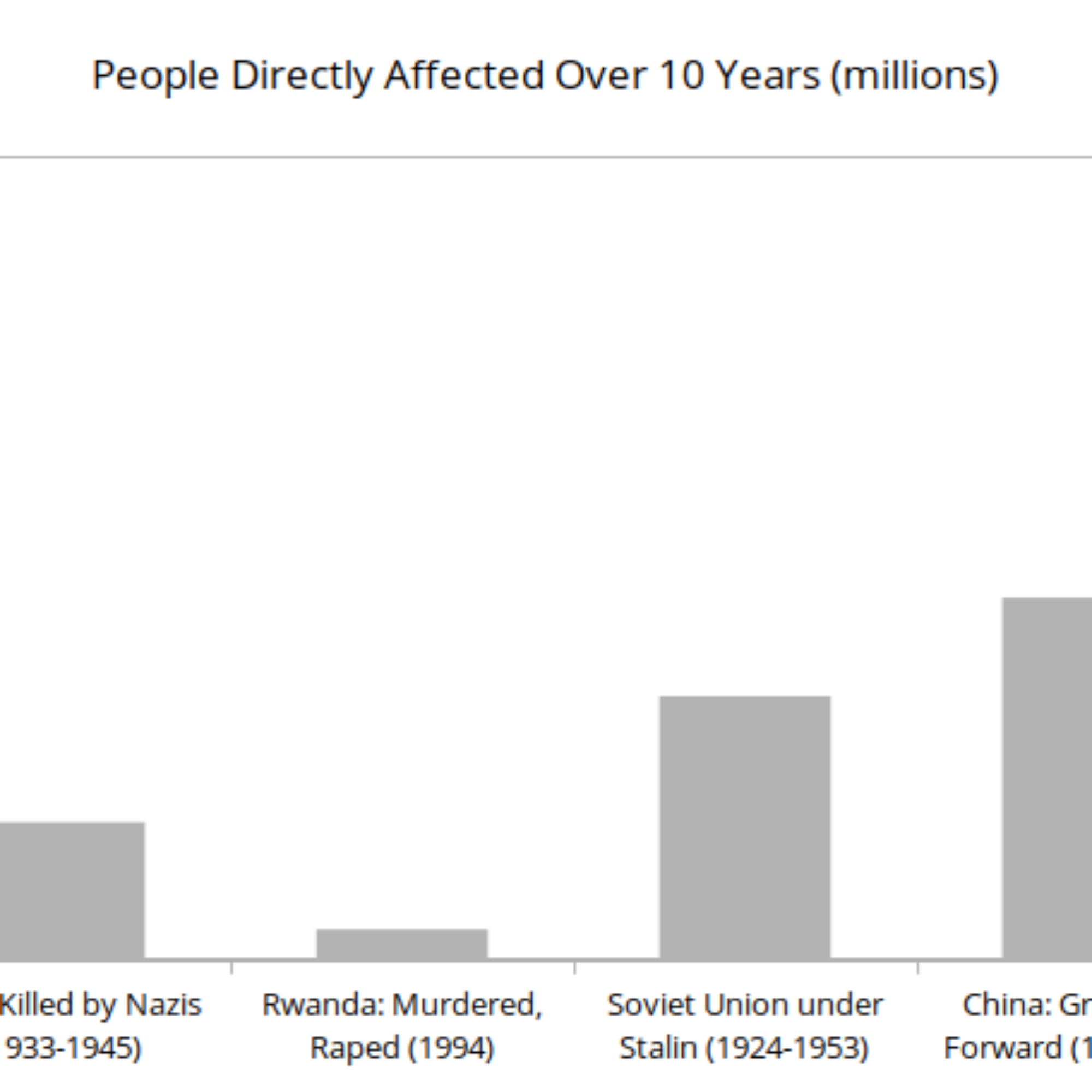
I talk about the USSR gulag system, abolitionism, slavery, the Holocaust, and similar atrocities in the context of pollution and depletion. Most Americans know the horrors of slavery and the Holocaust. We know viscerally the images of slaves' welts and concentration camp survivors looking like skeletons. By comparison, images of pollution and depletion look like piles of garbage and graphs of CO2 concentration. Similarly, few images of the gulag exist because few were taken and few Americans register how many more suffered and died, nor how gruesome the conditions. Am I stupid, ignorant, or crazy to talk about these atrocities in the context of pollution and depletion? Context and Frame of Mind Before reading this post, it helps to clarify how you feel about some…

0 Comments

850: AJ Harper, part 1: Write to change lives, including yours

Two core elements of leadership are effective communication and creating community. AJ has done both. I can attest from taking her writing workshop and participating in her author community since. I wrote the first draft of Sustainability Simplified in her workshop. I also valued the book she co-wrote with her writing partner and podcast guest Mike Michalowicz. As you'll hear in our conversation, their podcast is one of the only ones I've listened to every episode of. I've wanted to bring her on the podcast for a long time since I learned so much from her and value participating in her community so much. If you're here to build community to change culture, I believe you can learn from AJ's journey and building her community. I…

0 Comments

A new insight on beliefs

In Leadership Step by Step, I give several exercises on how to influence how you perceive the world. I recently found a simpler way of describing them. We all know that our beliefs influence our perception. If you believe a person approaching you is friendly, you perceive them differently than if you believe they intend to hurt you. Many people don't know that they can choose their beliefs, even people who work on mindfulness. I participate in a meditation group that includes people who have meditated regularly for decades. They generally know that if they feel an emotion or thought that they don't like then if they observe it, it will pass. This skill helps calm one's life. It makes you less reactive. I work…

0 Comments

849: Josh Bandoch, part 3: How to Get What You Want: Mastering the Art and Science of Persuasion

Josh Bandoch published a book on persuasion, influence, and leadership: How to Get What You Want: Mastering the Art and Science of Persuasion. I wish I'd had this book decades ago. It handles myths many people hold about persuasion that hold people back, then builds up the skills and theory to influence and persuade people effectively. It compiles many essential building blocks of persuasion and influence into one place. We talked about it at length in this episode. I recommend it, and would if I didn't know Josh B. In fact, our shared passion for learning, teaching, and coaching how to lead is a major piece of what connects us. From his book page: Life is about getting what you want. When you’re negotiating a…

0 Comments

Environmentalists rarely try to solve the problem

Fixing the results of a problem is not the same as stopping it from recurring and you rarely can undo all the problems, especially if you do it persistently. For example, exercising doesn't make up for an addiction to doof. Even if you burn off the calories, it doesn't fix the health problems or make back the wasted money. More importantly, since you keep consuming doof, you'll likely miss exercising sometimes. Relevant to polluting and depleting: plant all the trees you want. If our culture values affordable houses and food, when they want to chop your trees back down, they'll find a way to. I distinguish mopping up the mess from not causing it because I'm getting flooded with requests for people promoting stuff for…

0 Comments

Why do we fund our enemies by air conditioning the outdoors?

Find me a war where at least one side isn't partly funded by oil money. Find me a war that isn't threatening to expand at least regionally, maybe globally. Where is that oil money coming from? Who is helping raise fossil fuel prices, thereby increasing the resources and power of Putin and his peers? Look no further than this restaurant, running the air conditioning with the doors wide open, and all the people patronizing it. Also all its peer restaurants, stores with their doors open, etc, and all of us spending money with them. It's only April. The air outside is comfortable. Pictured below is total waste. Another view:

0 Comments
The Constitution has no extraneous protections.
The United States Constitution

The Constitution has no extraneous protections.

I wouldn't want to live in a nation or world without freedom of speech, freedom of the press, protection of being tried twice for a crime, or any of the protections in the Constitution. I don't know anyone who would. All must enjoy the protections you do for it to work, even if you really want to deprive others of them It might be tempting to think it would be nice to enjoy freedom of speech or of the press for yourself but to be able to limit the speech or press of others, like your political enemies, but if you think about it enough, you conclude that you're better off with everyone enjoying all those freedoms. That is, you might be tempted to be…

0 Comments

This week’s selected media, April 19, 2026: Heirs of the Founders, Led Zeppelin’s catalog

This week I finished: Heirs of the Founders: The Epic Rivalry of Henry Clay, John Calhoun and Daniel Webster, the Second Generation of American Giants, by H. W. Brands: The following words go through my mind a lot these days: We learn about Washington, Jefferson, Madison, Douglass, Lincoln, Gandhi, Mandela, and MLK because we want to be like them. Learning about role models helps us learn to live like them. But if we want to learn about who we are, we should learn about people like John C. Calhoun and Benedict Arnold. It's uncomfortable to accept, but the people in the first list are so important because they had to overcome so much resistance, which came from everyone else, which most of us resemble. We…

0 Comments

The ability to empathize with or speak for the oppressed isn’t what we think

Understanding the plots in my post Why I work on sustainability leadership here and now despite other things I could do instead clarifies how to see our culture. We live in a culture that causes more death and suffering than any other, including the greatest historical atrocities. People today often suggest that people today who don't descend from or look like people who suffered and died can't understand or empathize with them, implying that their voices shouldn't count as much. They also imply that people who descended from or look like people who caused suffering and death bear some responsibility by dint of that relation or similarity, or benefited from it. These views miss our complicity by polluting and depleting in causing suffering and death…

0 Comments

What we can learn from jarring images from the Civil War Museum in Harrisburg, PA

I gave a keynote and led a leadership workshop near Harrisburg, PA---a place halfway between where I grew up in Philadelphia and where my dad grew up, in Pittsburgh, so we passed through there many times growing up. I learned that the city hosts a Civil War Museum, so arranged to spend half a day there. I recommend it. A few items affected me beyond what I would have expected. Scroll down and you'll see the leg irons, collar with spikes, and whip with spiky metal spurs (the card implied that it wasn't known if this particular whip was actually used, but even if not, just that someone made it says a lot). First a few words. I'm not sure the pictures will hit you…

0 Comments

Nonfood things I’ve bought this year

I don't like buying things that pollute and deplete. Other than food and building maintenance, I try to keep track of things I buy that are material or cause polluting and depleting. I haven't kept track of subway and bus fares, but I ride them a couple times a month. April 16: Yesterday I bought an envelope to send a tax form. It cost fifty cents plus four cents tax. I gave them sixty cents and let them keep the change. I probably could have bought a box of fifty for a not much more, but I rarely use envelopes. I bought a round-trip ticket on Amtrak to Harrisburg, where I'm leading a leadership talk today. To get from Harrisburg to the conference center, I'm…

0 Comments

Discipline Equals Freedom: Two years no hot showers

If you don't get that discipline creates freedom, this post will make no sense to you. If so, probably best not to read it. Regular readers know I found value in taking cold showers. Maybe five years ago, after watching podcast guest Joel Runyon's TEDx talk on cold showers then reading his conversation with his readers on his Cold Shower Therapy Guide, which I recommend, I experimented taking a cold shower. I learned a lot from the experience. It was December in New York City, and very cold, but very invigorating and any discomfort ended the moment I ended the shower. There was no risk of injury. I got most of the value I get from a workout or practicing anything challenging with no cost…

0 Comments

The futures that futurists imagine are what I envision: Yet more evidence living without polluting or depleting isn’t regression

People consistently refer to life without polluting and depleting as returning to the Stone Age. The lack of historical awareness and imagination staggers the mind, or it would mine if I didn't realize that humans fill our minds with lies, or legitimizing myths, when we are induced to act against our values, to mollify our feelings. I was listening to William MacAskill (bio below) on Sam Harris's podcast. I'm not sure they would describe themselves as futurists, but they aren't far from it and in the part of the conversation I quote below, they were exploring what if artificial intelligence worked out. I quote several minutes of the conversation and share the audio, but I'll call attention to a few comments of what they imagine…

0 Comments

848: Peter Simek, part 1: EarthX’s CEO

I met Peter in person at a local (Manhattan) event that EarthX hosted for media people. I was invited for hosting this podcast. We spoke about leadership and sustainability. We focused on crossing political boundaries. We shared about our successes in these efforts, how important we consider such tactics and strategies, and how much that success is missing in the US. He invited me to participate in this year's conference, as you'll hear in our conversation. I wrote back that I don't fly, so I'd like to but transportation would be a challenge. I didn't say that I consider conferences that dozens to thousands of people fly to counterproductive because I didn't yet know enough about the conference or him, but I offered a few…

0 Comments

End of content

No more pages to load