Leadership


Occupy Wall Street and leadership, part 1: the context

This series of posts will present easy, low-risk-of-error, high-chance-of-success actions that would-be leaders can do. As always in this blog, it begins with context and an overview of the relevant principles as I see them. So far, the movement has revealed a stunning lack of leadership all around. People ask who is leading the movement. Great question, but the protesters are only one place lacking leadership. While most people point out the protesters' lack of leadership, I am more stunned by two other cases of absent leadership: the government's response and the changes to the financial system that prompted the protests in the first place. The protesters can at least point out they never expected the movement to resonate so strongly — an undeniable sign…
0 Comments

North Korean Strategy: the North Korean government’s sustainable competitive advantages

I'm using the lens of business strategy to understand the North Korean government's strategy. That lens applies, partly because of the similarities between business and political competition, but mostly because North Korea's situation is so simple. The three main relevant factors in competitive strategy are Keeping out competition -- to have a sustainable competitive advantage -- dominates strategy. Dominating geographically is often an effective strategy for a sustainable competitive advantage. Customer captivity is another effective strategy for a sustainable competitive advantage. What is a sustainable competitive advantage? This value investing site put it succinctly for businesses A sustainable competitive advantage is the ability for a business to do something that its (potential) rivals cannot. It means being able to: Keep the business's current customers; and,…

0 Comments

North Korea strategy: the players and their motives

First a few caveats before I paint the broad strokes for the perspectives and motivations for the major players as they relate to North Korean strategy. I haven't studied international and public affairs. I believe, nonetheless, that the broad strokes below describe the important aspects of the strategic situation. Perhaps I'm speaking out of ignorance, but I believe history backs me up: how else can you explain a regime maintaining power with no resources defying major global powers to build nuclear weapons, counterfeit the dominant powers' currency, deal arms and drugs, and oversee the preventable deaths of ten percent of its population? The North Korean Government The North Korean government controls the lives and economy of North Koreans more than most other countries. The higher…

0 Comments

There will never be a periodic table of emotions, part 2

Continuing yesterdays' post... In the examples above, the categorization schemes worked because they categorized something with an underlying structure -- the photon and its wavelength, the atom and its nucleus and electrons, natural selection and DNA, the (so far) fundamental particles and the laws governing their interactions. But not everything with patterns has an underlying structure. Let's look at anatomy, for example. As we'll see, it will reveal a lot about emotions and motivations. Notice that despite common characteristics across life, no one has created a periodic table of anatomy. Why not? Because anatomy has no underlying structure like those other categorization schemes. We know several unpredictable factors affect how a species' anatomy evolves -- for example, that species' current anatomy, its environment, and natural…

6 Comments

There will never be a periodic table of emotions, part 1

Discovering the periodic table of the elements told us wonders about chemistry and pointed the way toward understanding atoms. Figuring it out pointed the way toward tremendous understanding and improving our lives. We found similar structures that revealed underlying structure in the spectrum of light, life's family tree, the standard model of particle physics, and others. Wouldn't it be great to find such a structure for our emotions and motivations? Wouldn't we expect discovering such a structure reveal our emotional system and create tremendous progress in psychology, personal development, achievement, motivation, and well-being? Why can't we find such a structure? I think we never will. But that doesn't mean we won't make tremendous progress in those areas to improve our lives. Let's take a step…

0 Comments

North Korea strategy: the playing field and major players

The playing field for North Korean strategy, which reduces the number of relevant players, simplifies North Korea's strategic situation more than almost anything else. Few other nations see such a combination of global importance and simplicity. The map below, from Wikipedia, shows nearly everything you need to know about the playing field. North Korea shares borders with three countries: China, South Korea, and Russia. Farther to the east lies Japan. No other countries are close. For a few reasons, mainly that North Korea developed nuclear weapons and its involvement in the Korean War, the United States is involved. Within North Korea I distinguish between the government and the people. Each of these players contains multitudes of sub-players with divergent interests. Nonetheless, I think treating these…

0 Comments

North Korea strategy: a primer on strategy

If you want to plan something non-trivial, you need a strategy. If you don't know what strategy is, you can't make a good strategy. I've read one book that covers strategy better than any other -- Competition Demystified: a radically simplified approach to business strategy, by Bruce Greenwald and Judd Kahn (I haven't read On War yet but I have read Porter). While it focuses on business as opposed to political or military strategy the principles are similar. Competition Demystified's first chapter defines strategy, describes its importance, outlines its main principles, and begins the process of creating a strategy. On top of that, you can read most of it online for free, along with other parts of the book. I recommend reading it if your…

0 Comments

How to bring happiness and emotional reward to your life by analogy with pleasure, part 3

[This post is part of a series on creating happiness and reward by understanding pleasure. If you don't see a Table of Contents to the left, click here to view the series, where you'll get more value than reading just this post.] Two days ago and yesterday I described how seeing how easily you can create physical pleasure in your life shows how easily you can create emotional pleasure -- as much as you want. Today I'll go a step further -- how to create as much reward as you want. Remember, emotional reward is the feeling that everything in the relevant cycle syncs with everything else. It encompasses emotional and physical pleasure and more. Though in most cases emotional reward feels better and more…

0 Comments

North Korea strategy: preview

"What can I do?" This question drives interest in North Korea perhaps more than any other after asking what it's like. Even people who know little about the rest of the world sense something about North Korea they'd like to help with. Nobody sees what they can do. The next few posts will cover what you can do. I believe you need to understand North Korea's situation from a strategic level both globally and regionally to see what you can and can't do and what may or may not work. I also believe you can learn the relevant overall situation in a few blog posts. As unusual as the situation there is, I believe it is simple and that you can understand it easily. Yet…

0 Comments

How to bring happiness and emotional reward to your life by analogy with pleasure, part 2

[This post is part of a series on creating happiness and reward by understanding pleasure. If you don't see a Table of Contents to the left, click here to view the series, where you'll get more value than reading just this post.] Yesterday I wrote about how to bring about emotional pleasure in your life. Today I'll clarify and explore the analogy physical pleasure : emotional pleasure :: physical environment  : social environment In particular, you can bring about emotional pleasure the same way you bring about physical pleasure, just with healthy social situations instead of healthy physical situations. By emotional pleasure I mean all emotions you like to experience, like happiness, joy, satisfaction, and so on. If you've thought about it, you've probably realized…

0 Comments

How to bring happiness and emotional reward to your life by analogy with pleasure, part 1

[This post is part of a series on creating happiness and reward by understanding pleasure. If you don't see a Table of Contents to the left, click here to view the series, where you'll get more value than reading just this post.] You may have heard the phrase that we aren't designed to be happy. I agree with the concept. More than that, since in the Model we consider not only happiness but emotional reward, other pleasurable emotions, and physical pleasure too, I would further say we aren't designed to feel physical or emotional pleasure either. By emotional pleasure I mean emotions you like to feel -- like happiness, joy, satisfaction, etc. When some people understand these points they give up on improving their lives.…

0 Comments

See Professor Srikumar Rao at the New School December 13, 6:30pm

Anybody who knows my material knows the debt I own Srikumar Rao for how much of it derives from his work, his class Creativity and Personal Mastery, and his books Are You Ready To Succeed? and Happiness At Work. I can't recommend his material enough. Here is your chance to see him in person. I am privileged to help organize his next talk with the Columbia Business School Alumni Club (all are welcome), which will be at the New School's Kellen Auditorium, December 13 at 6:30pm. Click here to register and for more information. From the alumni club web page: Srikumar Rao: Achieve a quantum improvement in managerial and leadership ability Dr. Rao became famous for his ground breaking course in personal transformation - Creativity…

0 Comments

An offer to the Freedombox community

My post on how Freedombox's pursuit of perfection is undermining its goals prompted some discussion. Hearing how people the Freedombox community wants to help end up supporting products we see as non-Free jolted my system. I believe constructive criticism helps, but my desire to contribute more led to the offer below. One person's response got me thinking about how I, as someone who doesn't write much software, can help. Diaspora is a decent example. They released something buggy, with minimal functionality, reasonably early on… yes, they were criticized for it's quality at the time, but it got people using it (those who could get an invite / understand they go go elsewhere, anyway) and today they're by far the largest free socnet alternative. Diaspora has…

8 Comments

The Method: transformations, stage 3: regular life

[This post is part of a series on The Method to use The Model -- my model for the human emotional system designed for use in leadership, self-awareness, and general purpose professional and personal development -- which I find the most effective and valuable foundation for understanding yourself and others and improving your life. If you don't see a Table of Contents to the left, click here to view the series, where you'll get more value than reading just this post.] Eventually a transformation's new environments, beliefs, and behaviors synchronize completely with each other. The cycle you changed brings the emotions you want and reward. At this stage this cycle becomes a part of your regular life, a life now more rewarding for the change.…

0 Comments

The Method: transformations, stage 2: support

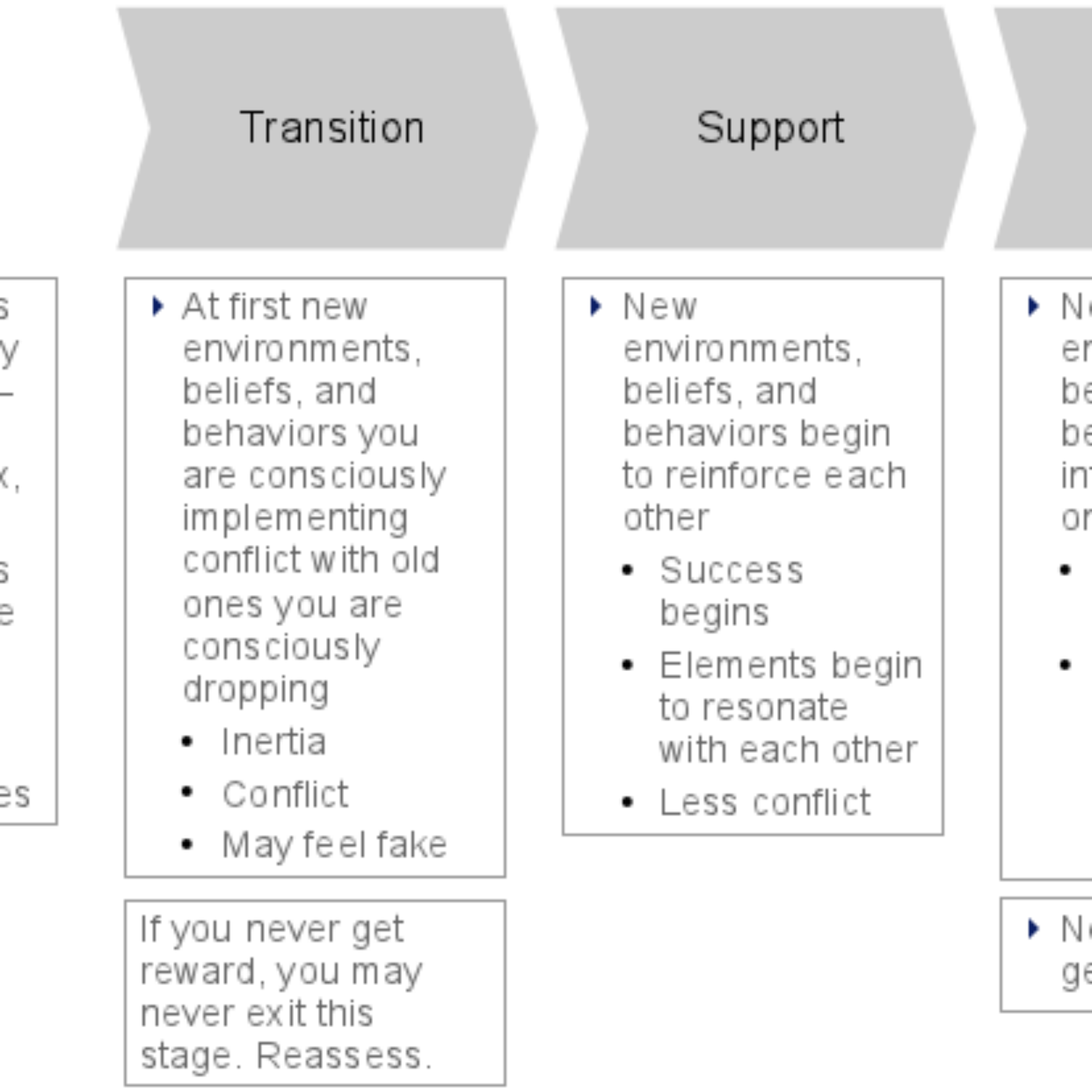
Once the elements of a transformation start supporting each other the transformation starts to feel like it will take root. You may still feel some inertia, fakeness, and conflict between the old and new you, but decreasingly. Examples of elements supporting each other include After starting a new hobby (behavior) you start meeting others who do the same hobby People compliment you on losing weight People you meet in new circles of friends or colleagues have mutual friends Confirmation biases start reinforcing new beliefs and so on. You also start feeling reward from new cycles as the elements in them resonate with each other. That reward means you decreasingly need to use willpower. Once you start feeling some reward, you generally don't doubt if the…

0 Comments

The Method: transformations, stage 1: a caveat

I should note a caveat for the transition stage. Since this stage involves conflict, feeling fake, and overcoming inertia, you may use a lot of willpower. How do you know you're moving in a direction that improves your life? How do you know you aren't pushing hard on something that you thought would help but isn't? The best answer is through experience. After a few transformations you pick up the subtle cues that show inertia decreasing or that what seemed feeling fake at the beginning also carried feelings of exploration and discovery. For example, if you tried a new style of clothing or haircut, it could happen that everyone you know and trust tells you they don't like it, but one person you don't know…

0 Comments

The Method: transformations, stage 1: transition

You can usually do the preparation stages of transforming a part of your life easily since you can do them yourself, without someone else. Working with other people usually makes things more complex. Still, you generally do benefit from involving others. Because they have different perspectives and can see your life from further away, their input usually helps. At the end of the preparation stages you have two sets of environments, beliefs, and behaviors in mind -- your current one and your desired one. You know your current situation so, however little reward it brings, you know how to get the reward it does bring and whatever emotions you want from it. You know what other parts of your life it conflicts or harmonizes with.…

0 Comments

The Method: transformations overview

We've covered the preparation stages of transforming a part of your life to bring more reward by choosing environments, beliefs, and behaviors based on your interests. Of course your life changes all the time whether you intentionally cause those changes or not. Using the Method, based on the Model, lets you do it systematically, intentionally, and makes you more likely to succeed than alternatives. Now let's look at how the transformation evolves in your life over the next few posts. Unplanned life changes can start and unfold unpredictably. Planned structured ones like intentional transformations following the Method can unfold unpredictably too, but tend to follow a more structured route. I tend to think of the route when I transform a part of my life following…

0 Comments
The Method: summary of preparation (with diagram)
The Method Process, part 1

The Method: summary of preparation (with diagram)

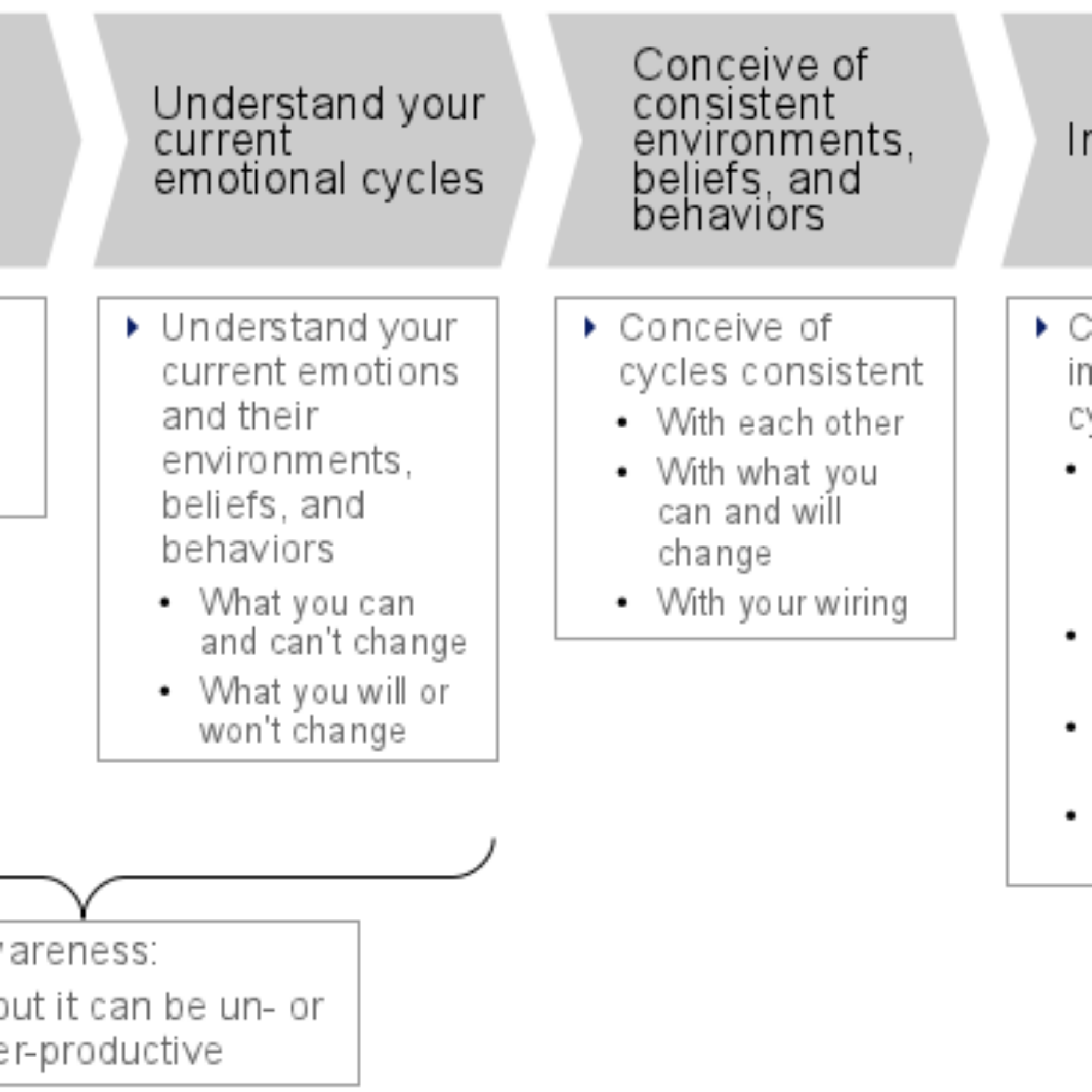
EDIT: I modified how I present the Method slightly. Please see the new version of this page and the updated series on implementing the Method. We've now covered the examples and preparation stages of how to implement the Method. Here is a diagram summarizing these steps (click it for full size) Preparation Know your emotional system Understand your current emotional cycles Awareness Conceive of consistent environments, beliefs, and behaviors Implement them Next: the stages of a transformation

0 Comments

The Method: step 4, create and implement them

EDIT: I modified how I present the Method slightly. Please see the new version of this page and the updated series on implementing the Method. Having conceived of new environments, beliefs, and behaviors consistent with each other, the emotions you want, and what you will, won't, can, and can't do, the next step is to create and implement them. Creating and implementing them means more than just doing some simple task. It means creating a lifestyle for yourself based on your emotional cycles, which you learned about in the first two steps. That is, choosing your environment means choosing whom you spend time with, where you work, where you live, and so on. Choosing your behavior could mean changing your wardrobe, your hobbies, you physical…

0 Comments

Reminder: My next leadership seminar: This weekend at the New School

  This weekend! LEADERSHIP THROUGH SELF-AWARENESS AND EMOTIONAL INTELLIGENCE In a two-day seminar, learn how to develop your personal leadership skills, self-awareness, and emotional intelligence by utilizing the latest advances in cognitive behavioral science, evolutionary psychology, and positive psychology. The course is open to all area leaders, b-school students, alumni, and colleagues. Below are the dates of the courses and a link that you can follow to sign up. If you have any questions please feel free to contact me. Schedule: Day One: Saturday, November 5, 2011  noon—5pm Day Two: Sunday, November 6, 2011 noon—5pm Top business schools and corporations are increasingly focusing on personal leadership, self-awareness, and emotional intelligence as foundations for leading others. However, many MBAs never had the opportunity to take a…

0 Comments

The Method: step 3, conceive of new consistent environments, beliefs, and behaviors

EDIT: I modified how I present the Method slightly. Please see the new version of this page and the updated series on implementing the Method. The next step after awareness is to plan -- in particular, to conceive of new environments, beliefs, and behaviors that are consistent with each other and what you can't or won't change to replace the old ones and designed to bring about emotions you want. Choosing environments, beliefs, and behaviors to bring about the emotions you want leads you to live according to your values, nobody else's. It makes you resilient to feeling bad and to some extent to other people's influence Choosing them consistent with each other means you will feel reward once the emotions become consistent with them.…

0 Comments

The Method: steps 1 and 2, awareness

EDIT: I modified how I present the Method slightly. Please see the new version of this page and the updated series on implementing the Method. The Method's first two steps -- knowing your emotional system and understanding your current emotional cycles -- involve little action. They constitute awareness. The appeal to act on a situation you want to change quickly and decisively can tempt you. I advise against it, whether you are leading yourself or others. Acting without awareness can point you in counterproductive directions. It can spur you to ever more action to make up for the initial wrong direction until you finally stop and reset yourself. I call acting that way reactive. Besides wasting your time, holding you back from your potential, and…

0 Comments

End of content

No more pages to load