
Tips


Business people should understand our effect on the environment better than anyone, part 2

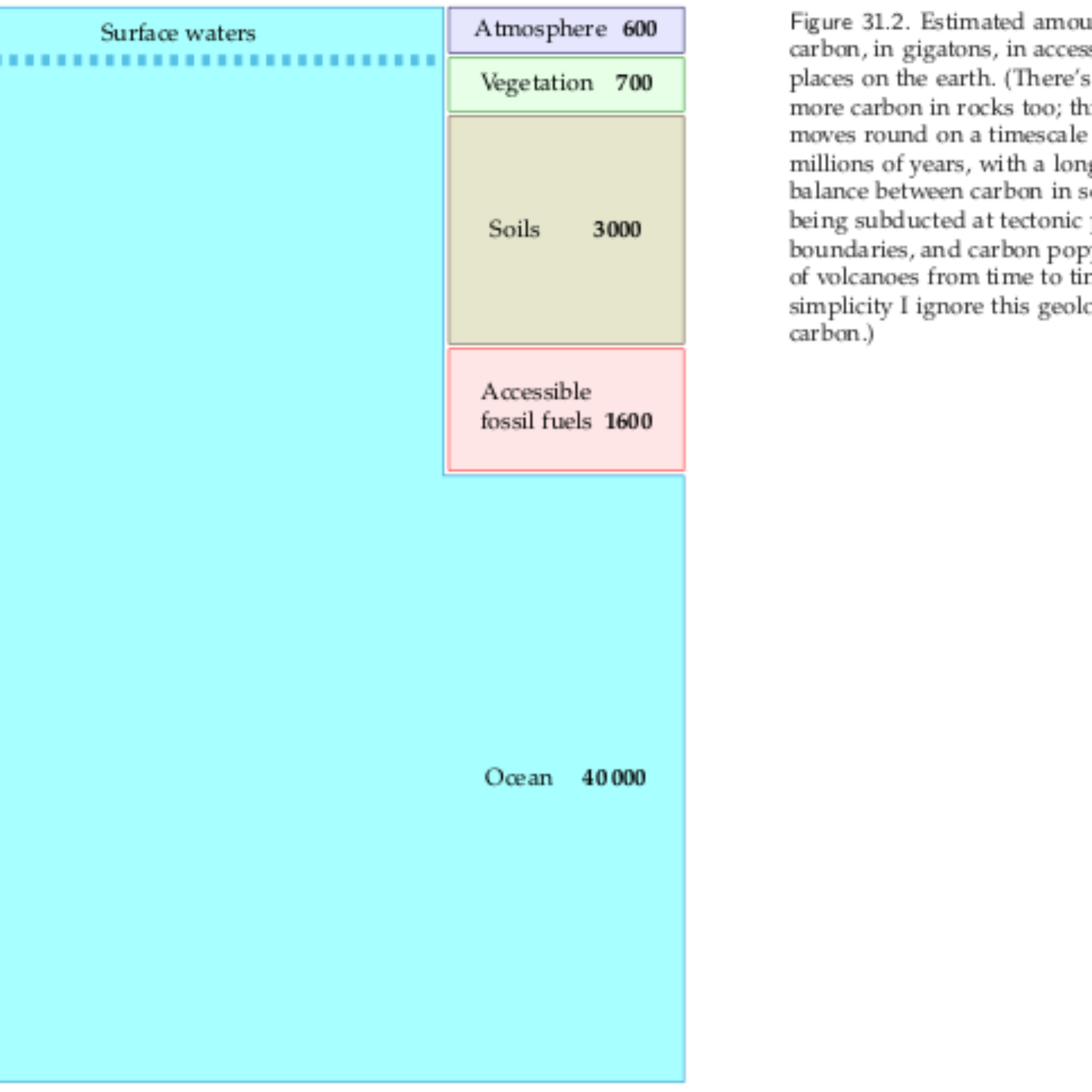
Following up yesterday's post on balance sheets and charts for using and producing energy and reporting our numbers to see if we can make them balance, let's look at carbon flows. People who don't know about carbon emissions, flows, and balance confuse simple ideas with each other. For example, some talk about how volcanoes and cows digestive systems produce tons of carbon and wonder why we should bother changing our practice. When you understand amounts and flows, you don't confuse unimportant effects for important ones, like business people who learn not to be penny wise and pound foolish. Below is a representation of where carbon is on the Earth. It's not exactly a balance sheet, though over time the total numbers have to add up.…

0 Comments

One of the best books I’ve read on the environment, our impact on it, and what we can do about it

Imagine living your whole life nearsighted and one day you wear glasses for the first time -- everything going from fuzzy blobs to clear. Or you know after you get out of the pool and your ears have water in them? Imagine you heard like that for your whole life and suddenly they cleared and you could hear properly. Or you've been wearing gloves and for the first time you take them off and feel something directly. That feeling of experiencing something clearly instead of vaguely and indirectly is what reading the book Sustainable Energy -- Without the Hot Air is like. Like the Do The Math blog I've been enjoying and praising, a Cal Tech educated physicist wrote it. This author, David MacKay, has…

0 Comments

A leader and physicist’s view on morality, ethics, and judgment

Wrapping up my series on the counterproductivity of leading with morality, ethics, and judgment, I'll present a model based I got from Einstein. Without all the emotion judgment can grip you with, you can understand the physics model easily. Then you can apply it to the emotional situation. Then I bet you'll improve your life. Before Einstein: the problem of the aether Before Einstein, people created a concept called the aether. They saw light traveling through a vacuum and figured something must be there, so they created a concept. For years they looked for properties of it. No one succeeded. You might remember the Michelson-Morley experiment from high school physics that famously couldn't detect the aether. That was a problem. People were looking for something…

0 Comments

How do you lead when you can’t stand working with someone?

Yesterday I wrote on how to lead people (yourself or others) you disagree with without judging them. I skipped cases where you felt you could not work with the person under any circumstances. Let's look at such cases today. I'm going to treat these cases strategically. Most cases will be unique at the tactical level so you'll have to figure out how to apply the strategy. If you can't work with someone, YOU have a problem First things first. No matter how bad you think they are, no matter how much evidence you have pointing out their faults and shortcomings, no matter how many other people agree the other person has problems, you have a problem too. I'm not saying they don't have problems too.…

0 Comments

Deciding right and wrong for others and causing them guilt and blame doesn’t help anyone

Prelude: this is about leadership (of others and yourself) Yesterday I outlined an essay on the counterproductivity of deciding right and wrong for people who disagree with you. Today I'm fleshing out the essay. The point of this blog is to help people lead -- to influence others, to work with them in teams, to negotiate with them, and so on -- even when you disagree. So I'll leave deciding right and wrong for others, figuring that, since some issues haven't been resolved for thousands of years, you might not resolve them before you have to deliver on your project (or while you improve your life if we're talking about leading yourself). Successful leaders ship while attract people to work with them. Today's post covers…

0 Comments

On the counterproductivity of motivating people with guilt and blame — aka moralizing

I liked Michael Pollan's Omnivore's Dilemma, which people have suggested I read for years. I like his perspective on food and "food." I don't intend for the following to detract from his overall message, but his chapter 17, "The Ethics of Eating Animals," makes a great example for leadership. Leadership means motivating others, which means changing their emotions. Few of us like when others motivate us with guilt or blame, so I find using leading through those emotions counterproductive. Claiming to appeal to absolute measures of right, wrong, good, bad, or evil tend to polarize. Motivating through guilt or blame with appeal to absolutes has a name: moralizing. Morality, ethics, meddling, being holier-than-thou, self-righteousness, and so on work to some degree, but risking alienating, polarizing,…

0 Comments

Perhaps this blog’s most useful and effective advice

For all my lessons learned, the Model, the Method, and so on, if we want to improve our lives, little works more effectively than Eat well Sleep well Exercise If you do nothing more than the above, you'll at least have a stable baseline of neutral. Last I checked, no medicine works better than exercise at keeping yourself happy. This advice costs nothing, takes little extra time, and requires no equipment. If you can't figure out how to work the above into your schedule, examine your priorities -- I suggest doing so until you see how to incorporate those three things into your life. When you do fit them into your schedule, you will find yourself generally at worst neutral to generally happy, with the…

2 Comments

Words of wisdom for crunch time

Crunch time means you don't have a lot of time, you have a lot to do, mistakes can cost a lot, people depend on you, and likely you depend on other people. People make mistakes. Also, sometimes you have to make decisions based on less information than you'd like. If people dwell on the mistakes or find out later that someone else could have made a better decision, they point fingers. Pointing fingers distracts from the task, takes time from productivity, and hurts morale. My general advice Don't look for blame, but take responsibility for making things better to the extent you can applies particularly well in crunch time. I'll add more specific words that seem to come up in many crunch times. I say…

0 Comments

Giving unsolicited advice generally backfires. Here are alternatives.

How many times do we have to learn? Giving advice someone hasn't asked for backfires. For that matter, giving advice to someone who asked for it tends to backfire. Why? Because when we give advice we imply we know the other person's life better than they do. We appear to impose our values on them. We likely neglect that the other person is already doing something to improve their lives. I've written about it before. I'm writing about it now because I caught myself doing it. Actually, this time I only appeared to give someone advice when I was comparing my experience to a friend's, but it was enough to provoke a defensive response. Even merely appearing to give unrequested advice will likely promote defensiveness…

0 Comments

How to identify great life lessons

Sometimes you recognize something you learned as a great life lesson. Sometimes what you thought was a great life lesson turns out not to be. How can you tell them apart? I've found that the more meaningful a life lesson, the more trivial it sounds when you explain it to someone else. For example, I went to North Korea and saw people living under different conditions than anyplace else, yet observed the commonalities we all share. It profoundly affected my perspective on myself, my culture, and being human. But when people ask why I value my trip so much, saying "I learned that people are people" never conveys that feeling. It sounds trivial. Yet I know I learned something at a deeper level than I…

0 Comments

Learning from performers to live in the moment

I learned something profoundly helpful watching a friend perform music on stage. You might find it obvious, but it helped me. The moment a musician makes a mistake while performing, it's in the past. You can't change it. The best thing you can do for a great performance is to keep playing regardless of what happened. That doesn't mean you believe it never happened, but changing something now, like stopping playing, doesn't change what happened then. You can later look back and learn from the mistake, but not while you're playing. This observation has helped me through many crunch times.

0 Comments

How to get the body you want

This isn't a diet or fitness blog, but your body is a major part of you. I don't see how you can live the life you want without achieving the body you want. Conversely, if you don't have the body you want, I suggest you aren't living according to your values: your body tells you what to change to create the lifestyle you want. This post is about emotions like joy and emotional reward -- getting the body you want is an inevitable side-effect. Having the body you want is one of the great life-level rewards you can experience. I'll come back to that point in a second. This is also a post on strategy, not tactics. I don't tell you what specific activity and…

2 Comments

One way to accept without judging

Here's an old story that comes in many versions (here are seven), but I learned from Srikumar Rao's book Are You Ready to Succeed (text from this blog). An old man lived in a valley with his son, a handsome and dutiful youth. They lived a peaceful life despite a lack of material possessions. They were very happy. So much so, that neighbors began to get envious. One day, the old man used all his savings to buy a young wild stallion. It was a beautiful horse that he planned to use for breeding. The very same day he bought it, the horse jumped the fence and ran off. The neighbors came over to sympathize. "How terrible!" they said. "Good thing? Bad thing? Who knows?"…

0 Comments

Leaving Facebook is easy and fun

I expect to log into Facebook once more -- to message my connections there that they won't be able to find me there, why, and where to find me instead -- then I'll leave for good. Why leave? I knew I wanted to leave after Facebook made its privacy policy too intrusive for my tastes. I felt they had too much control over my personal data. Facebook is creepy, getting creepier, and shows no sign of slowing down. Free cost does not mean I'm getting something for nothing. I came to see I was the product being sold to advertisers. What benefit I got -- networking online -- I realize I'm better off without, because I find myself more social without Facebook. I still appreciate…

5 Comments

Activating mental chatter

I've written about raising your awareness of your mental chatter (aka self-talk, internal monologue, voice of judgment, etc) and learning to voice it. I call both of those activities passive. You can also work actively with your mental chatter. Passive awareness and voicing of your mental chatter helps. In my experience going from unawareness to passive awareness improved my understanding of how my mind worked as much as anything. The next step is to change your mental chatter actively. Like breathing, if you don't pay attention to it, your mental chatter will continue automatically but if you pay attention you can control it. You always lose focus, so you can only do it for a while, but you can do it. Since your mental chatter…

0 Comments

What is status?

Yesterday I wrote on what power is. Today let's look at status, again because I find the more precisely you understand a concept, the better you can use it. Status is important. Nearly everybody wants to have a higher status. Nobody wants to have the lowest status. So what is status? I came across this definition that works well for me. It doesn't work as well as yesterday's definition of power, but it works. Status is access to resources People with greater access to resources have greater status. When resources get scarce, people with status become important. I like this definition because it's simple and connects an otherwise vague concept to something measurable. It also shows how to increase your status. Making money gives you…

0 Comments

Depressions don’t make you depressed

A lot of people equate a depressed economy with emotional depression. The two uses of "depress" have nothing to do with each other. They can, if you connect them, but they don't have to. If feel connected to you, they do because you connected them. But you can just as well make yourself happy or unhappy when business is growing or shrinking. Economic depressions don't make you depressed. Nor do problems in business. They're just part of your environments. You make yourself depressed. Economic or business growth don't make you happy. They're just part of your environments too. You make yourself happy. Saying parts of your environment cause your emotions is blaming something else for your emotions. It may make you feel better for absolving…

0 Comments

How to attract anyone, part 3

"What if the other person is boring?" People ask me this question all the time when I tell them they can attract people better, especially through genuineness and authenticity. The question reveals a belief about people I disagree with. My belief creates more friendships that are deeper and more meaningful. I'll talk about it here. Two beliefs that create friendships I believe everyone has facets of their personality that are interesting, intriguing, and fascinating. I also believe that you could know someone for decades and still find out new things about them. Think of the person you are closest to. You never run out of things to say, right? Imagine talking to them for fifty years. You'd still have things to talk about with them,…

0 Comments

A way to attract anyone, part 2: how to do it

How do we become more genuine and authentic, following yesterday's post on the value of genuineness and authenticity? I don't have a magic bullet but I can tell you some of the major steps that helped me. I don't claim to be the most genuine and authentic person, but I'm more so now than I was. First, I came to recognize that all these shells weren't helping me. They seemed helpful locally, but hurt me globally. I realized this by noticing why I liked some of my oldest friends. I felt less inhibited with them because I knew them before I put some shells on. Newer friends got humor, intelligence, and things like that, but more inhibition and less passion, compassion, and empathy. Naturally I…

0 Comments

How to attract anyone, part 1

I know a trick to attract any woman. If you want to attract a man it works too. I use it regularly when I flirt and it always works. I know it works because when I tell the woman I'm flirting with what I'm doing she always says it's working. Just to be sure I predispose her to be skeptical by telling her what I just wrote -- that I know and am using a trick that attracts any woman. She'll look at me incredulously and say, "oh yeah, what?" "You want to know my trick?" "Yes! What is it?!?" Usually I take longer to answer because I know she's curious, but since I'm not writing to flirt with you I'll answer here faster. I…

0 Comments

An exercise to help keep you from getting angry

Here's an exercise that helps you recognize why and when you get angry sometimes. You can use it to help prevent yourself from getting angry or not blaming others. It applies for any other emotion than anger, so you can use it to prevent any emotion you don't want and to create any emotion you do want. Step 1: Think of a time you got angry. Step 2: What did you do just before? Were you also angry just then, or rushed, under pressure, or something similar? Many times one type of pressure or stress affects your mood afterward, even if the later situation has nothing to do with the earlier except that they were close in time. Moods linger. You can feel angry toward…

0 Comments

A self-awareness exercise to help keep you calm and effective

Here's a quick exercise to make yourself aware of how your body handles stress, which can help you decrease stress. You'll recognize the answers to the questions easily. The point is how to use the answers. I'll explain how at the end. Step 1: Think of a painful experience in your life. Remember how you felt when it happened. Think of what you saw, heard, felt, tasted, etc, but especially try to remember your thoughts. Step 2: Notice three things: the level of judgment in your thoughts, how much you focused on yourself as compared to others, and your bodily response. Regarding your bodily response, do you recall your breathing -- shallow and quick or deep and slow -- what level of tension you had…

0 Comments

My habits

People generally think of habits as bad things they want to break. On the contrary, creating habits that you want is what creating a life you want means. It's a big part anyway. Creating habits you want frees you from trying to do things all the time. It frees you from using your limited willpower. I wrote yesterday about making behaviors you like habitual using your relationships. Today I'll write some examples of some behaviors I've made habitual in my life that way. Like everyone, I have a million more, but these are a fun start. Some seem trivial. Some may seem restrictive. To me, they represent freedom. Since they are generally healthy and crowd out unhealthy alternatives, I don't have to think about them.…

0 Comments

Habits can be contagious. How to make that work for you.

Many studies show that quitting smoking and losing weight spread through networks like diseases do (see links below). Many other behavioral changes work similarly. I like academic studies, but we don't just want information. We want to use it to improve our lives. Here's how. Make behavior you want into habits Trying to change behavior through willpower alone doesn't work in the long term, as my series on willpower described. Willpower gives out. Making new behavior stick in the long term requires making it automatic. Today's tip is to use your relationships or make new ones to reinforce the behaviors you want. Make your habits contagious Think of the behaviors you have now that you like. Maybe some habits you like started out of the…

0 Comments

A solution to all ethics problems

During orientation I learned one of business school's most valuable lessons. I learned the first step in resolving all ethics problems. Orientation included a case study on ethics. The case involved a guy who witnessed someone else breaking a rule at a company. If he told on the employee he would escalate the problem, possibly identifying himself as not a team player, no matter how justified his actions. Remaining silent would make him complicit, and who knew how many other rules the person he observed might be breaking? The details were relevant to the case, but keeping things at a high level reveals what I call the classic ethics problem: The Classic Ethics Problem: You have to choose between something you agree with that will hurt…

0 Comments

End of content

No more pages to load