Awareness


Rock Star Dream
Continued Fraction

Rock Star Dream

With my ability to announce my posts blocked by the Chinese government, now's my chance to indulge in a selfish post without destroying my modesty, since fewer people will find out about it. A few months ago I had the most amazing dream. It even impressed me. Somehow I dreamt about this: It's called a continued fraction. I know I'd seen the fraction before. I don't remember if anyone showed me how to solve it. I know I hadn't seen anything about it in years, maybe over a decade. The mildly rock star thing in my dream was that I realized how to solve it. I'm impressed I remembered it at all. I have no idea how my mind came to be thinking about it.…

0 Comments

Solving Problems II: The Dandelion Versus The Burning Building

Yesterday I wrote about an alternative model for solving problems to the prevalent model that you need to find and solve their root causes to be effective. The alternative -- the burning building model to solving problems -- says that if you can think of something that will improve the situation, acting on it will help. If you've used the dandelion model for a long time, you may believe it strongly. You may be skeptical of the burning building model. What if you act and don't solve the problem? Couldn't you make it worse? Won't it just come back later? Every problem is unique so you have to figure out what models apply best, but if you're used to the dandelion model, you'd be surprised…

0 Comments

Solving Problems I: The Dandelion Versus The Burning Building

Many people have a counterproductive yet common model for solving their problems. If you use it, you're holding yourself back from a better life. There's an alternative, however, which I'll write about below too. The Dandelion Model I call it the "dandelion model" because it's based on the idea that to get rid of a dandelion, you have to get to its roots. If you don't, it will grow back. The dandelion model says that to handle a problem in your life, you have to understand the root of the problem. If you don't, even if you think you've solved it, it will return and you'll have to deal with it all over again. A consequence of the model is that you should understand a…

0 Comments

More belief-changing exercises

Continuing the theme on flexibility in your beliefs giving you freedom, contributing to your intelligence, and attracting people, I'll continue about ways to increase that flexibility. Yesterday covered using a prevalent ad campaign to help develop non-judgmental acceptance of other people's beliefs and changing your own. By the way, by accepting other people's beliefs, I don't mean necessarily agreeing with them, just accepting that they have them and understanding them. The day before used changing your physical perspective to change your mental perspective. Today I'll give a couple cases where you routinely change your beliefs 180 degrees in a matter of seconds. The more you recognize you already change your beliefs to such a wide degree without thinking about it consciously, the more you'll be…

0 Comments
More changing your perspective
Perspective Change 1

More changing your perspective

I'll build on yesterday's post on changing your perspective to make it easier to change your perspective with a post I've been meaning to write for a while. Airports around the world are full of an ad campaign that provide another great exercise in enabling changing your perspective. Flexibility in changing your perspective is one of the most important tools in changing your world, creating freedom for yourself, and in building intelligence. The ad campaign illustrates what I call the passive view of models. It demonstrates that we simplify objects and concepts by modeling them. In the case of the ad campaign, usually a word or two represents a good deal of meaning of what's pictured. In practice we often represent things as complex as…

0 Comments

Change your perspective to change your perspective

Flexibility in changing your beliefs and perspectives is one of the more important skills in improving your life. It's also a major component of intelligence, one psychologist told me. In my seminars and with clients, it's one of the more challenging skills to develop, though easy with practice. Like most challenges, the way to master it is to start easy and build. Look for all the opportunities you can to practice. Traveling provides many such opportunities. Case in point... Growing up, maps of Europe showed Western Europe centered on Western Europe---France, England, Spain. Then there was a thick line on the right of which was all red, with a USSR in big, imposing letters to the right. Sometimes in the bottom right corner of the…

0 Comments

More thoughts on motions, values, children, and school

Yesterday I posted on making four-year-olds sing that they love something, accepting it was probably a tempest in a teacup. I also noted similar incidents may contribute to reinforcing what seems to me telling children what to think and feel. The incident reminded me of Woodie Guthrie's writing "This Land Is Your Land" as a response to hearing "God Bless America" over and over in the late 30s, implying these songs are political. I came across an August 2008 incident in which the Yankees and the New York Police Department were forced to pay restitution for kicking a man out of Yankee Stadium for not toeing the line on singing "God Bless America," apparently against the law. The Yankees had to state they had no…

0 Comments

How to tell if someone is good at something

Two observations I've made about how good people are at things: People who aren't good at something talk about how awesome they are at it. People who are great at something talk about the humiliations and failures that got them good at it. I've found this pattern far more accurate than I would have expected. I love hearing stories from people about the disasters that made them who they are. That's how I know they're good at the thing at hand. They've gotten over their insecurity through experience and aren't afraid to share. People who are afraid to share tend not to be so good at the thing -- I think because they are afraid of being associated with the failure. Incidentally, the stories about…

0 Comments

Celebrating other people’s values

People confuse someone else's values being different from their own with being worse than their own. If other people's values were worse, then statements like the following two would portend the end of society. The children now love luxury; they have bad manners, contempt for authority; they show disrespect for elders and love chatter in place of exercise. Children are now tyrants, not the servants of their households. They no longer rise when elders enter the room. They contradict their parents, chatter before company, gobble up dainties at the table, cross their legs, and tyrannize their teachers. -- Commonly attributed to Socrates The world is passing through troublous times. The young people of today think of nothing but themselves. They have no reverence for parents…

0 Comments

Leadership and personal development and school

In my seminar yesterday I mentioned "plays well with others" may be one of the most valuable skills in adulthood for team-based activities. Yet we treat it as a joke for children, or at best a euphemism implying the student in question doesn't do well academically. Have you ever learned something amazing while developing yourself as a leader or person and wondered why leadership and personal development isn't taught in school? School taught me valuable things like math, science, history, and so on. It vaguely addressed things like physical fitness. What didn't school teach? When I lead seminars on self-awareness, emotional intelligence, personal development, leadership development, and such, we cover things like how to motivate yourself and others, how to raise awareness of your emotions…

0 Comments

Willpower, part VI: examples

[This post is part of a series on willpower and how to understand and use it. If you don't see a Table of Contents to the left, click here to view the series, where you'll get more value than reading just this post.] An example of an ineffective way to use willpower to get in shape is to will yourself to go to the gym two days a week for a year. An effective way is to search for healthy activities that you love and make them a part of your life, letting go of activities you don't like. Or to find people who live active lifestyles you like and spend time with them, at the expense of people who don't live active lifestyles. For…

0 Comments

Willpower, part V: how to use it

[This post is part of a series on willpower and how to understand and use it. If you don't see a Table of Contents to the left, click here to view the series, where you'll get more value than reading just this post.] How to use willpower summarizes the previous posts. Use willpower either for brief, self-contained projects that you'll finish before running out of mental energy to sustain it or when it will lead to rewarding emotions that will sustain using it. You already know how to use willpower for brief projects. For longer projects, willpower works best to create rewarding emotions that motivate you to complete your goal. Willpower doesn't work well to complete the project. If you want to get in shape,…

0 Comments

Willpower, part IV: when to use it

[This post is part of a series on willpower and how to understand and use it. If you don't see a Table of Contents to the left, click here to view the series, where you'll get more value than reading just this post.] Yesterday's discussion of when not to use willpower -- when you aren't aware of where you are emotionally or where you want to or when you risk reinforcing the beliefs driving countervailing emotions -- implies when to use willpower: the opposite of when not to use it. So the first properties of when to use willpower are When you know where you are and where you want to go emotionally You are aware of the beliefs driving the behavior you're overcoming with…

0 Comments

Willpower, part III: when not to use it

[This post is part of a series on willpower and how to understand and use it. If you don't see a Table of Contents to the left, click here to view the series, where you'll get more value than reading just this post.] If all you could do was act on whatever emotion was most dominant at any time, you would be purely reactive. You would not be able to choose your actions. Bugs and lizards are purely reactive as far as I can tell. Your reflexes are reactive. So willpower keeps you from being purely reactive. Without it you couldn't choose. Without willpower, thoughtfulness and reflection wouldn't help you because you wouldn't be able to act on them. Some people take pride in the…

0 Comments

Willpower, part II: what it is

[This post is part of a series on willpower and how to understand and use it. If you don't see a Table of Contents to the left, click here to view the series, where you'll get more value than reading just this post.] Understanding willpower requires understanding emotions functionally, so let's start there. A functional perspective isn't the only way to view emotions -- exploring and communicating how they feel is another, more relevant to art and music, for example -- but it serves our purposes. I'll stick with it, but I don't mean to imply other perspectives aren't important in other contexts. Emotions, functionally Functionally, emotions motivate you to interact with and change your environment. They also result from your environment, subject to your…

0 Comments

Willpower, part I: what is it, when to use it, and how

[This post is part of a series on willpower and how to understand and use it. If you don't see a Table of Contents to the left, click here to view the series, where you'll get more value than reading just this post.] I'll be starting what I expect to be a four or five part series on willpower. The series should give an understanding of what willpower is and how to use it more and more effectively to improve your life. Everyone generally knows what willpower is. Some people value being able to use willpower to overcome great challenges. Some people don't know how to use it at all. In all cases, we want to be able to use it more effectively than we…

0 Comments
Observations on Flow, part II: two improvements
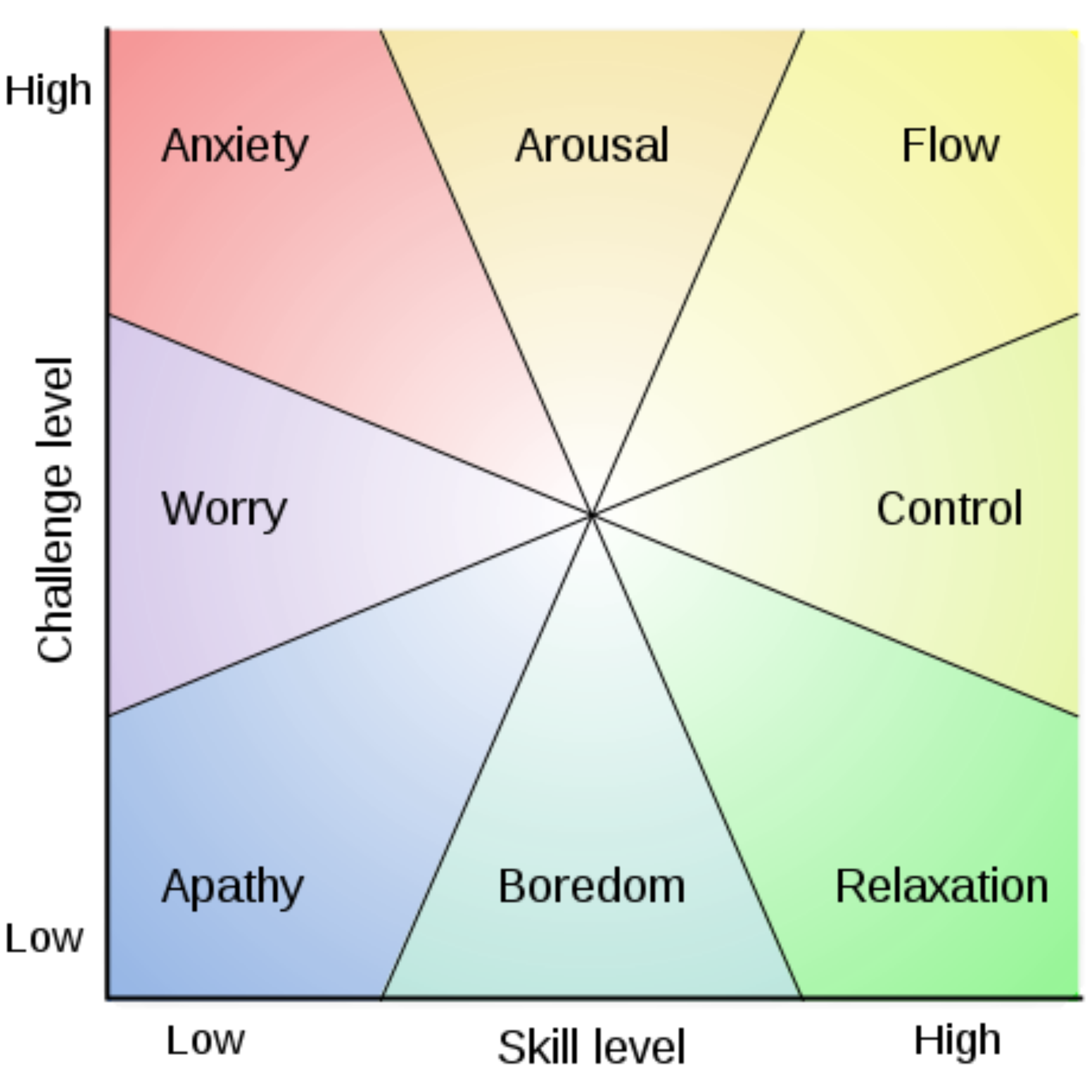
Emotional state resulting from level of challenge and skill

Observations on Flow, part II: two improvements

Following yesterday's primer on flow, here are two simple ideas to bring more flow. If you've read only Mihaly Csikszentmihalyi's book, they may be new. The Wikipedia page on flow but not Csikszentmihalyi's book covers the first. The second is new, as far as I know, though small. Recall the ten conditions of the flow state (from Wikipedia, citing Csikszentmihalyi articles): Clear goals (expectations and rules are discernible and goals are attainable and align appropriately with one's skill set and abilities). Moreover, the challenge level and skill level should both be high. Concentrating, a high degree of concentration on a limited field of attention (a person engaged in the activity will have the opportunity to focus and to delve deeply into it). A loss of…

0 Comments

Observations on Flow, part I

Do you remember the last time you felt like this musician? You are in an ecstatic state to such a point that you feel as if you almost don't exist. I have experienced this time and again. My hand seems devoid of myself, and I have nothing to do with what is happening. I just sit there watching it in a state of awe and wonderment. And [the music] just flows out of itself. We all know the feeling. We love it. It's one of the great states of being. It comes through many ways -- sports, hobbies, work, conversation, etc. A psychologist, Mihaly Csikszentmihalyi, studied that state and called it flow, now established as a something to be studied and understood. I figure most…

0 Comments

More thoughts on “Where you get energy”

Two thoughts to follow up my post from two days ago: Where you get energy. First, after mentioning I was mystified by people who used the same excuses not to dance that I used to dance, I should mention that before my dancing friends got me to go dancing the first time, I would have used any excuse to avoid dancing too. I didn't know how to dance and was afraid of being judged. I'm like everybody else, of course. I had to get over those fears too. Overcoming them once improved my life in one area. Generalizing that result to realize overcoming fears around things I loved brought me my greatest joys improved my life everywhere. Second, after mentioning the energy you feel has…

0 Comments

If you love it, do it even if you aren’t good at it

"I love to do X, but I'm not good at it" or "I think I'd love X, but I can't do it." Such common excuses not to do something. People just stop thinking or motivating themselves after saying that. Result? Even as they watch others have the times of their lives, they don't sing, they don't go to the gym, they don't dance, they don't get on stage, they don't ask for the promotion, they don't ask out the girl or the guy, they don't rock climb, ... They deprive themselves of things they would love. I can't think of anything you'd want to do less than avoid something you love. If you have a reason that makes sense -- like you're allergic to some…

0 Comments

Where you get energy

Want to have more energy to do things? I'll demonstrate how how much energy you have to do something rarely has to do with how much energy you have. When I used to go dancing every Friday night I would look forward to the excitement of seeing friends, listening to great music, dressing up, etc. The friends I went out with looked forward to it too. I was mystified by people who would say they were tired at the end of the week and as a result didn't want to go dance. The exact reason motivating my friends and me -- to release, have fun, meet people -- demotivated them. How much energy you have to do something depends more than anything else on the…

0 Comments

Vipassana Meditation

A reader emailed me about mindfulness and self-awareness. I mentioned to him a meditation retreat I did a few years ago and found an old post I wrote about the experience, answering another reader's questions about the course. I did a ten day Vipassana course a few years ago. What it's about: It teaches you a meditation technique and gives you the time and space to practice it. It's based on buddhist beliefs. We meditated for 8-10 hours per day for ten days. That's basically it. You aren't supposed to read, write, gesture, etc, except to ask the instructor questions. They provide food and instruction on what to focus on. Was it hard: Yes, it was hard. The first couple days were painful while getting…

0 Comments

Don’t be like a cheetah running into a wall

Every species has a few traits that give it advantages over any other. Cheetahs have their speed, for example. As far as I know they're the fastest animals on land. We have our intelligence, among other things. As far as I know, we're the most intelligent animal on land. Like other species with their traits, we have been using our intelligence to help us survive. We've been doing so for millions of years. So many people get so stressed over what they view as the complications of life or their lives. As I wrote recently, life is no more or less complicated than you believe it is. Everyone does what they think is best at the time -- as does every living creature. Some people…

0 Comments

What’s wrong with “making the world a better place”?

Can you think of anyone who isn't trying to make the world a better place in his or her own way? The statement means nothing if everyone says it. And effectively everyone does. Think of the worst people you can. Weren't they trying to make the world a better place, in their minds at least? You can say how wrong these terrible people were, but in their minds they weren't wrong, they were right. In their minds you're wrong and they're right. And no matter how much you appeal to a foundation they can't  -- scripture, your notion of human nature, human life, whatever -- they can appeal to some other foundation that for them is equally absolute. They can also claim your absolutes are…

0 Comments

End of content

No more pages to load