If you want to change something important in your life, you’d better understand the concept called “empathy gaps.” An example of an empathy gap is when you say in December you’ll go to the gym twice a week for the next year, that you have the fortitude to do it and will simply will yourself to do it no matter what, then find yourself in February saying you’re not in[…] Keep reading →
Category Archives: Models

Master introversion AND extroversion
on January 12, 2014 in Awareness, Freedom, Leadership, Models, Nature, VisualizationYesterday I wrote about freeing yourself from constraining beliefs. Today I’ll expand on creating new beliefs to free yourself from such constraints. I wanted to illustrate at least one alternative to the standard one-dimensional model of introversion and extroversion that I find impedes self-awareness, understanding, and personal growth and development. Many people continue to believe it because they have no alternative that helps their life more. Others rigidly hold on[…] Keep reading →
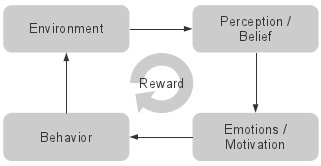
How to bring happiness and emotional reward to your life by analogy with pleasure—the series
on January 3, 2014 in Awareness, Leadership, Models, VisualizationI’ve written, thought, and acted on distinguishing between pleasure, happiness, and emotional reward. I like them all, but sometimes life creates situations where sacrificing one will get more of another. Knowing their differences and similarities helps you figure out how to create the optimal balance of each in your life. For example, lately I’ve been experimenting with cold showers, although the following applies for any other SIDCHA or challenging activity.[…] Keep reading →
The Method: the series
on December 14, 2013 in Awareness, Education, Exercises, Leadership, Models, Nonjudgment, Perception[EDIT: I covered this series in more depth in Leadership Step by Step, so I recommend the book, but the core is here. I use this technique as a part of my life, basically daily.] Here is The Method on how to use The Model—my model for the human emotional system designed for use in leadership, self-awareness, and general purpose professional and personal development—in series form. I find the Model[…] Keep reading →
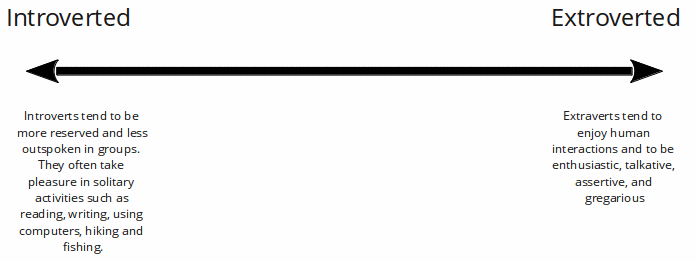
Introversion is not the opposite of extroversion, part 1
on November 20, 2013 in Awareness, Blog, Fitness, Freedom, Models, Nature, VisualizationHere is a common belief for the relationships between introversion and extraversion. I’m going to show how it worsens your life and offer an alternative you will resist and fight against, but if you keep an open mind you’ll realize explains your world more effectively and helps you to improve your life. I call it the “Or” model of introversion and extraversion for reasons you’ll see below. It says that[…] Keep reading →
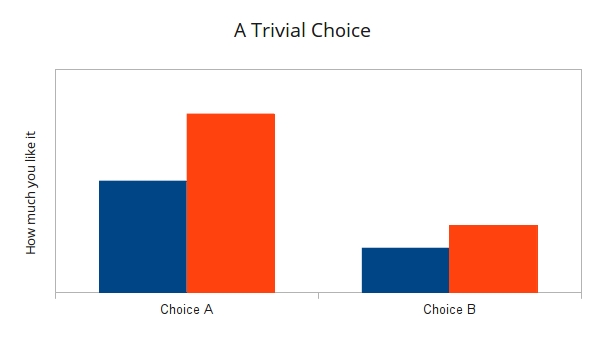
Choose easier by visualizing choices, part 2
on October 30, 2013 in Blog, Choosing/Decision-Making, Models, Tips, VisualizationMultiple factors Not all options have only one decision factor. Many have two or more. For example, do you prefer a job with higher pay but lower chance of promotion or higher chance of promotion but lower pay? You have to look case-by-case, but let’s see how our visual representation shows them. A trivial choice The easiest two-part case is when you prefer both parts of an option to both[…] Keep reading →

Choose easier by visualizing choices, part I
on October 29, 2013 in Blog, Choosing/Decision-Making, Models, Tips, VisualizationYou know choosing can be hard. I’ve written about it before from a few angles: Why are decisions hard? Difficult life decision? Here’s how to look at it. How to decide among close options A belief to choose without getting mired in indecision Today I’ll give you a tool to simplify decision-making more with a way of visualizing the challenge that shows the hard part. Partly I’m following up on[…] Keep reading →
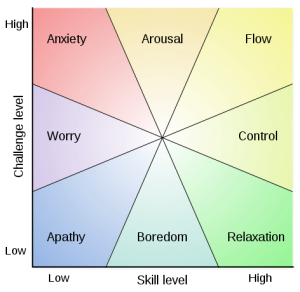
A doubly improved representation of Flow-related emotional states
on September 28, 2013 in Awareness, Models, VisualizationA couple years ago I wrote two posts on the emotional state where you get so lost in an activity you lose track of time, focused with all your attention. Hours pass without your noticing while minutes may seem like hours as you focus intently. We like this state. A researcher named Mihaly Csikszentmihalyi studied it and named the state “flow.” He wrote a book on it that improved my[…] Keep reading →
A model leading to “Nice Guys”
on August 25, 2013 in Blog, ModelsI can’t help but comment more on the Nice Guy behavior I mentioned a couple days ago in “The false dichotomy of the nice guy and the jerk and what to do instead.” A lot of the guys I coach have what others have called Nice Guy behavior and described problems with it. I don’t mean being nice as a guy. I mean how Wikipedia put it in its “Nice[…] Keep reading →