Awareness


How a habit forms

There are plenty of books on habits. Too many, if you ask me. You don't need books to start habits. In my experience, self-awareness will get you farther. In particular, starting new behavior creates new emotions and reactions. Paying attention to them will guide you how to follow up to improve them more than reading---if you pay attention to everything you can. That level of self-awareness takes time and effort to develop, so books may seem to help more, but you have to practice self-awareness to develop it, which books hinder, like training wheels when learning to ride a bike. I recommend losing the training wheels as soon as you can. The habit development pattern Not just habits, but sidchas: Start sidcha ⇓ 2. Feel…

0 Comments

How science improves leadership and coaching: My conversation with Ron Potter

Does a background in science help someone lead? ... does it help someone coach? If so, how? I spoke with longtime leadership and executive coach Ron Potter, who came from an engineering and technical background to coach executives at top levels of major global companies, about how our backgrounds help. We covered: How a science and technical background helps us understand and work with emotions better than others ... and the limits of rationality ... and how to work with them effectively, calmly, and productively How science helps change beliefs, freeing yourself and teams from mental jails How a science background helps coaching Stories illustrating why More... You'll hear that I've held back on the value of my science background despite others working with me…

0 Comments

Love, work, commitment, and anxiety

Have you ever loved a job or person without the love resulting in more work and commitment? Did the work lead to loving it, him, or her more? But did feeling that you'd have to work more stopped you, often unconsciously, from allowing yourself to love something or someone? Do we move away from passions for the reasons we should move toward them? I call the feeling driving that inhibition, when it motivates us unconsciously. low-level anxiety, which inhibits lots of behaviors. It's helpful to learn to recognize, make conscious, and act on.

0 Comments

A catalog of inner monologue thoughts

If you pay attention to your inner monologue, as the exercise I call The Most Effective Self-Awareness Exercise I Know leads you to, you'll notice patterns. Songs get stuck in your head. You judge people. You judge yourself. You try to figure out the best order to do things in. You play out arguments you might have with others. Sound familiar? Years ago I had the idea to catalog the types of thoughts you repeat. Before doing the exercise, I thought we could think about anything. After doing the exercise enough times and hearing how much others' thoughts resembled mine, I concluded we think in patterns, and not as many as we'd think. I suspect the types of patterns emerged through evolution, so most patterns…

0 Comments

What 80s pop music teaches us about global warming

Most people seem to view acting to avoid polluting and caring about the environment as deprivation and sacrifice. They seem to ask, "why should I sacrifice something I like, like flying, meat, air conditioning, etc? If billions of others don't, then what I do doesn't matter. The result is most of the world, or at least most of America, contributing to global warming beyond nearly any contribution by anyone in history, well beyond the Paris agreement's allotment per person. For me the answer is clear, that behaviors that pollute less, like not flying, eating fresh vegetables, and dressing for the weather so you don't have to heat or cool the air, improve my life. Not polluting improves my life. Few people see not flying as…

0 Comments

The opposite of consuming unnecessarily is not deprivation or unhappiness

Apparently of all the materials we mine, extract, harvest and so on, after six months, less than one percent is still in use or in the product we got it for. Over 99% of what we get from the earth is used that long. I found that statistic from The Story of Stuff (video and annotated script). These two pages 21 Surprising Statistics That Reveal How Much Stuff We Actually Own and Surprising Stats give even more insane statistics about how much we materially consume. It feels like we could use an interaction like the scenes in the shows about people who weigh over 600 pounds where they have them look in the mirror, which they never do because they prefer denying seeing themselves, and…

0 Comments

Learning to respect my elders

When I was young I thought I knew what older people knew and could do what they could. I planned to do important things while younger than most. I saw no reason I shouldn't be their peer. I just had to prepare, not that preparation would take long. But preparing took longer than I expected. Looking back, I see I couldn't have done it faster. Now I'm older, doing what prepared for, and I see why younger people can't know or do some things, even ones as great as I thought I was.

0 Comments
Experience Less Stress By Being Aware of Your Emotions: The Mindfulness Mode podcast interview with Bruce Langford
The Mindfulness Mode podcast with Bruce Langford and Joshua Spodek

Experience Less Stress By Being Aware of Your Emotions: The Mindfulness Mode podcast interview with Bruce Langford

I've wanted to share some of my views on mindfulness, which connects with leadership, especially personal leadership, for a long time. Bruce Langford, who hosts the Mindfulness Mode podcast gave me the chance. If you care about mindfulness, leadership, mindful leadership, you'll value listening to this conversation. We talked about Starting mindfulness What mindfulness is Getting more done through mindfulness Habits and mindfulness Food, eating, and mindfulness The counterproductive results from the lack of these things My top app for mindfulness And more! Click here to listen to the podcast! Click here to listen to the podcast! Bruce's podcast notes Joshua Spodek is a scientist, specifically an astrophysicist and SO much more. He's an expert in the field of leadership. He can discover and help…

0 Comments

Absurdly Useful Leadership Tactics That You Can Use Today: the second interview with Jim Harshaw

I don't know if the interviewers are getting better, if I'm developing in conversation, or if I'm just enjoying podcast conversations more, but it feels like the interviews are getting better all the time. Yesterday, Jim Harshaw (scroll down to learn more about him) of the Success Through Failure podcast posted our second conversation. Second conversations lead to greater comfort, depth, trust, and intimacy, so I recommend listening. We cover a couple exercises from the book, connecting leadership to everyday living, sports, and more. Jim was a division 1 athlete and coach, among many other achievements so he knows leadership from multiple angles. He's taken on and overcome challenges many of us don't even try. All this comes out in his podcast. When you don't…

0 Comments

One of the most important videos on the internet barely has 10,000 views: Donella Meadows on Sustainable Systems

I just watched what I consider one of the most important videos I've seen. It's not exciting, but it covers what I consider the most important issue of our time---how to understand global warming and what we can do about it. Not just the usual questions about science, numbers, and politics. The video is of Donella Meadows speaking at the University of Michigan. She approaches the topic through systems thinking, which is, in my opinion, the most useful and illuminating way to understand it. The talk explains systems, systems thinking, the environment, and how we, as humans with technology, values, economies, and so forth interact with it. By the way, I've long ranked Donella Meadows near the top in my influences and resources page. I…

0 Comments

Judgment is automatic, what you do with it is your choice

People are so quick and smug to say, "You shouldn't judge so much" or that they don't judge. Next time you notice yourself judging, try to notice if you chose to create that feeling of judgment or if the feeling happened without conscious intent. The involuntary part I haven't experienced how anyone's mind works but my own, but as best I can tell, feelings of judgment happen automatically, without conscious intent on my part. In this sense, they're like the feelings of pleasure when I eat delicious food. I don't choose to feel pleasure when I eat a fresh, ripe mango. When I bite into it, I experience feelings of reward that come from part of my mind I don't control. Same if someone gives…

0 Comments

The shockingly valuable life lessons of vigorous exercise

With five Ivy League degrees, especially the PhD in astrophysics, experience teaching at Ivy League and other elite schools, and a father who was a tenured professor in history, I think I'm qualified to know the value of intellectual knowledge. The more I learn through physical experience, the more valuable I find it. The intellectual world, especially schools and universities, value the intellect so much, I don't think they realize the value of learning through experience, especially vigorous exercise. Case 1, superfically: deadlift form The other day my physical trainer friend was over. I asked him to evaluate my form on a few exercises. He pointed out that on my kettle bell deadlift, my right knee went inward. It's a common mistake, but the relevance…

0 Comments

A more personal podcast interview with Jared Angaza

I comment these days that I'm becoming friends with the people interviewing me in podcasts and Jared Angaza's interview of me, "Do the Thing," is a perfect example. I've also said lately that if you put yourself out for public scrutiny, to succeed you can either create a persona and act like it or you can express yourself more openly, but to mix them---to mix acting like someone else with acting authentically---doesn't work. I'm trying to use these interviews to open up more and to speak more freely. I think I'm succeeding. I'm sure I have blind spots, like anyone, that people who know me pick up on but I don't. And I can't talk about everything all the time. I'm mostly focusing on the…

0 Comments

The bigger your achievement, the more it’s a beginning

Back when I made my art, I would sometimes find a new venue or commission that would give me the chance to work bigger than before. I'd sign a new gallery, meaning more pieces, or a museum. Or a venue with a budget would commission me. My art was technical, with laser cut steel, 8 foot photographic quality images, power cables, and so on. I could only scale up when I had a budget and a space big enough to mount the displays and for people to step far enough away to view it. How did I decide how big to make a new display? From my experience building subway advertising displays a quarter-mile long, meeting safety and fire codes for ten years in brutal…

0 Comments

The Benefits of Experiential Learning for Leaders with Rocket Scientist Joshua Spodek

https://www.youtube.com/watch?v=2-DZIZxl1IM Mark Bidwell, founder and podcast host of Innovation Ecosystem, posted today a wonderful interview about Leadership Step by Step, experiential learning, exercises, and more. I can only describe Mark as someone who gets it. He ascended the corporate ladder, where he drove innovation, built teams, and so on, then found there was more to life and is creating resources to enable others to. If you are looking to improve your leadership, social, and emotional skills, Mark gets to the heart of how to, covering techniques that work, as well as the problems of traditional education that suppress learning these things. Listen to the interview! A few words about Mark and the Innovation Ecosystem podcast: We interview remarkable and thought-provoking guests about innovation, leadership and…

0 Comments

Stellar reviews of other courses I’ve taught like Leadership Step by Step

Pre-order Leadership Step by Step on Amazon! or Register for a free webinar on the course! Reviews of Other Courses of Joshua Spodek Below are anonymous reviews by people who did the progression of exercises of other courses that I teach in the same style as Leadership Step by Step. They range from first year undergraduates to graduate students to adult learners to adult clients. (Not all are native English speakers.) -- "This is one of the greatest classes I have ever taken. It was engaging, thought provoking, challenging, and fun. Josh is an incredible teacher, mentor, and friend to everyone in the class who is passionate about the subject matter. If I could take this class all over again, I would" -- "10/10 would…

0 Comments

Reviews of Leadership Step by Step: the Course

Leadership Step by Step Below are anonymous reviews by people who did the book's exercises. They range from first year undergraduates to graduate students to adult learners to clients in their 60s who have sold businesses. (Not all are native English speakers.) "This course really changed by definition of "Leadership." Joshua is an amazing professor. He taught this class in a way that we learned about ourselves and then to understand others. He taught us how to find the real emotions and beliefs behind someone's behavior and use that emotion to lead them and make them feel understood." -- "I truly hope other NYU students have the privilege of taking this course. It is the exact material that students of my generation need in order…

0 Comments

Stop Unwanted Beliefs From Sabotaging Your Self-Improvement: Read my guest post in Tanveer Naseer’s blog

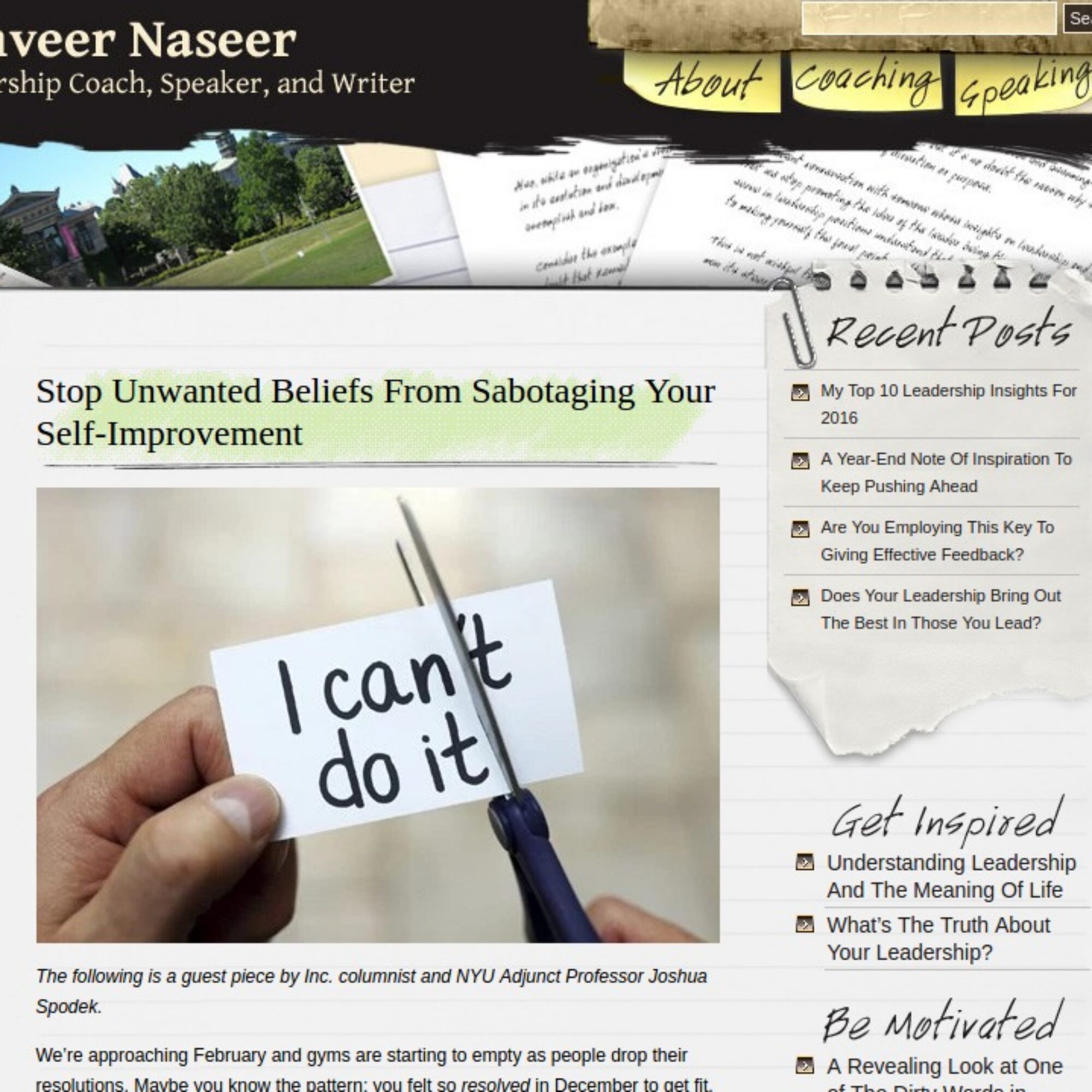
Tanveer Naseer is the recipient of several awards and recognitions as one of the top thinkers/writers in the leadership sphere, including being recognized by Inc. Magazine as one of the Top 100 Leadership and Management Experts, earning a #3 ranking on HR Examiner's Top 25 Online Influencers in Leadership, and being consistent ranked on numerous lists as one of Top 15 Leadership Bloggers in the world. He read an advanced copy of my book and asked me to write a guest post for his blog. I wish we could have recorded our conversation about leadership, writing, and teaching. I agreed and my guest post just came out. Check it out! It begins Stop Unwanted Beliefs From Sabotaging Your Self-Improvement We're approaching February and gyms are starting…

2 Comments

Who traveled more?

Consider two travelers. One went online, bought a plane ticket to a spot half way around the world, took a taxi to the airport by highway he's been on countless times, got in a plane---a long metal tube he can't see out of---sat, confined, packed with hundreds of others, was fed food from a box, watched movies on a tiny screen, slept fitfully, eventually emerged in an airport similar to the one he left from, took another taxi to a hotel, and slept in a bed someone else made. He left a trail of thousands of gallons of jet fuel, equivalent to a year's worth of driving. The other rode a bicycle under his own power, carrying a tent, sleeping bag, and everything he needed,…

0 Comments

Leonardo DiCaprio, Martin Scorsese, and Trent Reznor’s Important but Flawed Statement

My Inc.com article today, "Leonardo DiCaprio, Martin Scorsese, and Trent Reznor's Important but Flawed Statement," began Leonardo DiCaprio, Martin Scorsese, and Trent Reznor's Important but Flawed Statement Before the Flood brings global warming to your living room and Hollywood. But does it lead to changing the behavior that causes it? Leonardo Di Caprio played Romeo, the lead in Titanic, then the highest grossing film ever, and won an Oscar fighting a bear. Martin Scorsese is the most Oscar-nominated director alive, having revolutionized film making and directing over half a century. Their movies earned 31 Oscar nominations and grossed $1.3 billion. Trent Reznor has won an Oscar and Grammy for his scores. Time named him one of the world's most influential people. Fisher Stevens, with a…

0 Comments

It pays to blow your mind sometimes

Flexibility in your beliefs and mental models is a key part of intelligence and leadership. Your beliefs influence how you see the world. Only being able to see things one way confines you to a mental jail and keeps you from solving problems. Think of the 4-minute mile. When everyone believed breaking it was impossible, almost nobody tried. Once the first man did, within months another followed. Now high school boys have done it. Do you want to trap yourself below your potential by limiting your beliefs? I don't know what beliefs' changes will help you improve your life most, but I guarantee that developing the skills of flexibility of beliefs and openness to new ones will enable you to change more and be trapped…

2 Comments

The bounty of more value from less crap

I'm scheduling being on a podcast (with Steven Shalowitz of the fascinating The One Way Ticket Show) and Steven and I got to talking about food, flying, and trying new things instead of unthinkingly doing what everyone else does. Or not experimenting at all. Since I figure you're here to improve your life, I couldn't help but share some of our conversation. I mentioned I'm avoiding flying for a year. He asked, didn't know about the year of no flying. what precipitated it, if you don't mind my asking? love the idea. at this point i'd like to try a year without tv . . . I wrote, Two main precipitations: The first was my huge improvements in my life of little experiments like that…

0 Comments

Imagine a world with more empathy: Why I write and teach

My books and courses teach empathy. I used to think of empathy as an intangible, nebulous, even weird concept I couldn't really understand. Now I view it as a skill anyone can learn as well as they can learn to ride a bike or throw a baseball. Improving your empathy skills improves your ability to lead, all your relationships, and your moods. As a teacher, it's incredible to see people develop the skill. I don't see many resources that treat empathy as a skill anyone can develop. Of those I find, they give vague advice on how to improve it. My book and courses teach it with clear instruction and follow-up. I tend to think it will change how we view empathy. One of the…

0 Comments

The five times I got mugged growing up

Not sure how interesting this post will be to others since it's not about helping or insight. Just reflecting on my childhood. On the other hand, I suspect people have a morbid fascination about reading about crime and personal stories. Talking to my sister recently about her comparing this generation growing up and our growing up, she commented on how our childhoods seemed normal to us but that they weren't by the standards of most people she knew. I hadn't thought about it, but agreed with her. I just took for granted that most people got mugged a few times as kids. Growing up in Philadelphia meant an urban environment. My family's neighborhoods were residential, but within the city, and bordered some poor and dangerous…

4 Comments

Origins: of me and teaching leadership

My reasons for teaching leadership experientially today are mainly To enable people to create meaning, value, importance, purpose, and passion in their lives and in the lives of people around them Because the challenges the next several generations will face require changing behavior on a global scale, which are social and emotional challenges, not technical, and I hope to help create a community of people with the skills to overcome these challenges but why I do it today isn't why I started. Why I Felt Attracted to Leadership I remember the first time I saw Nurse Ratched, from One Flew Over the Cuckoo's Nest, named as one of the top villains in movies (#5 in the American Film Institute's ranking, two spots below Darth Vader…

0 Comments

End of content

No more pages to load