Awareness


What a pound of juicy, ripe cherries teaches you about life

You can learn a lot from a cherry. Enjoying my first half-pound of these sweet, tangy, juicy wonders of nature of the season reminded me how much nature teaches us about life. Sorry to my southern hemisphere readers. "Multitasking" makes you do multiple things poorly. Focusing on one thing gives you quality. I was about to start reading while eating. But wait! Why would I allow something to divert my attention from the cherries' flavor and how they burst with juice in your mouth. Nor could I process what I read while giving any attention to the fruit. No, better to do one thing well than two or more things poorly. Experience and base feelings trump intellect. Did parents and school value grades over recess…

0 Comments

After ten days with no internet, phone, reading, writing, or talking

The last ten days' experience was challenging and rewarding---too much to cover fully, so I'll just put some highlights. Top benefit 1: time without distraction Few vacations give you undistracted time like ten days without internet, phone, reading, writing, talking, or almost any obligations. This retreat gave that, though it was not a vacation. It was work. You know your world distracts you. Sometimes you can tune some of it out. Some people can escape it for some time, but even getaways to the beach, camping, or remote islands tend to have obligation and people you have to talk to. Interacting with people, as much as I love it, takes a lot of attention. At home it's hard to get more than a few minutes…

0 Comments

Ten days with no internet, phone, reading, writing, or talking

If you didn't know, I spent my past ten days at my second ten-day mediation retreat. Here are old posts on it for your background: Vipassana Meditation Goenka and 10-day meditation retreats These retreats have no internet, phone, reading, writing, or talking. You sit still for about ten to twelve hours a day. Because writing here is one of my SIDCHAs and I don't want to deprive readers of my material (and I had a backlog of post ideas I'd meant to catch up on for a long time) I wrote the past ten days' posts before leaving and scheduled them to come up on time. I wanted to speculate on what I might get out of the retreat before going on it to compare…

3 Comments

Where value, important, meaning, and purpose come from

Meaning. Value. Importance. Purpose. What I call MVIP. They aren't identical concepts, but close enough to consider them together. Whatever you want in life---money, power, fame, beauty, youth, etc---matters to the extent it overlaps with these things: what it means to you, how much you value it, what importance it has to you, how it relates to your purposes... what MVIP they have. But think about the last job offer you negotiated. I'll bet you thought more about the money you'd get than the meaning your work would create for you. Everyone does. Money and those other things are easier to talk about. You can hold a dollar bill in your hand and exchange it for material things. Reporters can write about these things and…

0 Comments

Want to influence someone? Understand them and make them feel understood

Want to influence someone? Yes, you do. Your spouse, girlfriend, boyfriend, manager, people you manage, kids, ... anyone you communicate with. I don't care if you think they're perfect. You want to influence them. Why else do you communicate with someone except to influence them? (A question worth thinking about!) If you want to know your potential to influence them, ask yourself how well you understand them. If you don't understand someone, you can't influence them well. You can guide them and create incentives for them with various carrots and sticks to get them to do what you want, but you don't get at their motivations they haven't shared with you. Not knowing people's motivations is mostly what not understanding them means. If you want…

0 Comments

“Want to eat more” and “tastes good” aren’t the same feeling

Do you notice the difference between something tasting good and something making you want to eat more of it? If you want to eat healthy, you'll care about the difference because companies that make junk food know the difference and use it to manipulate you. You end up spending money on unhealthy things that are profitable to them and you lose control of your eating habits. Most of the time these feelings overlap: a mango tastes good and when you have some you usually want more. But they don't always overlap. Eat too much mango and while the taste will stay the same so it will taste just as good, you won't want to eat more of it. See the difference? I find most fruit…

0 Comments

People who succeeded despite adversity: the series

I can't stand people who give up too easily. I never want to be like them. People who overcome adversity to achieve greatness inspire me. They remind me I don't need external advantages to succeed. If they could do it, so can I. So when I hear of someone's greatness coming despite adversity, I take note of them and when I can I record them here---their names, achievements, and the adversity they overcame. They include some of the greatest achievers you can think of and their adversities far outweigh those of nearly everyone reading this page, meaning anything you might complain about, someone handled something bigger and succeeded beyond what you probably have. Click here to see the series, feel inspired, and lose reasons to…

0 Comments

When and how polarizing helps

When you hear about polarization in leadership, what do you think? You think polarization is a problem, right? Do you think about how polarized politics silence moderate voices? ... about how leaders treating everything as black and white miss the nuances of your thoughts? ... about how you've learned to see things with nuance, which you consider more mature? ... about polarizing leaders whose divisiveness you don't like? Maybe not everyone thinks that way, but I just searched on polarization and leadership and every post (that wasn't about sunglasses) described polarization in leadership as a problem to overcome. I tend to think that way. My life improved as I learned to understand nuances in issues and not treat issues or people as right or wrong,…

0 Comments

The better my life, the less I plan ahead

When you chose your college classes, did you also plan your life based on your courses? I used to think choosing a particular class would move me into a particular major, which would put me into a particular field after college, which would decide decades of my life ahead. By graduate school I would plan a bit under a decade ahead. Starting my first company, I found predictions of the company's direction five years ahead useless. Things changed too quickly and dramatically. In recent years, I found the more I develop skills to improve my life, the less into the future I even think about, let alone plan. A friend emailed me the other day What do you hope to change in the next 5…

0 Comments

Binary thinking that ruins your life

Another coach emailed me about my posts about the bankrupt concepts of introversion and extroversion, which he described as That binary thinking you highlight is the bane of my working life! People who escape from that kind of thinking discover great freedom in their thoughts, which they usually use to create better lifestyles, relationships, thoughts, beliefs, and emotions. They also find great tools to lead others. People who don't escape from it tell you how wrong you are in thinking you don't have to be so miserable. Bizarre thinking, but that's what happens when you're stuck thinking that way. Anyway, I realized some of what I wrote could help people who read me regularly here. I know what you mean about binary thinking. At some…

0 Comments

The Great Pacific Garbage Patch and the world we live in

For some reason my blog has gotten tons of hits to my post on the Great Pacific Garbage Patch, "Secret silly confession." I don't know why, but it put it on my mind so now I'm going to write about it more. Also I recently read a would-be humor piece poking fun at people who care about the environment, implying they're just following trends, want to act holier-than-thou, don't know what they're talking about, or undermine what they say by also polluting. I'll grant many people fit those descriptions, but that doesn't mean everyone does or that their perspective has no merit even if they don't as individuals. From my perspective, the issue is not how other people think about us or trends. Polluting means…

0 Comments

Explore and expand your boundaries and those of people you lead

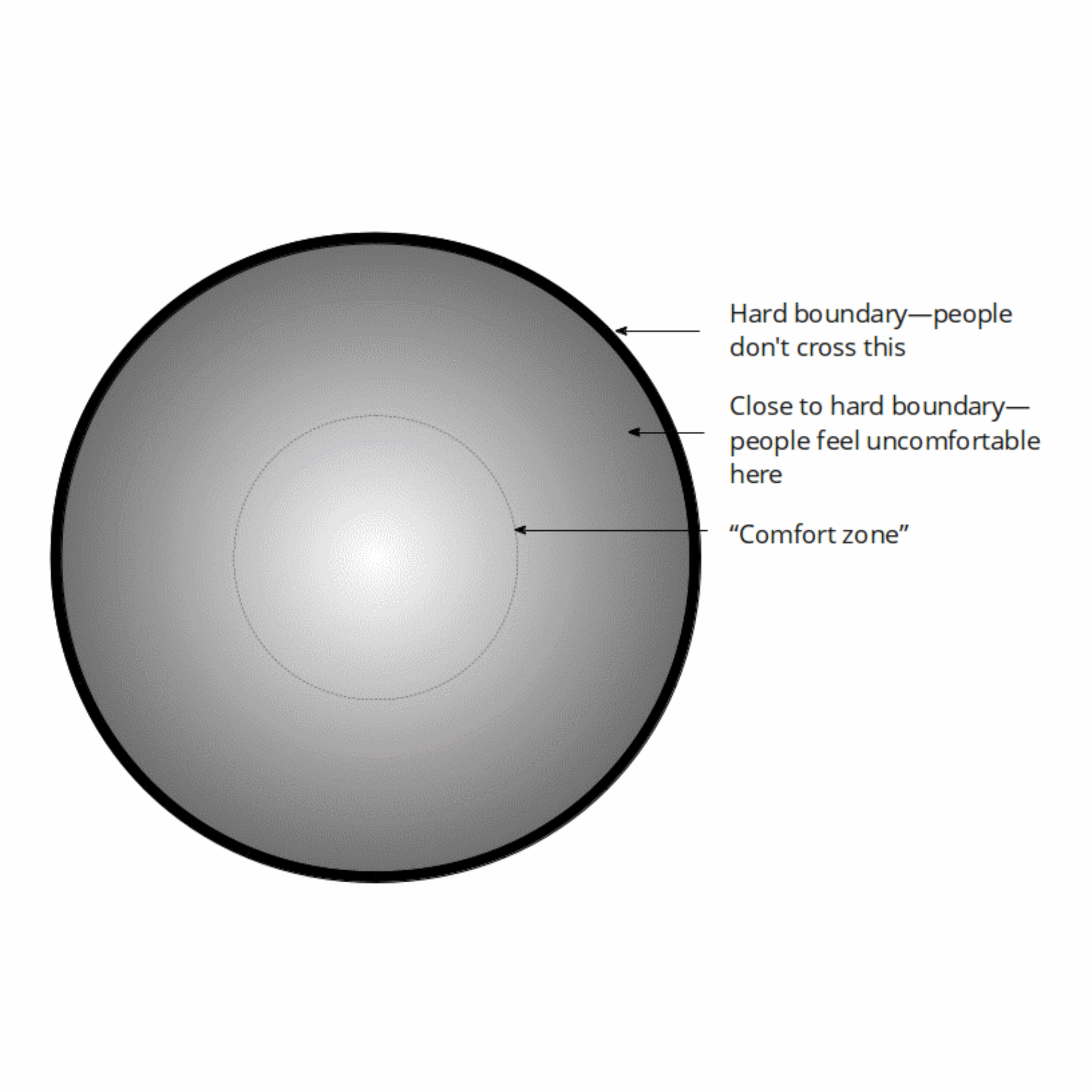
Exploring and expanding your boundaries and horizons creates freedom and comfort in your life. Doing so can be challenging---"getting out of your comfort zone," as many put it---but creates results and emotional reward. The more experience you have in it, the more you can lead others to do the same, creating freedom and comfort in their lives. I'll illustrate the process with some simple diagrams. I find visualizing would-be complex things simplifies them and makes them easier to do. First, consider a diagram of the things you do, as illustrated below. As I've illustrated it, the light-colored center is where things are easier---that is, the center of your comfort zone, bounded by the dashed line. I colored it darker farther from the center, indicating that…

2 Comments

Memories and getting rid of stuff

Moving back into my apartment after renovations, I've been unpacking things packed for a year or two. I packed some of those things fourteen years ago when I moved here and it seems I packed some of those things before then. I've tried to come up with definitive conclusions on dealing with old things that connect with memories, but haven't. I'm getting rid of stuff, but it's harder than I expected, so I have just some thoughts on the process of getting rid of stuff... What are these memories for? If something I saved is my only access to some memory, then what do I lose if I lose it? I'm not going to miss it. I have a bunch of old letters and notes…

0 Comments

Specifics: more general than generalities

The moderator at my recent group talks at NYU-Stern and Harvard started the question-and-answer period with an instruction to the audience I hadn't heard before. I found it tremendously effective at making the questions useful and poignant. He asked that everyone ask only personal questions from their lives, not to ask about general points. Did you also first think, "Wait, if people only ask about personal issues to themselves, won't they not matter to everyone else in the room? Don't we want to learn general principles that apply to everyone?"? I thought so too, but I saw that the instruction had the opposite effect. What was the effect? First, most people had trouble with the instruction. If someone asked something like "What's the best way…

0 Comments

Home!

'Tis a gift to be simple, 'tis a gift to be free 'Tis a gift to come down where we ought to be, And when we find ourselves in the place just right, 'Twill be in the valley of love and delight. When true simplicity is gained, To bow and to bend we shan't be ashamed, To turn, turn will be our delight, Till by turning, turning we come 'round right. -- "Simple Gifts," Joseph Brackett If you've seen me in person over the past four months you know I've lived that time away from home, during renovations. Four months or so away from home isn't long, but in November my contractor told me he'd start Monday after Thanksgiving and could finish the project by…

0 Comments

Four-and-a-half months to two years of helplessness

Since December my life has had an out-of-control problem I thought I resolved twenty-five years ago. I have to describe a choice I made in Paris to explain it. To put it in context, on the scale of things people suffer, it's small. The point isn't the scale of the problem, but having something affecting you that you think you should be able to control but you can't. It makes you feel helpless. Helplessness is hard to handle. I find exploring and understanding emotions helps me handle them. Helplessness that you don't learn to handle turns into resignation, futility, and complacency, emotions I don't like feeling. Anyway, back to 1990 Paris, the problem I solved there, and how it resurfaced. I took a year off…

0 Comments

Adam Smith: Life is more than materialist

Is Adam Smith the prototypical economist whose work forms a basis for free-market economics and capitalism based in material wealth we view him as today? His background and works besides the Wealth of Nations tells a richer story. While The Wealth of Nations was fundamental to economics, he studied "social Philosophy" and taught "moral Philosophy," concerning himself with motivations, passions, feelings, and emotions, out of which emerged The Wealth of Nations. His first major work, "The Theory of Moral Sentiments" covered morality and emotions, and at least one biographer said Smith considered it his best work. A quote of Smith's, in fact the opening to The Theory of Moral Sentiments, shows he saw emotions and feelings as fundamental to economics, not just material wealth, and…

0 Comments

Michael Jordan: fair to middling?

Michael Jordan was the best basketball player of all time, a star everyone knew was destined for greatness from college on, right? Wrong. It's a nice myth if you want to take it easy on yourself and not try, but things didn't unfold that way. On the contrary, even after he started in the NBA, knowledgeable people, including Jordan himself, doubted his ability. This Chicago Tribune article, "He Was No Bowie (thankfully)" collected some great headlines from sports reporters, scouts, and more. If you aren't great yet, neither was he well into his career and if he got great, so can you. This line actually appeared in a Washington Post story after the 1984 NBA draft: "Many scouts felt (Leon) Wood was the best all-around…

0 Comments

A reader responds on the concepts of introversion and extroversion

An attendee at a recent seminar I spoke at that covered the concepts of introversion and extroversion read my posts on them and wrote. I asked if I could share what she wrote here so others could benefits from her thoughts and our discussion and she agreed. Hello! We met last night at the Gotta Be Good Tour at NYU, and talked briefly about the concept of extroversion-introversion. It had never occurred to me to question this idea. I'd taken it for granted and it seemed patently true. Like many things people don't yet question! So first, thank you for even questioning this concept and bringing it to my attention as something to be examined. I've read your blog posts. Well-written and quite interesting! Some…

0 Comments

How meditation helps

Interruptions distract you from your thoughts. How often you get interrupted determines how complex and developed your thoughts can be. If someone interrupts you every five seconds it's hard to think thoughts that take more than five minutes to develop. Someone interrupting you every ten minutes would let you develop more complex, longer-term thoughts. If you can only think short-term, you can only see short-term trends in your life, you can only address simple problems, and you can only see things superficially. You react more than you lead. Short-term thinking limits your ability to make sense of life, to plan long-term, to think deeply, and to create patterns. You live and react. You don't create your life. Meditating for twenty minutes lets longer thoughts develop.…

2 Comments

Motivating Rejections — The Series

Welcome to my series on turning rejections into motivations. Click on the Table of Contents entries to the left to read the posts in the series. I've learned to view what many people call failure as experience and lack of failure as not experimenting enough. If you avoid failure absolutely, I would guess I would sound annoying to me. Not that I'm special in this way. The entrepreneurial community celebrates failure, at least among those who learn from it despite the pain. So do sports and plenty of other places. A major part of my failures come in the form of rejections. Like many of my failures that turned into great learning experiences that led to great successes, many rejections renewed passions in me to…

0 Comments

If you talk about protein, dopamine, seratonin, carbohydrates, and other big words you probably don’t know what you’re talking about

Ordering a burrito the other day the server asked me what "protein" I wanted in it. I got the same question ordering a potato not long before. Has calling food by once-highly scientific terminology become standard? I guess protein has become a standard word. It used to be a scientific word. That means originally almost nobody knew what it meant. I think people still don't know what it means, but that doesn't stop them from using it. People ate before someone discovered some group of complex molecules and named them. In fact, they lived healthy lives before knowing such compounds existed to call them names---healthier lives than most Americans, as do most people in the world, all the more so the further you venture from…

2 Comments

Emotional skills versus emotional intelligence

Who hasn't heard about the value of emotional intelligence? Everybody talks about how mere regular intelligence only gets you so far before you hit limits. It makes sense. Emotions affect your relationships and for projects bigger than you can finish alone, which means nearly everything, you need to use relationships. Deeper than how well you lead others, emotions help you understand yourself, so understanding emotions helps you improve your life too. As much value as emotional intelligence has, I feel the concept misses something important. The more I learn about and coach people on emotions, the more value I see not in just knowing about emotions, but in the skills to use them, which means action, behavior, communication, and practice, all of which come through…

0 Comments

Overcoming Objections and Blocks — The Series

Do you know you want to improve something about your life but never seem able to? Do you find yourself always trying to understand your problems but never overcoming them? Or just saying you're just this way and can't do anything about it, even though you know other people who were like you learned to get past it? You probably have internal objections and blocks stopping you. External hurdles are much easier to overcome. Some people never learn to overcome internal ones. Read my series on some common objections and blocks, "Overcoming Objections and Blocks -- The Series," and how to overcome them. Overcoming blocks and internal objections is one of the most important skills to improve your life. Nail a few of these and…

0 Comments

Suffering in silence for someone creates problems. Getting the credit you deserve helps the relationship or keeps you from wasting your time.

Do you suffer in silence for anyone? Do you find it helps the relationship? It happens in business, but I'll illustrate it with a classic case where two people suffer in silence for each other is a marriage where both parties think they work and contribute more to the relationship than the other. You can substitute a relationship between manager and report or among teammates if you prefer. Say one of the spouses works long hours and earns more money and the other takes care of the house more. The first might think the other spends their money without valuing the sacrifices they make being away from home. The second might think the other doesn't contribute their time to the relationship like they do. You…

0 Comments

End of content

No more pages to load