Awareness


How to get the body you want, never buying another fitness or diet book

Since I work on motivation, I've read a ton of diet and exercise books. They generally try to fill you up with information. While filling your head with information doesn't necessarily hurt your fitness efforts, it won't likely help either. And any book claiming any latest and greatest methods can't get over that countless people before that book created fit, healthy bodies for themselves. Information doesn't make you fit. Behavior, and only behavior, does. Information can only influence your beliefs, which can influence your motivations and behavior, but that connection is indirect and weak. Working backward gives effective answers. First, figure out the body you want The first step was simple. For the body you want, do the behaviors that create it Only the behaviors…

0 Comments

My plan to solve executive pay

Executive pay in the U.S. is out of hand and everybody knows it. Wikipedia put it well Executive compensation in the United States differs from other employee compensation in the forms it takes, laws and regulation it is subject to, its dramatic rise over the past three decades and wide ranging criticism leveled against it. In the past three decades in America executive compensation or pay has risen dramatically beyond what can be explained by changes in firm size, performance, and industry classification. It is the highest in the world in both absolute terms and relative to median salary in the US. It has been criticized not only as excessive, but also for "rewarding failure"—including massive drops in stock price, and much of the national…

0 Comments

People who say you think about it too much are telling you they willfully misunderstand you

Do people say to you "You're thinking about it too much," or "You're analyzing it too much," or things like that? I usually tell them that to me ideas are like Lego pieces. I like turning them around, looking at them from different angles, seeing how I put them together with others, taking them apart and reassembling them, and so on. So to me when someone says I'm thinking about something too much, it's like they're saying "You're having too much fun." That doesn't make any sense to me at all. I like having fun. It still took me a while to figure out how people could misunderstand something so clear and important, since few things are more important to me than making sure I…

8 Comments

Lessons in freedom and self-expression from a high school student in a project-based learning school

Kids often say things more clearly than adults. Actually, I think I should credit the insight below as much to inquiry-driven project-based learning as to the innocence of youth. Context: When I visited Science Leadership Academy last winter, a student led a tour of the school. A question came up about school uniforms, which the school didn't have. During the discussion on the topic, someone asked if any problems ever came up from students causing trouble by pushing limits on how they dressed. Our guide said no. Someone asked, "Really, why not?" She said, "We know that we can do it, so we don't have to." That perspective, to me, is a major piece of awareness, self-expression, and freedom: knowing you can do something but…

0 Comments

How to manage your manager: the main concepts

"My manager sucks. How do I get them to manage me better?" People ask me this question all the time. The words differ for each person but the concept is the same. Probably every client I've coached, no matter what issue they started with, also wanted to work on improving their situation with their manager. Having coached enough on it, I'm putting the main concepts here. If I see demand I'll make a book of it. When the book "How to manage your manager" debuts as a best-seller, you can tell people you saw the first post on the topic. How to manage your manager: the main concepts This issue is common. You aren't alone. "Why would they do that?!?!": People ask this question rhetorically,…

0 Comments

Understand your anger to develop compassion

A client recently described how his boss's behavior annoyed him. As we planned about how to respond he made clear he wanted to include in his message a subtly vindictive part. I told him that vindictive part would be effective in venting his feelings but suggested it would not likely be effective in influencing his boss. Rather, it would influence the boss, but not likely how he wanted. He thought about his goals, realized he was more interested in influencing his boss effectively than venting to the boss (he could still vent to me, his wife, and so on). We all feel similarly when we feel anger or related emotions: we want to punish the person we feel created the anger---to teach them a lesson…

0 Comments

There’s no point in trying to figure *everything* out

Do you get hung up trying to figure everything out or worry you can't succeed if you don't learn enough? A lot of people seem to, to the point it debilitates them. I like information, but I don't get hung up trying to figure everything out like I used to. Another way of looking at everything I find the following perspective helps. Our minds didn't evolve to understand everything. They evolved to help our ancestors live and pass on their genes. If my life is in danger, I focus on solving the problem. As long as my life isn't in danger, I use my mind to enjoy life and experience emotions I want---in other words, living the life I want. The universe stretches on for…

0 Comments

What’s not “practical” about fun?

The New Yorker published this judgmental statement about practicality in an article on a video game. As you know, since the term "practical" creates a value judgment, I try to avoid using it to impose my values on others. There may not be any practical application for [the] game and its findings, but he nevertheless believes that it has significant value aside from science-fiction entertainment. I barely play video games and don't like much science-fiction, but I recognize that those are my tastes based on my values. Others choose to play based on their values. How can anyone call one person's values better than another's. I ask you this: After taking care of life's basics like food and water, what do you value more than…

0 Comments

What you’re thinking

This post follows up "The most effective self-awareness exercise I know of" and the exercise in it, so I recommend reading it and doing it first. Besides making these posts personal, the exercise increases your self-awareness. When I talk to a client after doing that exercise, we cover six main points, which I'll cover in detail below. The details of their results---that is, the content of their inner monologue and trends in it Their reaction to becoming aware of those thoughts The liberation of realizing they aren't the only one who thinks that way Clarifying how this part of their mind works How to use what they've learned The incredible value of knowing how this part of the mind works I'll cover them in reverse…

0 Comments

Making fitness inevitable

I've never had a flat stomach with definition---a six-pack---but I'm close to it now and I'm amazed at how well getting close to it motivates me to eat healthily and exercise. It's not the first time I've felt motivation to get fit. Earlier times led to long-term changes nothing like what diet books seem to recommend. While I didn't grow up fat, I was chubby enough that my step-brother made fun of me and my parents tried to get me to eat more slowly. I wasn't close to today's typical fatness, but I felt shame. I love the way I'm thinking about food and my body now. I haven't felt such an improvement since I started playing sports competitively in college and started wearing clothes…

2 Comments

How to increase empathy, part 2: a model and strategy

Yesterday's post discussed how the world complicates understanding empathy with vague definitions and associating it with neediness and unwanted emotions. Today I'll describe a simple model to understand empathy simply. A simple model for empathy The model you have for something determines how you understand it and how you use it. I'll talk about emotions in general and then empathy in particular A simple model for emotions in general Many people contrast emotions with reason and conclude that emotions are irrational or random. I also used to think so, and that mental model undermined my ability to understand others' emotions and motivations, as well as my own. I've found another model more useful. My series on The Model, explains my model for emotions more deeply,…

0 Comments
How to increase empathy, part 1: why it seems so hard to
If you can tell Michael Phelps and his teammate feel happy and triumphant, you have empathy, probably more than you suspect.

How to increase empathy, part 1: why it seems so hard to

You want to improve your empathy because you've heard it's fundamental to leadership, influence, and motivation, but find it hard to define, measure, or see in use, making it hard to improve or learn from others. In other words, empathy is important for working with people, but hard to learn, all the more so for those who lack it most. While I don't pretend to be the most empathetic person, having started with little, I've improved a lot. I can teach you to improve yours. Today let's see how others make it hard. The world makes learning empathy hard when it's not. For example, searching on "What is empathy" returns pages and pages of links but searching on "how to increase empathy" returns fewer than…

0 Comments

Everybody got made fun of and feels emotions from it today

Once as a kid after a getting a haircut, my classmates taunted me, "Josh got a haircut! Josh got a haircut!" I felt ashamed. I didn't want to get haircuts after that for fear of being teased. I didn't consciously realize until recently that decades later, I still feel a tinge of being teased when I think about getting my hair cut, even though I would never feel ashamed if someone tried to tease me about a haircut today. I wouldn't have thought about it except that it came up while I led a seminar on emotions and vulnerabilities. The experience came to mind as an example of how feelings we had as kids can still affect us today for events that wouldn't affect us…

0 Comments

Explaining “I’m just being honest” is usually a jerk move deceiving only the speaker

Listen, I'm just being honest. Other people might not be, but I am. If you can't handle honesty, that's on you, not me. There's nothing wrong with the truth. You've heard people say that message before, even if not to you or in those words. Maybe you've said words like them. Nobody likes someone treating them like an idiot, especially when the person doing it pretends they are doing you a favor. When someone says something to hurt you and then pretends they were just being honest and if you can't take it it's your problem, they're doing that. Everyone knows a message can be delivered a million different ways. Everyone also knows anyone communicating a message has multiple motivations, but at least one is…

2 Comments

Unnecessary pollution

Thoughts while putting my clothes in the dryer: Every time you leave a light on in an empty room, you use more electrical power than Alexander the Great, who conquered an empire, in his entire life. Every time you start a car, you burn more gasoline than Napoleon, who won more battles than anyone in history, in his entire life. Every time you turn on the clothes dryer, you use more electrical power to do it than the billions of humans who ever lived, collectively, from the dawn of time until about seventy-five years ago did for all their clothes ever. Every time you turn on an air conditioner, you pollute more than anyone who lived in a similar climate since forever to cool themselves,…

0 Comments

Everybody has a cringeworthy past

I cringed the other day talking to a friend about some past behavior I would never do today. I forget what, partly because I wish it hadn't happened, but I'm sure you know what I'm talking about. Maybe it was something like using guilt in a relationship to try to keep it going. Part of me wants to forget that behavior or blame others for leading me to it. If I thought long enough I could come up with dozens of things I did that would make me cringe today. My friend admitted to some similar behavior. We got to talking and realize we both had done lots of regrettable things. We can all think of times we've seen other do something that would make…

0 Comments

Op/ed Fridays: Does “Stay in school, work hard” produce mediocrity? Can it produce greatness?

The more I spend time out of school, the more I find value in non-academic things I learned. The more I see people who just work hard---by "just work hard" I mean working hard for other people for a pay check without choosing the job---the more they don't seem to create greatness or deep satisfaction with their lives. The more I see the great people our society admires don't seem to have emerged from our schools or from working hard at a regular job. They seem to work hard, often harder than most people, but at things that matter to them, often sacrificing pay, status, and such until they succeed. So I have to distinguish between working hard for someone else who directs your work…

0 Comments

Why do people who say “You can do anything you can dream of” or “You can make your dreams come true” not fly or cure AIDS?

When you write about achievement and beliefs, you come across a lot of "inspirational" people and quotes. I don't mean people who inspire you, like great historical figures or people you know who have done a lot. I mean people who describe themselves as inspirational. For some reason, a lot of them tell people they can do anything they can dream if they just set their minds to it and work for it. Is it just me, or can you dream a lot more than you can do? I mean, I can dream of flying. I have dreamed of flying, and not in a plane. Just me, flying around like gravity didn't affect me. No wings, no plane, no jet engine or propellers. Just me.…

0 Comments

How to turn anxiety into excitement

Do you like feeling anxious? Would you prefer feeling excited to feeling anxious? Did you know that a doctor reading your vital statistics can't tell the difference between you feeling anxiety and you feeling excitement? I looked it up and have a peer-reviewed paper somewhere confirming that---something like that the two emotions are physiologically concordant, or some academic-speak like that. The point is that your body reacts the same when you feel either way. Your pulse increases, your breathing gets shallower, and so on. Only your mind differs. Excitement has a feeling of optimism, anxiety has more pessimism, roughly speaking. How to use this information I don't know about you, but I prefer feeling excitement over anxiety, especially in high stress situations. I speak in…

0 Comments

You don’t have to talk about what you don’t want to

This lesson is so simple people don't believe it. The title says it all. You don't have to talk about what you don't want to. People challenge it. I guess I should specify the context: casual conversation between people who don't have authority over each other. At work or in court under oath may be a different story. How many times have you been in a boring conversation going nowhere or, worse, a conversation that was actively making you look bad? This lesson applies. Something like this feels too basic to cover, so schools don't teach it. They learn higher level concepts, but many people don't learn this simple stuff. You're part of the conversation. You can change the subject. You are not swept along…

0 Comments

Why is “know thyself” hard?

Why is "know thyself" hard? You'd think you'd know yourself better than anything. Here's a major reason why: because almost everyone in the world benefits from you not knowing yourself. Because organizations mediate your interactions with everyone in the world except the dozen or so people closest to you and nearly all organizations benefit from you not knowing yourself. They benefit from manipulating you. Don't believe me? Think of the most influential organizations in the world---governments, religions, corporations, schools, etc. Each says it's right or the best or something like that and all others should be more like it. These claims are patently bogus. As much as each government says its history and people are the best, the others do too. They can't all be best.…

0 Comments

Intelligence? Emotional Intelligence? I’ll take someone with skill over intelligence

I'm not impressed with intelligence. I say that as someone people often describe as intelligent. Too many people (including myself in the past) consider themselves strong in the abstract ability to solve problems over the activity of solving them. I value execution over ideas. Concrete over abstract. Earned over entitled. Experience over observation. I wasn't always like this. I used to hold the opposite values---mind over body. Note the difference between the definitions of intelligence and skill. Intelligence generally involves abstract problem solving. People tend to view it as something innate or inborn and hard or impossible to change. This perspective often leads to people who consider themselves intelligent feeling they could solve something but not actually solving it. The problem is that abstract problems…

0 Comments

If someone tells you the world around you isn’t real or what you think it is, watch your wallet!

"The world you see is not what you think it is." How many organizations start with this philosophy? It piques your curiosity---"It isn't?"---to hear what comes next. The next step is the tricky one: "We'll tell you what it's really like." They rarely word it so bluntly, but many organizations start this way. For all I know they're right. What I do know is that once someone gets you to doubt your senses and awareness, they primed you to believe anything they say. I've meant to write this since the meditation retreat a few weeks ago. Though Buddhism is less intrusive than most major religions, it still rests on supernatural concepts like reincarnation and enlightenment. I didn't appreciate someone telling me if I didn't do…

0 Comments

Two posts by others I recommend

Two great posts by others force me to break my pattern of sticking to original work. The first is that if you know me you know I love Calvin and Hobbes. The first new work by Bill Watterson in a long time appears here -- "Ever Wished That Calvin and Hobbes Creator Bill Watterson Would Return to the Comics Page? Well, He Just Did." The second is one of the best pieces on meditation I've read -- "My journey with meditation. And, why you should do it too." It's simple, just talks about the practice without needlessly referring to the supernatural or religion, and connected it to life. The 'should' in the title got me to read it so I could find flaws in it, since…

2 Comments

Visualizing reactivity and freedom, part 2: how to improve

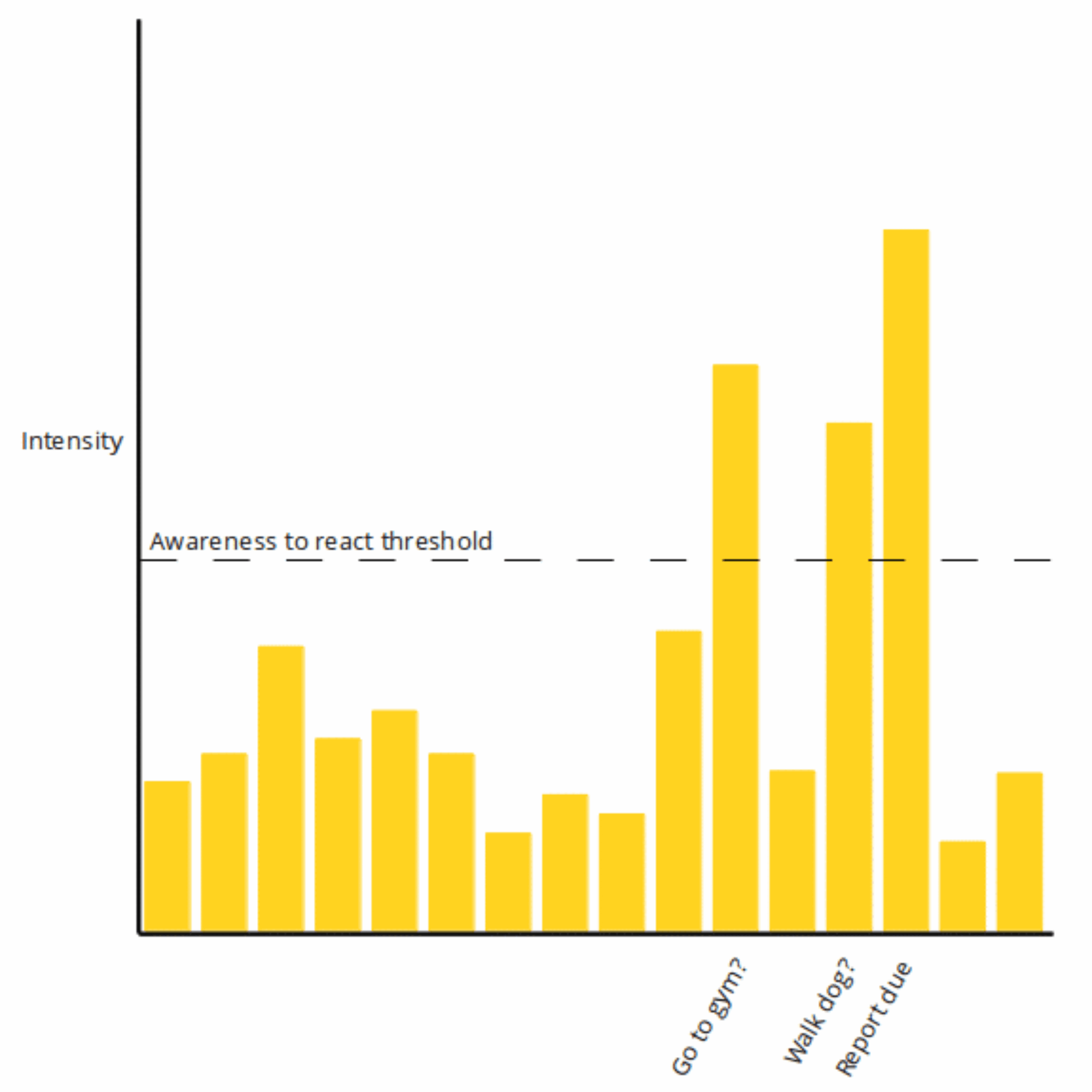
Emancipate yourself from mental slavery, None but our self can free our mind. -- Bob Marley, Redemption Song Context How do you move from living reactively, like in this graph, where you can't help but react to any intense motivation: To living aware and non-reactively like this, where you are aware of many motivations but don't feel compelled to react blindly to any? That change brings freedom. It comes from raising awareness and lowering compulsion to act on it. How to raise awareness by increasing your sensitivity to your motivations A motivation being subtle---that is, not intense---doesn't mean it's unimportant. On the contrary, often your most important motivations are subtle ones. How many people want to write books, paint, and so on, but never do…

0 Comments

End of content

No more pages to load