Nature


Visualizing reactivity and freedom, part 1

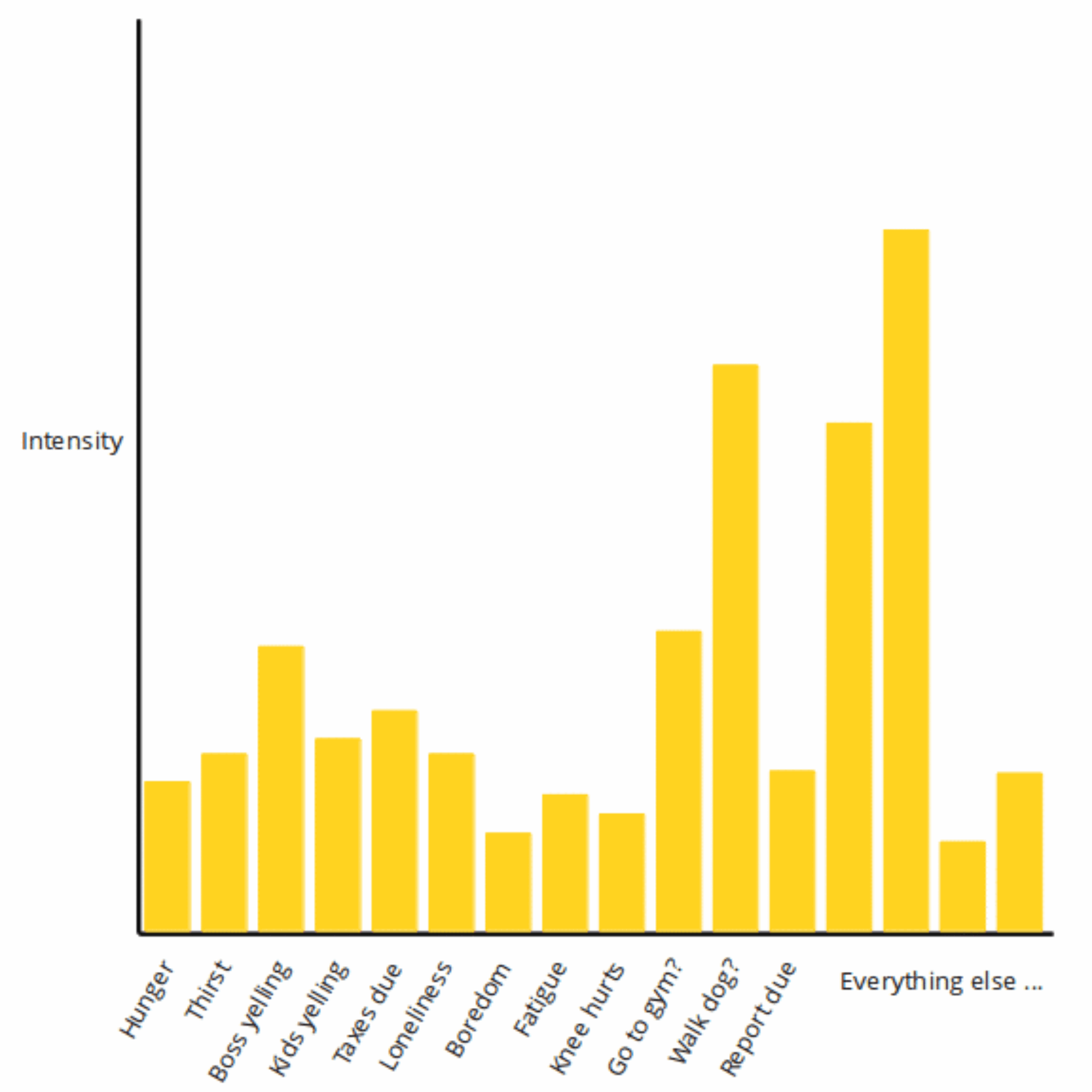
Think of a time you reacted blindly. Did it go well? How do you feel about leaders who react without thinking or intuition? You don't want to react blindly---the opposite of leadership, since it means you're reacting to someone else, or unpredictable events in your environment, which I call blowing in the breeze. Most people understand the term "reactive" vaguely, so they can't do much about it. I find visualizing complex ideas helps me understand them. Visualizing reactivity Context: at any moment many things in your environment, body, and mind call for your attention and create motivations. You feel hunger and thirst, your boss yells at you, your kids yell for your attention, you remember you have to do your taxes, you want to go…

0 Comments

“Why we store fat” doesn’t make sense

You've heard the reason why we store fat. You probably never questioned it. Have you noticed it doesn't make sense? You've heard the following from any number of sources. Have you ever questioned it? The reason our bodies store fat goes back to the earliest of times. Fat storage was a tool of survival for humans. When food was plentiful people ate as much as they could. The extra food was stored as fat tissue (also known in medical circles as adipose tissue). When food was scarce at other times of the year then the stored fat was used as energy. The bodies of these early humans required the stored fat tremendously for their energy source. What is this talk of "When food was scarce…

4 Comments

What a pound of juicy, ripe cherries teaches you about life

You can learn a lot from a cherry. Enjoying my first half-pound of these sweet, tangy, juicy wonders of nature of the season reminded me how much nature teaches us about life. Sorry to my southern hemisphere readers. "Multitasking" makes you do multiple things poorly. Focusing on one thing gives you quality. I was about to start reading while eating. But wait! Why would I allow something to divert my attention from the cherries' flavor and how they burst with juice in your mouth. Nor could I process what I read while giving any attention to the fruit. No, better to do one thing well than two or more things poorly. Experience and base feelings trump intellect. Did parents and school value grades over recess…

0 Comments

After ten days with no internet, phone, reading, writing, or talking

The last ten days' experience was challenging and rewarding---too much to cover fully, so I'll just put some highlights. Top benefit 1: time without distraction Few vacations give you undistracted time like ten days without internet, phone, reading, writing, talking, or almost any obligations. This retreat gave that, though it was not a vacation. It was work. You know your world distracts you. Sometimes you can tune some of it out. Some people can escape it for some time, but even getaways to the beach, camping, or remote islands tend to have obligation and people you have to talk to. Interacting with people, as much as I love it, takes a lot of attention. At home it's hard to get more than a few minutes…

0 Comments

Ten days with no internet, phone, reading, writing, or talking

If you didn't know, I spent my past ten days at my second ten-day mediation retreat. Here are old posts on it for your background: Vipassana Meditation Goenka and 10-day meditation retreats These retreats have no internet, phone, reading, writing, or talking. You sit still for about ten to twelve hours a day. Because writing here is one of my SIDCHAs and I don't want to deprive readers of my material (and I had a backlog of post ideas I'd meant to catch up on for a long time) I wrote the past ten days' posts before leaving and scheduled them to come up on time. I wanted to speculate on what I might get out of the retreat before going on it to compare…

3 Comments

Want to influence someone? Understand them and make them feel understood

Want to influence someone? Yes, you do. Your spouse, girlfriend, boyfriend, manager, people you manage, kids, ... anyone you communicate with. I don't care if you think they're perfect. You want to influence them. Why else do you communicate with someone except to influence them? (A question worth thinking about!) If you want to know your potential to influence them, ask yourself how well you understand them. If you don't understand someone, you can't influence them well. You can guide them and create incentives for them with various carrots and sticks to get them to do what you want, but you don't get at their motivations they haven't shared with you. Not knowing people's motivations is mostly what not understanding them means. If you want…

0 Comments

“Want to eat more” and “tastes good” aren’t the same feeling

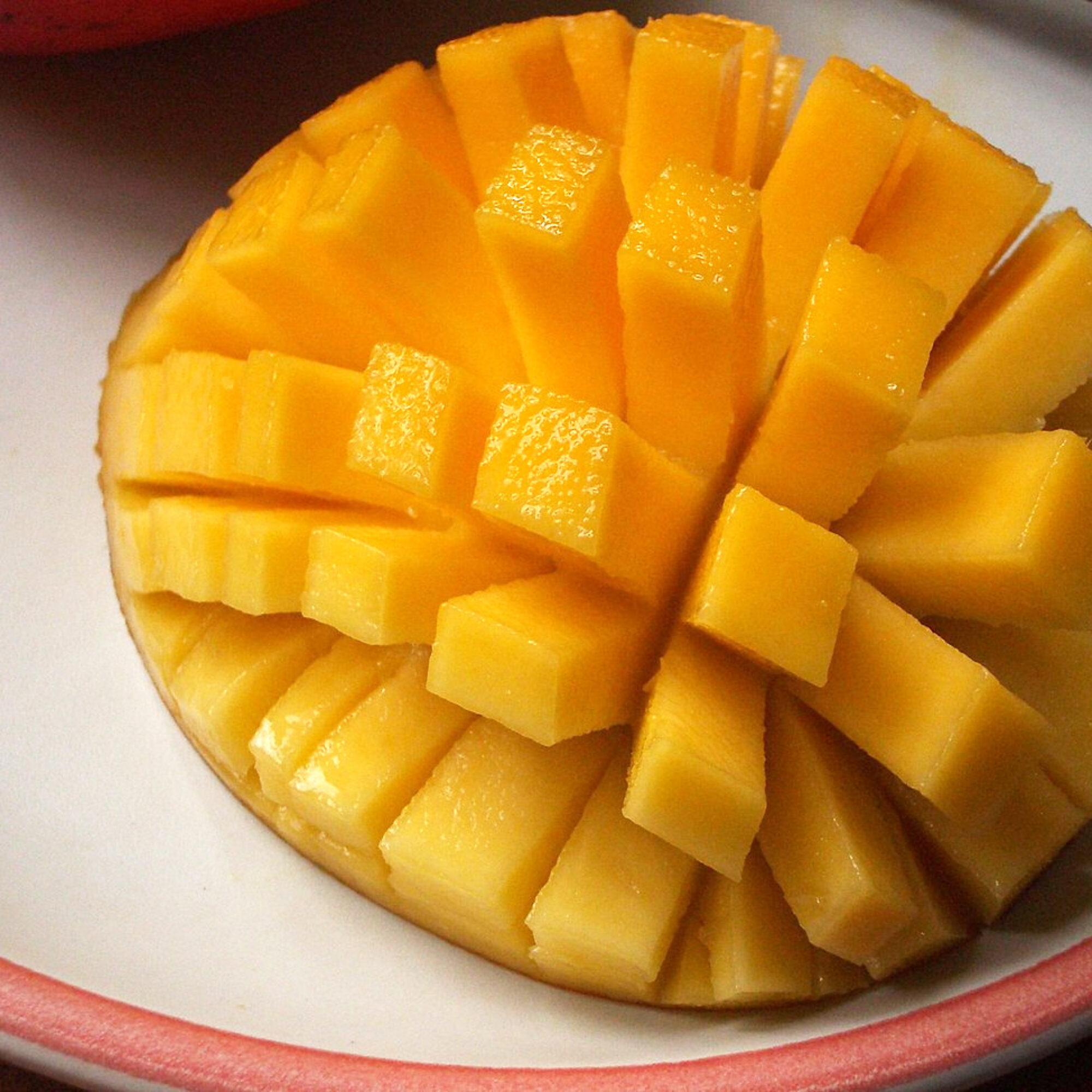
Do you notice the difference between something tasting good and something making you want to eat more of it? If you want to eat healthy, you'll care about the difference because companies that make junk food know the difference and use it to manipulate you. You end up spending money on unhealthy things that are profitable to them and you lose control of your eating habits. Most of the time these feelings overlap: a mango tastes good and when you have some you usually want more. But they don't always overlap. Eat too much mango and while the taste will stay the same so it will taste just as good, you won't want to eat more of it. See the difference? I find most fruit…

0 Comments

The Great Pacific Garbage Patch and the world we live in

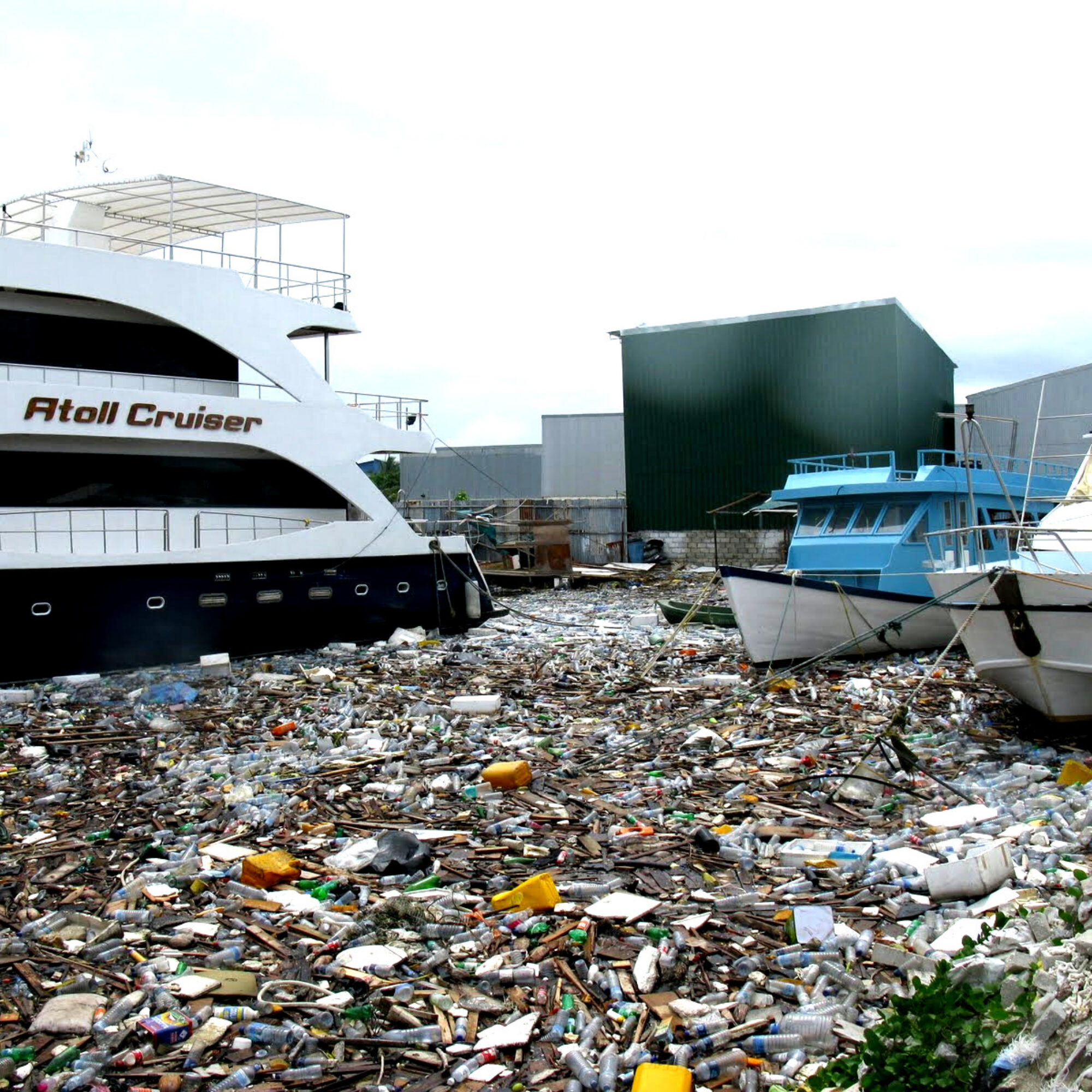
For some reason my blog has gotten tons of hits to my post on the Great Pacific Garbage Patch, "Secret silly confession." I don't know why, but it put it on my mind so now I'm going to write about it more. Also I recently read a would-be humor piece poking fun at people who care about the environment, implying they're just following trends, want to act holier-than-thou, don't know what they're talking about, or undermine what they say by also polluting. I'll grant many people fit those descriptions, but that doesn't mean everyone does or that their perspective has no merit even if they don't as individuals. From my perspective, the issue is not how other people think about us or trends. Polluting means…

0 Comments

What is science? What is physics?

"Do you use your education?" People ask me this question all the time when they hear I got a PhD in physics. I feel like they don't understand physics or science, at least not like I do. I didn't either, but I love it more now that I do. What is physics? Look at the world. Everywhere you look are patterns. The sun always rises and sets. The sky is blue anywhere you go. Of all the types of plants, they all have green leaves or something similar. What goes up comes down. Science means seeing patterns in nature, figuring them out, and explaining them to others. We find beauty in symmetry and patterns. Symmetry comes in many forms beyond mirror images, like rhythms in…

0 Comments

See my New York Academy of Science interview!

"Albert Einstein and Charles Darwin were members of this organization!" I thought when I first spoke at the New York Academy of Sciences. So were Thomas Jefferson and Thomas Edison, I later found. To speak at the same organization isn't that big a deal, but it feels like it counts for something. I've spoken there several more times, generally about leadership skills for scientists and geeky people like myself. Many of its members focused mainly on learning academic things, less on social, business, and emotional awareness and skills, which I've focused on. They're creating a series of video interviews of people with academic science backgrounds who didn't go into academia. Last year they interviewed me as someone who started a company. The other day they…

0 Comments

Adam Smith: Life is more than materialist

Is Adam Smith the prototypical economist whose work forms a basis for free-market economics and capitalism based in material wealth we view him as today? His background and works besides the Wealth of Nations tells a richer story. While The Wealth of Nations was fundamental to economics, he studied "social Philosophy" and taught "moral Philosophy," concerning himself with motivations, passions, feelings, and emotions, out of which emerged The Wealth of Nations. His first major work, "The Theory of Moral Sentiments" covered morality and emotions, and at least one biographer said Smith considered it his best work. A quote of Smith's, in fact the opening to The Theory of Moral Sentiments, shows he saw emotions and feelings as fundamental to economics, not just material wealth, and…

0 Comments

A reader responds on the concepts of introversion and extroversion

An attendee at a recent seminar I spoke at that covered the concepts of introversion and extroversion read my posts on them and wrote. I asked if I could share what she wrote here so others could benefits from her thoughts and our discussion and she agreed. Hello! We met last night at the Gotta Be Good Tour at NYU, and talked briefly about the concept of extroversion-introversion. It had never occurred to me to question this idea. I'd taken it for granted and it seemed patently true. Like many things people don't yet question! So first, thank you for even questioning this concept and bringing it to my attention as something to be examined. I've read your blog posts. Well-written and quite interesting! Some…

0 Comments

A human perspective on quantum gravity

You've probably heard or read about the experimental discovery of gravity waves, a major and historic discovery in science with widespread implications, in the news lately. Understanding those implications is difficult. So is understanding the experiment. What's not hard to understand is the effect of hearing about the experimental results on someone who does understand its meaning and who explored this part of nature for decades. This video shows the unrehearsed reaction of two such people with a friendly surprise breaking of the news. https://www.youtube.com/watch?v=ZlfIVEy_YOA I notice most their interest in nature---specifically understanding what the experiments observed. I suspect to them, looking at what most people see as impossible-to-decipher equations and graphs, the data is like seeing deeper beauty of nature. I expect they feel…

0 Comments

If you talk about protein, dopamine, seratonin, carbohydrates, and other big words you probably don’t know what you’re talking about

Ordering a burrito the other day the server asked me what "protein" I wanted in it. I got the same question ordering a potato not long before. Has calling food by once-highly scientific terminology become standard? I guess protein has become a standard word. It used to be a scientific word. That means originally almost nobody knew what it meant. I think people still don't know what it means, but that doesn't stop them from using it. People ate before someone discovered some group of complex molecules and named them. In fact, they lived healthy lives before knowing such compounds existed to call them names---healthier lives than most Americans, as do most people in the world, all the more so the further you venture from…

2 Comments

How I keep from feeling depressed

When people talk about depression other people often start talking about psychology, psychiatry, and medical conditions no one understands the magnitude of who hasn't experienced them or studied them. Today I'm only going to talk about my experience. If it doesn't apply to you, I hope you still find something to learn from it. If it does, I'm confident you'll find something helpful in it. As far as I know, everyone has the same gamut of emotions. We feel different ones at different times, but if you name any emotion, anyone in the world would know it. A corollary is that everyone feels depressed at times. By depressed I mean unmotivated to do anything, seeing no point in doing anything, feeling like you can't get…

2 Comments

The connection between physics and self-awareness and emotions

People often ask me if I use my physics education today. As I see it, whereas physical sciences aim to make the world a materially better place, by studying and sharing what I learn about self-awareness and emotions I aim to make the world an emotionally better place. To me, physics is the study of the most fundamental parts of nature---time, distance, gravity, charge, mass, and so on. It also includes the human side of observing, honestly sharing results, and accepting improvements to past work, which I consider essential parts of science. People study nature for different reasons, some personal, some social. I expect many share my most personal reason---to find more and deeper beauty in nature. That is, something about learning about nature creates…

0 Comments

“Passionless” people?

[This post is part of a series on Communication Skills Exercises for Business and Life. If you don't see a Table of Contents to the left, click here to view the series, where you'll get more value than reading just this post.] A couple of my Communications Skills Exercises begin with asking people what their passion is, including "Meaningful connection" and "How to make someone feel understood: confirm and let them correct you", both tremendously effective yet simple and easy exercises. Many people ask "What if the person doesn't have any passions?" Some people I start these exercises with say they have no passions. Today I'll show how to get past such challenges. As usual, it involves belief and behavior. Belief: Everyone has passions, they…

0 Comments

What does the current rate of global warming mean?

When you hear the temperature is rising a degree or two over the course of decades it doesn't sound like much. I came across a quote to put it in context. Because the atmosphere is so big, even little temperature increases like that get multiplied over a huge volume compared to usual human scale. Climatologist James Hanson, of my alma mater, Columbia University, describe the current rate of increase in global warming in terms we could understand more graphically: "(it's) equivalent to exploding 400,000 Hiroshima atomic bombs per day, 365 days per year. That's how much extra energy Earth is gaining each day."

0 Comments

Improve your life by rejecting mental models that inhibit freedom, joy, and other reward

On another forum I got into a dialog about the mental models of introversion and extroversion I found relevant, given my posts here. My goal on treating the mental model of the one-dimensional introversion-extroversion is deeper than examining this one mental model. It's to show how much people can confuse mental models with actual observations. Without that confusion you can reject models that inhibit you. They see the mental models of introversion, extroversion, and the spectrum between them as parts of reality independent of their perception. They are only as real as people perceive them. So was the impossibility of breaking a four-minute mile. So was the idea that angels flapping their wings made the Earth go around the Sun. Someone described themselves as introverted…

0 Comments

A history of the universe in eight hundred words

I've been meaning to write today's post for a long time. I prepared to tell it for a Moth story on stage, but didn't get to, so I'll share it with you. It's the story of how you got here from the beginning of the universe, at least as far back as we can trace it. As you know, I like both physics and being able to make complicated things simple. I hope I convey both here. The history of the universe in a few paragraphs As far we can project back, everything seems to have explode out from a small volume. We can't figure out before then since nothing we can see today gives us any clue about what happened then, which makes sense…

0 Comments

Things you never get bored of

Today's post is on awareness--to note something about yourself you may not have noticed. You know how if you listen to a song too much you get bored of it, no matter how much you loved it at first? Or if you spend too much time with someone you need time away from them? I noticed a few things I never get bored of. It's not the biggest insight into humanity ever, but I think it helps you understand yourself better, especially my priorities, which helps me simplify my life and so no to good things to make way for great things. I noticed though I eat nearly the same breakfast every day--oatmeal with fresh fruit and nuts, usually with chia seeds sprinkled in--I never…

2 Comments

Secret silly confession

I don't know why I should feel like keeping this recent practice of mine secret, since I should be proud of it. It's no different from how I bring a bag with me when I go shopping so I don't need a new bag, which pollutes. I wondered why stores make such an effort of giving you bags -- the checkout people seem like they have to pamper you and giving you a bag is how they do it. Expensive stores do it more -- they give giant bags, with extra paper wrapping your clothes, as if to protect them and keep them as safe as you might keep a baby. Maybe stores want to appear generous to you so you feel generous back to…

0 Comments

Willpower is like a starter motor. Emotions are like an engine.

When you drive a gas-powered car you use its engine. It has a lot of power and can get the car to go hundreds of miles. But when you get into a car, you can't just start using that engine. Internal combustion engines aren't good at starting on their own. So gas-powered cars have electric starter motors. Electric starter motors are designed just to start the gas engine, which you can then use to drive. In old stick shifts, if you left the car in gear and tried to use the starter motor, it would move the car a few feet. In principle you could use the starter motor to drive the car around, but since it wasn't designed for that purpose, doing so would…

0 Comments

Technical solutions generally don’t solve social problems

With a PhD in physics, a few patents, and several start-ups to my name, I have some experience with developing and building technology to solve problems. I consider knowing the limits of what technology can solve as important as how to use technology. Social problems, I find, aren't amenable to technological solutions. The big one I see is global warming. I see people suggest technologies to deflect sunlight, beam energy from space, and so on. They may contribute to some solution, but ultimately they can only address small parts of a system including population size, the economy, the environment, ecology, and so on. Each area is complex, suggesting simple solutions wouldn't solve their problems, let alone a problem involving all of them. When I see…

2 Comments

Different perspectives

Fable The mountain and the squirrel Had a quarrel; And the former called the latter "Little Prig." Bun replied, "You are doubtless very big; But all sorts of things and weather Must be taken in together, To make up a year And a sphere. And I think it no disgrace To occupy my place. If I'm not as large as you, You are not so small as I, And not half so spry. I'll not deny you make A very pretty squirrel track; Talents differ; all is well and wisely put; If I cannot carry forests on my back, Neither can you crack a nut." — Ralph Waldo Emerson

0 Comments

End of content

No more pages to load